
Forget baby name books. In Sarawak, they have a rooster for that.
I have been to Sarawak. I can even speak Iban. Not fluently, mind you, more like enough to get a laugh from actual Iban speakers before they take over in Bahasa Malaysia out of mercy. But I have spent enough time around the community to feel a genuine warmth and respect for the culture.
And yet I had absolutely no idea that the Iban have a baby naming tradition where a rooster decides what the child will be called for the rest of their life.
A rooster, deciding your name.
Let me explain.
First, the Baby is Called a Worm
Before we even get to the rooster, there is another detail worth knowing. According to Iban custom, a newborn baby is not given a name immediately after birth. Until the naming ceremony takes place, the baby is referred to as "ulat," which translates directly as "worm." Not "little one." Not "precious bundle." Worm.
This is not an insult. It is simply a practical placeholder that the community uses until the child has been properly and officially named through the correct ceremonial process. In Iban culture, a name is not something you pick casually from a list of popular options. It carries weight, meaning, and spiritual significance. It deserves a proper ritual.
And that ritual involves rice, a rooster, and a decision that nobody questions.
How the Rooster Chooses
When a baby is ready to be named, the family first prepares a shortlist of preferred names, typically chosen from the names of deceased relatives. Naming a child after a living relative is considered bad practice, as it is believed to potentially shorten that relative's life. So the pool of names comes from those who have passed, carrying their memory forward into a new generation.
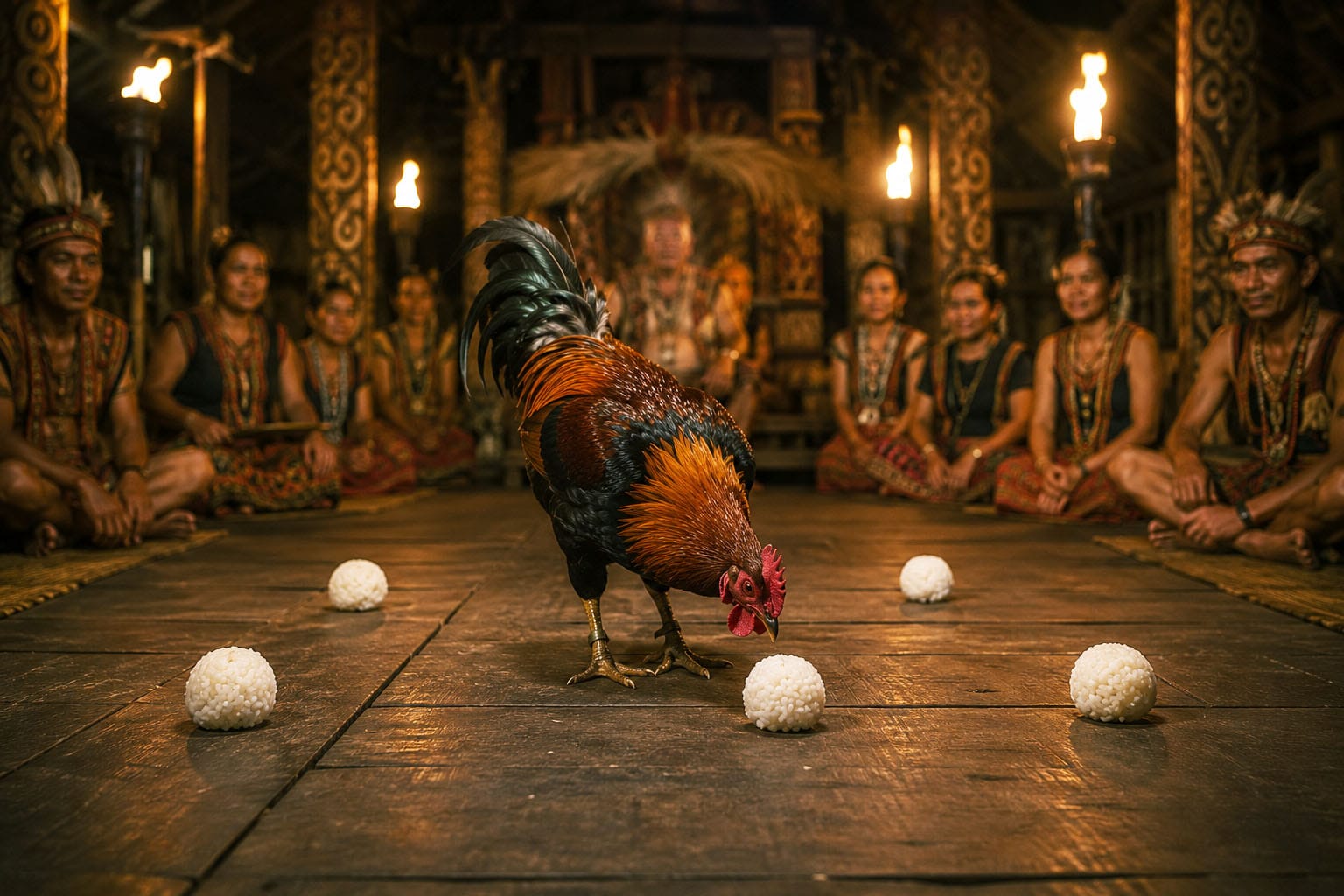
Once the shortlist is finalised, a rice ball is prepared for each name on the list. Each rice ball represents one potential name. The balls are then placed on the floor in front of a special rooster called the "manuk tawai."
The rooster is released.
Whichever rice ball the manuk tawai pecks at first, that is the child's name. No arguments. No second opinions. The rooster has spoken.
The child is then brought to a nearby river in a ceremonial procession, accompanied by the sound of traditional Iban drums called the taboh, where the official bathing ceremony called "Meri Anak Mandi" takes place to formally give the child their new name.
This Is Not Random. It Is Deeply Intentional.
Before you laugh, and I say this as someone who absolutely laughed the first time I read this, it is worth understanding what this tradition actually represents.
The Iban are one of the most spiritually connected indigenous communities in Southeast Asia. Their worldview is deeply intertwined with nature, with the spirit world, and with the belief that certain forces beyond human control carry wisdom that humans alone cannot access. A village elder from Kesit Longhouse in Sarawak explained it plainly: "Finding the right name is very important. According to Iban customs, this can influence the person's health and longevity."
The rooster is not a random animal. The manuk tawai holds sacred significance in Iban culture, with cockfighting carrying symbolic meaning representing supernatural contests between rival forces. Allowing the rooster to make the selection is not leaving it to chance. It is inviting a higher spiritual authority into the decision. The rooster becomes a conduit between the human world and the spirit world, selecting the name that is most auspicious for the child's future.
In a way, it is not so different from other cultural practices around the world where important decisions are guided by signs, omens, or rituals rather than pure human calculation. We just happen to think our own cultural logic is normal and everyone else's is unusual.
The Name Can Be Changed Later
Here is another fascinating detail. The naming tradition is not necessarily permanent. In Iban custom, if a person later feels they are experiencing persistent bad luck, health problems, or difficulties in life, they can choose to change their name through the same traditional process. There are even cases where a person adopts a new Iban name following a significant dream.
The name, in other words, is not just an identity label. It is a living relationship between the person and their spiritual wellbeing. If that relationship needs adjusting, the tradition allows for it.
My Take on This
I have a soft spot for Sarawak. The people, the food, the longhouse culture, the sheer biodiversity of the land… it is a part of Malaysia that feels like an entirely different world from the Klang Valley, and I mean that as the highest possible compliment.
Knowing about this naming tradition now makes me see the community with an even deeper respect. There is something quietly beautiful about the idea that a child's name is not just a parental preference but a communal ritual, a spiritual consultation, and a connection to ancestors who came before.
My own boys were named after careful thought, discussions between my wife and I, and some degree of gentle disagreement that every Malaysian parent will recognise. No roosters were involved. But I will admit that after reading about the manuk tawai, a small part of me wonders whether letting a chicken weigh in on the matter might have settled a few debates faster.
One thing is certain. The next time I am in Sarawak and someone introduces themselves, I am going to think about the rice balls, the longhouse floor, and the rooster who started it all.
Anang lupa, Sarawak. Aku rindu nuan.
Share hidden facts about Malaysia and stand a chance to win prizes worth up to RM4,300! Find out how to join here. T&Cs apply.
Kamarul Azwan (k.azwan@gmail.com) is a content creator under the Newswav Creator programme, where you get to express yourself, be a citizen journalist, and at the same time monetize your content & reach millions of users on Newswav. Log in to creator.newswav.com and become a Newswav Creator now!
The User Content (as defined on Newswav Terms of Use) above including the views expressed and media (pictures, videos, citations etc) were submitted & posted by the author. Newswav is solely an aggregation platform that hosts the User Content. If you have any questions about the content, copyright or other issues of the work, please contact creator@newswav.com.