
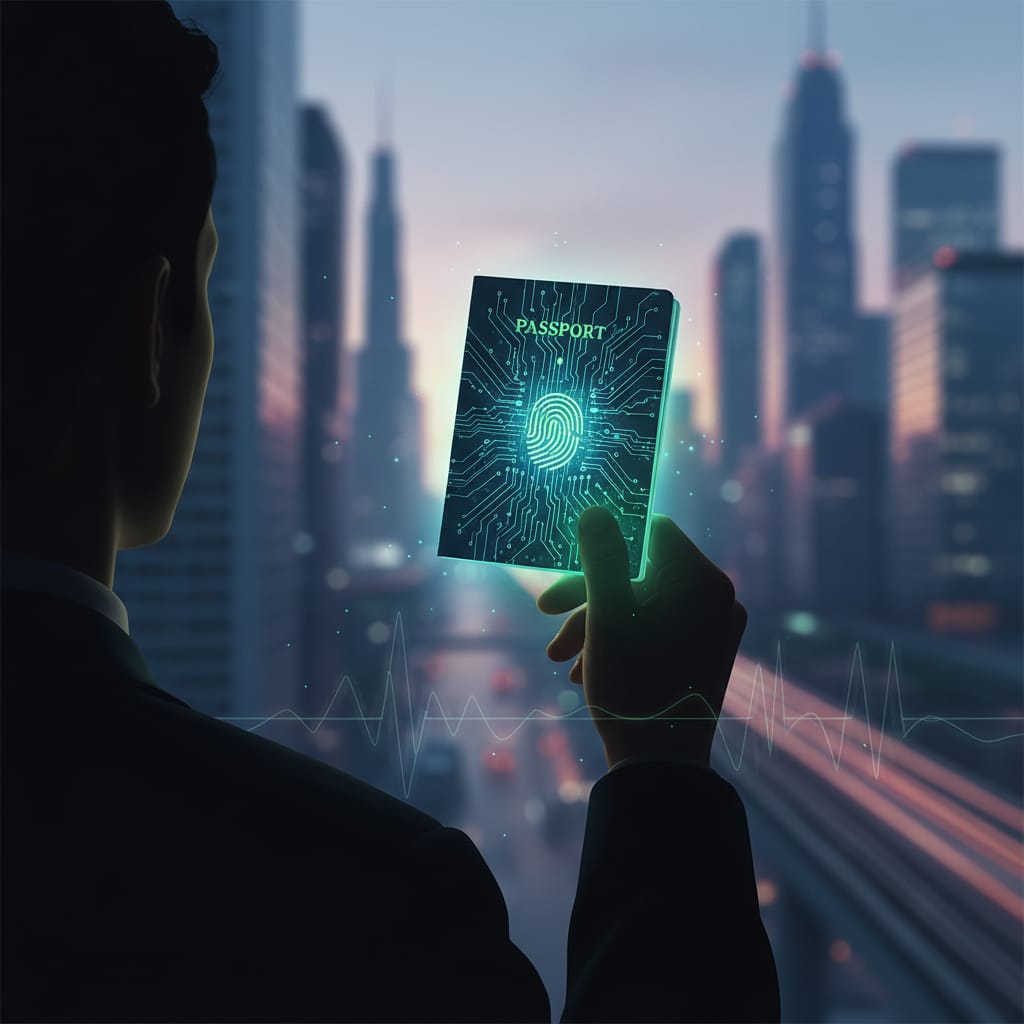
“The First Spark: How Malaysia Lit the Biometric Age”
In the long river of human movement, passports have always been bridges—small booklets carrying the heavy burden of identity and trust. For decades, they were little more than ink and stamps, like dry leaves pressed between the pages of history, easily copied and easily deceived. But in 1998, Malaysia changed the story. It became the first country in the world to issue a biometric passport, turning a fragile document into a vigilant guardian. Like a lighthouse cutting through fog, this innovation illuminated a new path for global travel.
At the heart of this transformation stood IRIS Corporation, a local technology firm that transformed ambition into reality. Tasked with upgrading Malaysia’s passport, it embedded biometric intelligence into the document, allowing identity to be verified not just by printed words, but by the uniqueness of the human face. The passport was no longer a silent witness—it became a mirror that could recognize its owner.
Before this shift, passports were like masks at a masquerade—convincing, yet removable. Forgers could imitate signatures like artists copying masterpieces and replace photographs like actors switching roles. Security relied on human inspection, and human judgment, like a flickering candle, could fail. By integrating facial recognition into a machine-readable format, Malaysia transformed the passport from parchment into pulse—from ink into instinct.
This innovation marked a philosophical shift. Identity was no longer anchored in paperwork alone, but in biology itself. A face is like a constellation—unique, intricate, and nearly impossible to replicate. By encoding facial features into digital data, Malaysia stitched a thread of truth into every passport, weaving security into its very fabric.
The timing was crucial. In the late 1990s, globalization surged like a rising tide, bringing with it both opportunity and risk. As more people crossed borders, identity fraud spread like cracks in a dam. Malaysia’s decision to pioneer biometric passports was like reinforcing that dam before it broke—an act of foresight that turned vulnerability into strength.
The role of IRIS Corporation was pivotal. Implementing biometric systems nationwide required coordination across government agencies and international standards. It was like composing a symphony where every instrument had to play in harmony. The result was a passport equipped with machine-readable zones and biometric data, enabling faster and more accurate verification.
Airports began to transform. What were once crowded halls of paper checks became streamlined systems of scanners and algorithms. Travel grew smoother, like shifting from rowing against the current to sailing with the wind. The passport evolved from a static booklet into a dynamic interface between human identity and digital systems.
Yet innovation, like a stone cast into water, creates ripples. One unexpected ripple emerged when Malaysia stopped relying on traditional exit stamps. Previously, passports were like travel diaries, each stamp an inked footprint marking a journey. With biometric systems, Malaysia moved toward digital records—footprints written not in ink, but in invisible code.
This change surprised immigration authorities in other countries. Malaysian passports, lacking exit stamps, appeared incomplete—like stories missing their final chapters. Confusion arose at foreign checkpoints, where officers expected visible proof of departure. To address this, the Malaysian government inserted informational slips into passports. These slips explained that exit and entry stamps were no longer required, acting like quiet translators between two eras. They reassured foreign officers that the absence of stamps was not an omission, but an evolution.
This episode revealed an important truth: innovation must be understood as well as implemented. Even the brightest torch must be explained to those accustomed to candlelight. Malaysia’s experience showed that progress requires communication, not just invention.
By 2004, the ripple had grown into a wave. Several countries began adopting biometric passports, following Malaysia’s lead. What started as a bold national step became a global movement. Like the first star in the night sky, Malaysia’s innovation was soon joined by others, forming a constellation of biometric systems worldwide.
International organizations began setting standards to ensure compatibility between countries. Airports introduced automated gates, where passports could be scanned and faces instantly recognized. Travelers moved across borders like keys fitting smoothly into locks—faster, safer, and more efficient.
At its core, Malaysia’s biometric passport represents a shift from trust based on paper to trust based on presence. It is the difference between hearing a name and seeing a face. Identity is no longer just declared; it is revealed. The passport, once a passive object, became an active participant in verifying truth.
Yet every light casts a shadow. The rise of biometric technology brought concerns about privacy and data security. Questions emerged: where is this data stored, and who has access to it? These concerns linger like shadows at dusk, reminding us that progress must be balanced with responsibility.
Today, biometric passports are commonplace, their origins often forgotten. Yet Malaysia’s role remains like the roots of a great tree—hidden, but essential. Every time a traveler passes through an automated gate, their face recognized in seconds, they follow a path first carved by Malaysia.
In the end, this story is about more than technology. It is about vision—the courage to see beyond the horizon and act before others do. It reminds us that even a small booklet can carry the weight of transformation, and that sometimes, the quietest revolutions leave the deepest marks—not in ink, but in light.
moykokming@gmail.com

Share hidden facts about Malaysia and stand a chance to win prizes worth up to RM4,300! Find out how to join here. T&Cs apply.
Moy Kok Ming (moykokming@gmail.com) is a content creator under the Newswav Creator programme, where you get to express yourself, be a citizen journalist, and at the same time monetize your content & reach millions of users on Newswav. Log in to creator.newswav.com and become a Newswav Creator now!
The User Content (as defined on Newswav Terms of Use) above including the views expressed and media (pictures, videos, citations etc) were submitted & posted by the author. Newswav is solely an aggregation platform that hosts the User Content. If you have any questions about the content, copyright or other issues of the work, please contact creator@newswav.com.