
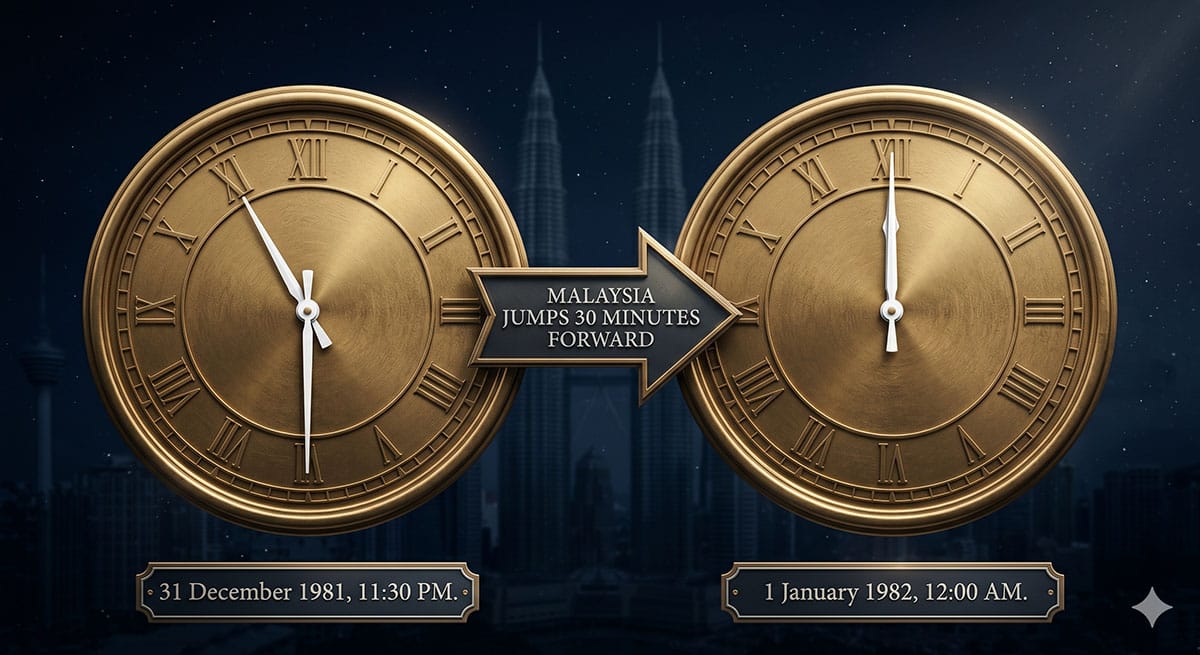
Malaysia once celebrated New Year's 30 minutes early. Here is the story.
You know that awkward moment when someone asks you a simple question about your own country and you have absolutely no idea what the answer is?
That was me when I first came across this fact. Malaysia has changed its official time zone six times throughout its history. Six. And the last one happened at exactly 11.30pm on New Year's Eve 1981, when Tun Mahathir essentially gave Malaysians the shortest New Year's celebration in history by jumping the clocks forward 30 minutes so that midnight arrived half an hour early.
Most Malaysians have no idea this happened. I certainly did not. And once you go down this rabbit hole, it is genuinely one of the most fascinating and slightly bizarre chapters in Malaysian history.
When Malaysia Had No Fixed Time
Before standardised time zones existed, every city simply set its clocks based on the position of the sun. Kuala Lumpur ran on its own local mean time, which was UTC+06:46:46. Not a neat round number. Just whatever the sun said it was.
This changed in 1901 when Peninsular Malaysia adopted Singapore Mean Time at UTC+06:55:25. Still not a round number. Still very much a work in progress. Four years later in 1905, the British aligned the country with the 105th east meridian, moving clocks to a cleaner GMT+7:00. That was the second change.
The third came in 1933 when the British introduced Daylight Saving Time, pushing clocks forward another 20 minutes to GMT+7:20. Originally a one-year trial, it was eventually made permanent in 1936. Malaysia was essentially waking up 20 minutes earlier than nature intended, for reasons that made sense to someone in London.
The Japanese Came and Took Our Time Too
The fourth time zone change is perhaps the most dramatic, and the most forgotten.
When Japan occupied Malaya in February 1942, the military administration forced the entire country to adopt Tokyo Standard Time at GMT+9:00. Overnight, clocks jumped forward by one hour and thirty minutes. Not because of any geographical logic. Simply because Japan wanted its occupied territories to run on Japanese time.
It is one of those quiet details of the occupation that rarely makes it into history textbooks but speaks volumes about what it means for a foreign power to take control of a country. They did not just take the land, the resources, and the freedom. They took the time itself.
When Japan surrendered in 1945 and the British returned, the fifth change came immediately, reverting clocks to GMT+7:30. Malaysia breathed again, and got its hours back.
The 30-Minute Problem Nobody Talked About
For the next 36 years, this is where things stood. Peninsular Malaysia ran on GMT+7:30. Sabah and Sarawak, however, operated on GMT+8:00. Which meant that Malaysia, a single country, had two different official times running simultaneously. A 30-minute gap between the peninsula and East Malaysia.
In practice this caused endless confusion. Business meetings across the South China Sea required mental arithmetic. Official communications needed time zone clarifications. And anyone who has ever been 30 minutes late to a meeting knows exactly how much damage half an hour of miscommunication can cause.
Mahathir, Hong Kong, and the Shortest New Year's Ever
Enter Tun Mahathir.
In December 1981, Mahathir submitted a motion to Parliament proposing the Malaysian Standard Time Act, which would align Peninsular Malaysia with Sabah and Sarawak at a unified GMT+8:00. His reasons were practical and economic. Moving half an hour forward meant more usable daylight hours in the late afternoon, beneficial for farmers and outdoor workers. It also meant Malaysia's financial markets would open and close at the same time as Hong Kong, Manila, and Perth, making business coordination across Asia significantly easier.
The motion received unanimous support in Parliament, including from the opposition. It was made effective at 11.30pm on December 31, 1981, meaning clocks jumped forward 30 minutes to midnight, ushering in 1982 half an hour ahead of schedule.
New Year's Eve 1981 was the only New Year's Eve in Malaysian history where midnight arrived at 11.30pm. Partygoers counting down from ten to one ended up welcoming the new year with thirty minutes to spare.
And Singapore, which had been running on GMT+7:30 alongside Peninsular Malaysia, quietly followed suit. They did not have much choice. Their largest trading partner had just moved the clocks forward.
The Quirk That Explains the Sunrise
Here is the practical consequence of that 1982 decision that you can observe any morning without opening a history book.
Geographically, Kuala Lumpur sits at roughly the same longitude as Bangkok and Jakarta. Both cities use GMT+7:00. But Malaysia uses GMT+8:00. This means the sun rises noticeably earlier in Bangkok and Jakarta relative to their clocks than it does in Kuala Lumpur relative to ours. We are technically running one hour ahead of where the sun thinks we should be.
In plain language: by the time you wake up at 7am in Kuala Lumpur, the sun has already been up for a while. And by the time evening comes, darkness falls later than it would in cities at similar longitudes. More usable evening daylight. Exactly what Mahathir planned for.
I Was as Surprised as You Are
I came across this story as an adult and found myself genuinely surprised. I knew Malaysia was in the GMT+8:00 zone. I had never once thought about why, or that it was a deliberate policy decision made within living memory, or that it came with a New Year's Eve surprise for everyone who was awake that night.
It is the kind of history that sits quietly in the background of daily life, completely invisible until someone points it out. Every time I look at a clock, there is a small piece of 1981 parliamentary history in that number.
And somewhere out there, there are Malaysians who remember staying up on New Year's Eve 1981, watching the clock hit 11.30pm and suddenly becoming 1982. I was too young to remember it. But I think that would have been a genuinely strange and memorable moment.
The time changed. Malaysia moved forward. And we have been running slightly ahead of the sun ever since.

Share hidden facts about Malaysia and stand a chance to win prizes worth up to RM4,300! Find out how to join here. T&Cs apply.
Kamarul Azwan (k.azwan@gmail.com) is a content creator under the Newswav Creator programme, where you get to express yourself, be a citizen journalist, and at the same time monetize your content & reach millions of users on Newswav. Log in to creator.newswav.com and become a Newswav Creator now!
The User Content (as defined on Newswav Terms of Use) above including the views expressed and media (pictures, videos, citations etc) were submitted & posted by the author. Newswav is solely an aggregation platform that hosts the User Content. If you have any questions about the content, copyright or other issues of the work, please contact creator@newswav.com.