
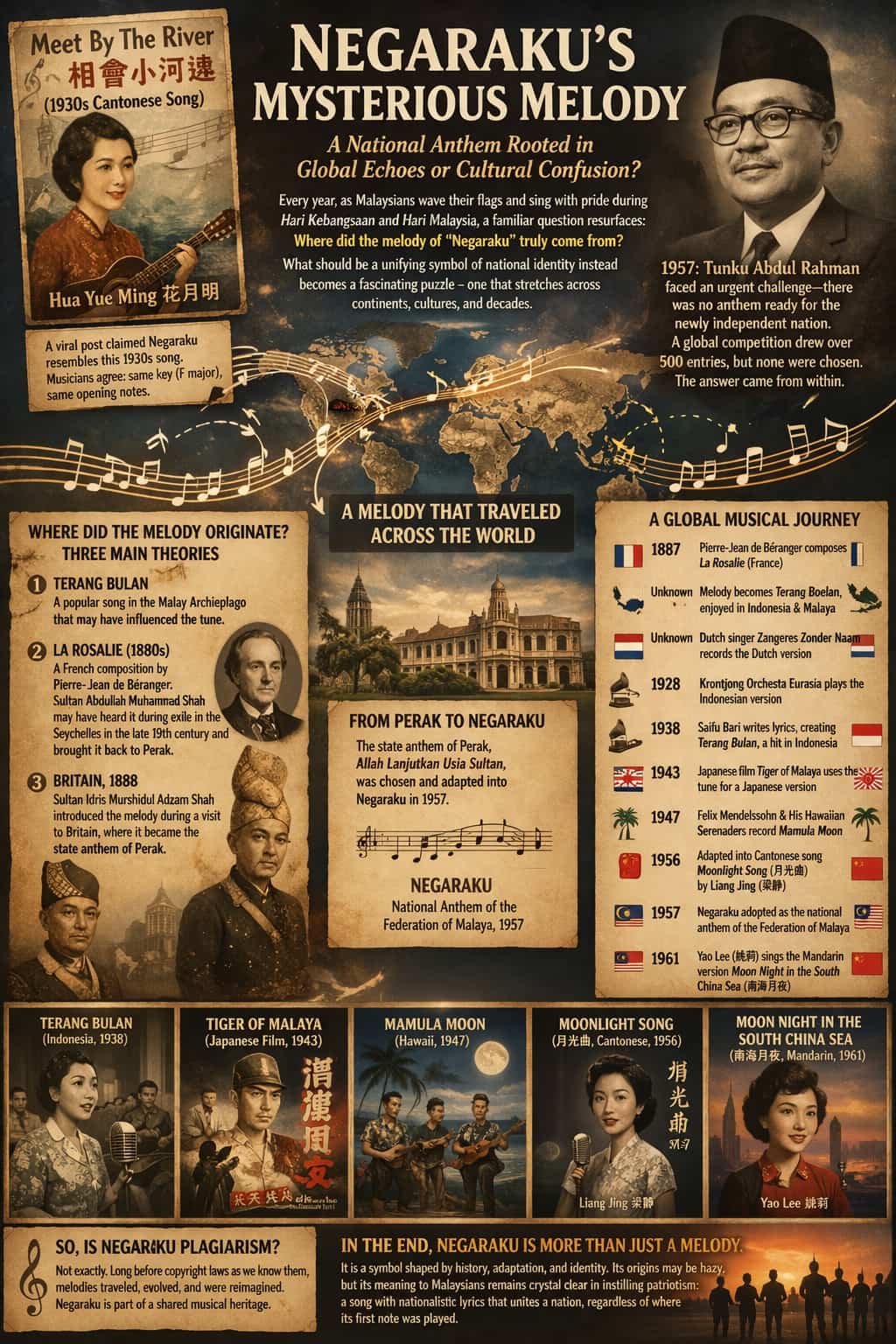
Every year, as Malaysians wave their flags and sing with pride during Hari Kebangsaan and Hari Malaysia, a familiar question resurfaces: Where did the melody of “Negaraku” truly come from?
What should be a unifying symbol of national identity instead becomes a fascinating puzzle - one that stretches across continents, cultures, and decades.
As reported by Says - an online news media - a viral social media post claiming that Negaraku closely resembles a 1930s Cantonese song titled Meet By The River (相會小河邊), performed by Hua Yue Ming. Netizens were quick to point out the uncanny similarity in melody, rhythm, and structure. Musicians, including trained vocalists and pianists, even agreed that both pieces share the same musical foundation - written in F major and beginning with the same note progression. However, while the resemblance is striking, the timeline tells a deeper and more complex story.
Historical records suggest that the Cantonese version is not the origin, but rather a later adaptation. In fact, reports indicate that the melody used in that song likely dates back to 1957 or earlier, aligning with the year Negaraku was officially adopted. This revelation shifts the narrative from plagiarism to something far more intriguing: a shared musical lineage.
To understand this, we must revisit the birth of Malaya’s national anthem. In 1957, as independence loomed, Tunku Abdul Rahman faced an urgent challenge - there was no anthem ready for the newly forming nation. A global competition attracted over 500 entries, yet none met expectations. Even commissioned works from Western composers failed to impress. In the end, the solution came from within: the state anthem of Perak, Allah Lanjutkan Usia Sultan, was selected and adapted into Negaraku.
But where did that melody originate?
Here lies the heart of the mystery. One widely discussed theory links the tune to Terang Bulan, a popular song in the Malay Archipelago. Another traces it further back to La Rosalie, an 1880s French composition by Pierre-Jean de Beranger. According to historical accounts, Sultan Abdullah Muhammad Shah may have encountered the melody during his exile in the Seychelles in the late 19th century, bringing it back to Perak where it gradually evolved into a royal anthem.
A third and arguably more credible theory suggests that Sultan Idris Murshidul Adzam Shah introduced the melody as the state anthem during a visit to Britain in 1888. Regardless of which theory holds the most truth, one thing is presumably evident - the melody predates all modern versions, including the Cantonese adaptation now circulating online.
Over time, this tune has traveled remarkably far. It appeared in Indonesian songs like Terang Bulan, Japanese wartime film - 'Tiger of Malaya', Hawaiian recordings such as Mamula Moon, and later Chinese renditions - 'Moonlight Song (月光曲)', performed by Liang Jing and 'Moon Night in the South China Sea (南海月夜)' by Yao Lee. Each version added its own cultural flavor, yet the core melody remained unmistakably consistent.
In 1957, the melody reached a defining moment in history when it was officially adopted as Negaraku, the national anthem of the Federation of Malaya.
So, is Negaraku a case of plagiarism?
The answer is far from simple. Rather than being “copied,” the anthem appears to be part of a global musical journey - one where melodies evolved, migrated, and were reinterpreted across borders long before strict notions of intellectual property took hold.
In the end, the debate may never be fully settled. But perhaps that is not the point. Negaraku is more than just a melody - it is a symbol shaped by history, adaptation, and identity. Its origins may be hazy, but its meaning to Malaysians remains crystal clear in instilling patriotism: a song with nationalistic lyrics that unites a nation, regardless of where its first note was played.
By: Kpost
Information Source:
Share hidden facts about Malaysia and stand a chance to win prizes worth up to RM4,300! Find out how to join here. T&Cs apply.
Kpost (ckhorsk@gmail.com) is a content creator under the Newswav Creator programme, where you get to express yourself, be a citizen journalist, and at the same time monetize your content & reach millions of users on Newswav. Log in to creator.newswav.com and become a Newswav Creator now!
The User Content (as defined on Newswav Terms of Use) above including the views expressed and media (pictures, videos, citations etc) were submitted & posted by the author. Newswav is solely an aggregation platform that hosts the User Content. If you have any questions about the content, copyright or other issues of the work, please contact creator@newswav.com.