.jpg)
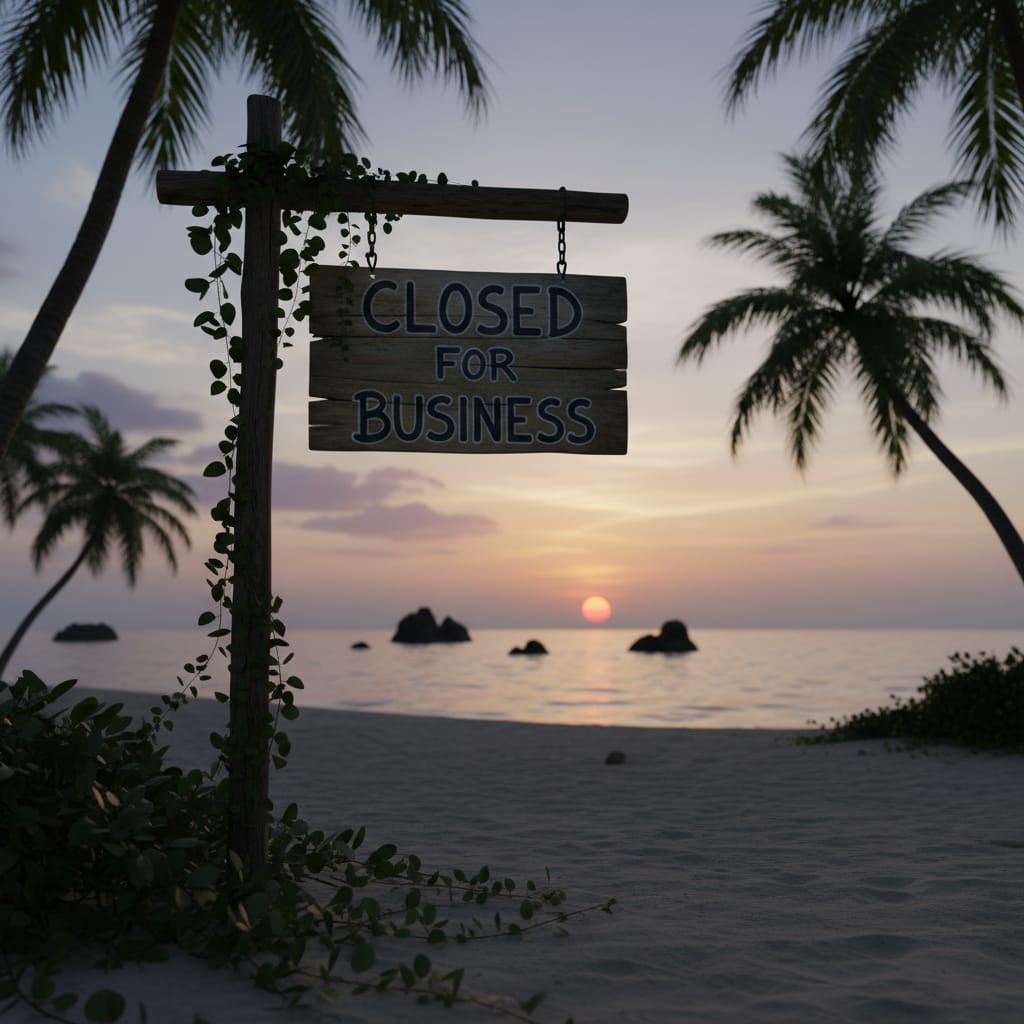
Langkawi: The Island That Put Up a “Closed for Business” Sign—One Policy at a Time
By Mihar Dias April 2026
There is a certain genius—almost artistic—in how we manage Langkawi. Not the kind that builds a world-class destination, mind you, but the sort that slowly, methodically, and with admirable consistency, squeezes the life out of one.
First, it was the moral housekeeping. The quiet tightening around alcohol sales, the raised eyebrows at beach attire—as though tourists flying in from Germany or Australia might suddenly develop a fondness for modest swimwear upon landing. One could almost hear the unspoken marketing slogan: “Langkawi—Now with Less Fun.”
But tourists, being a forgiving species (and often armed with prepaid hotel bookings), still came. They adapted. They drank less publicly, dressed more cautiously, and told themselves the sunsets were worth it.
And then came the masterstroke: make it harder to get there.
The recent reduction in ferry services—from five daily trips to three—has all the elegance of a self-inflicted wound. For an island where, by admission, about 70% of visitors arrive by sea, this is not just a logistical adjustment. It is economic Russian roulette, played with the livelihoods of small traders, tour operators, and the entire fragile ecosystem that depends on tourist footfall.https://www.thevibes.com/articles/news/122052/langkawi-ferry-cuts-spark-protest-as-residents-tourism-sector-warns-of-economic-fallout
Imagine running a restaurant, a souvenir stall, or a modest homestay in Kuah, only to discover that your customer base has been quietly throttled—not by lack of demand, but by lack of seats on a boat.
It is the kind of policy contradiction that deserves a case study. On one hand, we speak earnestly about boosting domestic tourism, encouraging Malaysians to rediscover their own backyard. On the other, we ration the very ferries that make such rediscovery possible.
One almost admires the symmetry.
Of course, the ferry operators have their reasons. Rising diesel costs, operational sustainability—perfectly rational explanations in isolation. But public infrastructure, especially one that underpins an entire island economy, is not meant to operate like a boutique startup delicately balancing its books. It is, or should be, a lifeline.
And when lifelines become profit-sensitive luxuries, something has already gone wrong.
The protests at Kuah Jetty—peaceful, orderly, and tinged with desperation—are not just about ferry schedules. https://www.thevibes.com/articles/news/122052/langkawi-ferry-cuts-spark-protest-as-residents-tourism-sector-warns-of-economic-fallout
They are about an island beginning to feel like it is being managed in fragments. A rule here, a restriction there, a cost-cutting measure somewhere else. Each decision defensible on its own. Collectively, suffocating.
One wonders what the long-term vision is.
Is Langkawi meant to be a vibrant international destination, competing with Phuket or Bali? Or is it slowly being rebranded—unofficially, of course—into something more restrained, more “compliant,” and ultimately, less visited?
Because tourism, inconveniently, thrives on ease. Easy access, easy movement, easy enjoyment. Start inserting friction—whether moral, logistical, or financial—and tourists will do what tourists do best: go somewhere else.
And there is no shortage of “somewhere else.”
The real tragedy here is not that Langkawi will collapse overnight. It won’t. Decline, like all well-managed things in this country, will be gradual. Quiet. Explained away with statistics and temporary measures.
Until one day, the island that once bustled with energy will simply feel… manageable.
Not overcrowded. Not chaotic.
Just… manageable.
Which, in tourism terms, is often a polite way of saying: empty.

Share hidden facts about Malaysia and stand a chance to win prizes worth up to RM4,300! Find out how to join here. T&Cs apply.
Mihar Dias (mihardias@gmail.com) is a content creator under the Newswav Creator programme, where you get to express yourself, be a citizen journalist, and at the same time monetize your content & reach millions of users on Newswav. Log in to creator.newswav.com and become a Newswav Creator now!
The User Content (as defined on Newswav Terms of Use) above including the views expressed and media (pictures, videos, citations etc) were submitted & posted by the author. Newswav is solely an aggregation platform that hosts the User Content. If you have any questions about the content, copyright or other issues of the work, please contact creator@newswav.com.