
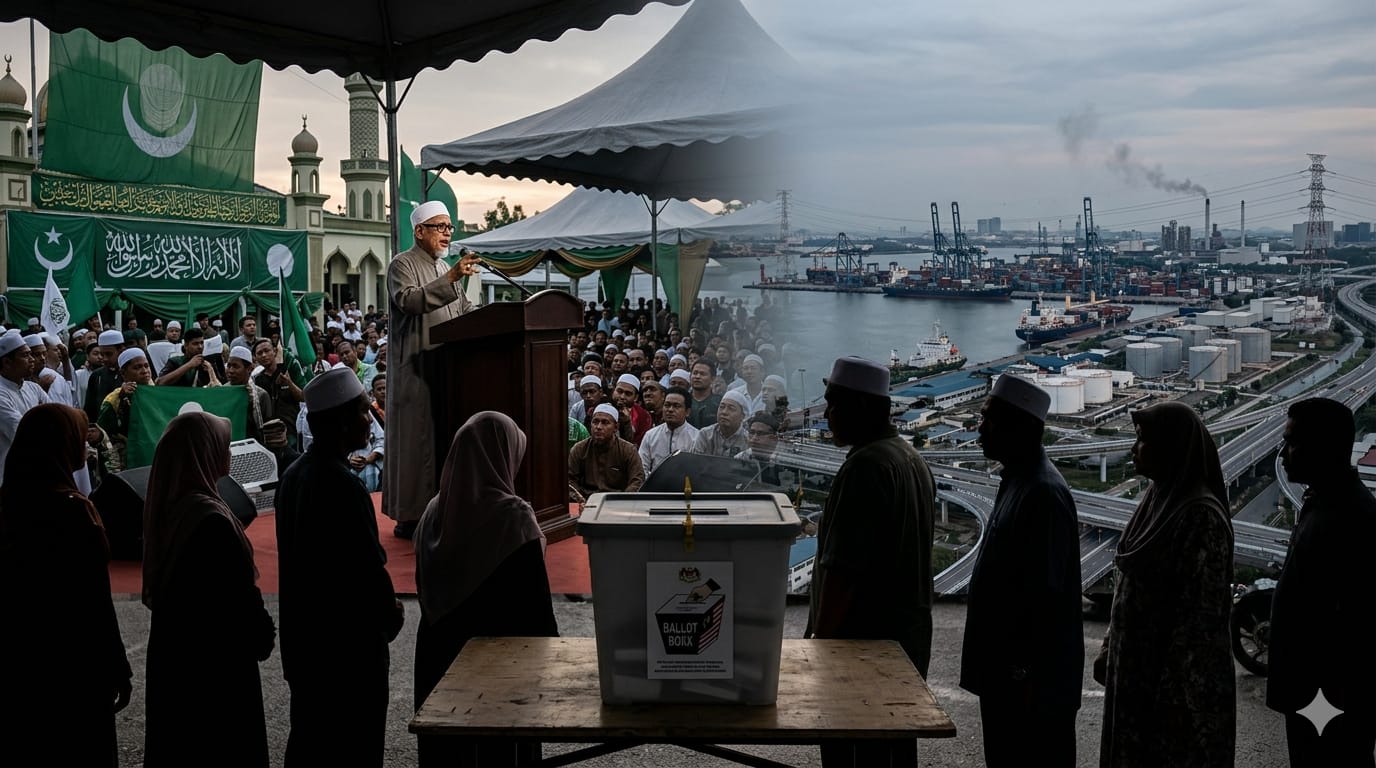
To watch modern Malaysian politics is to witness a never-ending cycle of existential panic. In late 2024, PAS President Tan Sri Abdul Hadi Awang shared a personal account of a dream he had where he met the Prophet Muhammad at Masjid Rusila in Marang, claiming he was instructed to unite the Muslim ummah (community). Fast forward to today, and the narrative has shifted drastically from supernatural dreams to strict legalistic threats; Hadi now declares casting a ballot to be a compulsory religious obligation (wajib), warning that political indifference is an Islamic failure. To the casual observer, this looks like standard campaign posturing. But if we look past the immediate outrage and the superficial rhetoric, this moment exposes a far more dangerous structural flaw: the complete fragmentation of the Malay political elite, and their desperate attempt to weaponize the majority to hide failures in economic governance.
For decades, the foundational myth of Malaysian statecraft has been the necessity of absolute majority unity to safeguard national stability. Yet, history shows this monolith is an entirely manufactured illusion. Consider the ideological gymnastics of our leaders: Muhyiddin Yassin famously declared himself "Malay first" during the Najib era, only for that rigid identity politics to lose its currency as alliances shifted. Tun Dr. Mahathir Mohamad, even past the age of 100, continues to try and orchestrate a singular ethnic consensus that simply will not take root. The reality is glaring: the majority is not a monolith; it is highly competitive and deeply divided. When leaders run out of viable solutions, they turn to existential anxiety to keep voters in line.
By transforming a standard civic duty into a theological test, political strategists intentionally shift the goalposts of accountability. If voting is rebranded as an act of faith to defend the community against fabricated external threats, the actual economic performance of a state government disappears from the scorecard. This approach forces voters to overlook basic failures in governance.
This selective theology has sparked profound public frustration, drawing sharp criticism over why political leaders weaponize religion for electoral survival while ignoring its core ethical mandates. If amanah (trust) and divine law are the benchmarks for leadership, why is the unashamed theft of national coffers or rampant systemic graft never given the same wajib status? Regular citizens increasingly point out the blatant hypocrisy: leaders are quick to issue absolute decrees to secure power, yet they show zero moral urgency or political will when it comes to eradicating corruption. By framing political survival as a spiritual battlefield, the ruling elite conveniently absolves itself of the financial and moral accountability demanded by the very faith they claim to defend.
The structural failure of this dynamic is laid bare when looking at concrete data from the Department of Statistics Malaysia (DOSM). While states driven by religious rhetoric focus heavily on moral policing, they fall severely behind in economic viability. Industrialized hubs like Selangor dominate the national economy, contributing roughly a quarter (25.9%) of the total national GDP with a strong annual growth rate of over 6%. Similarly, Johor acts as a vital economic engine, pulling in nearly 10% of the national GDP and leading as one of the fastest-growing state economies due to rapid surges in modern infrastructure and data center investments.
In stark contrast, PAS-led heartlands tell a story of developmental stagnation. Kelantan accounts for a minimal fraction of the national GDP, weighed down by a slow 3.6% growth rate and an economy deeply reliant on low-value agriculture and public service jobs. Terengganu, despite its resource wealth, remains structurally dependent on federal oil royalties and heavily lacks a diversified local job market.
This developmental gap creates a glaring economic contradiction. Tens of thousands of young workers routinely leave economically stagnant heartland states to find employment in industrialized regions like Johor, Selangor, or Penang. Yet, when elections arrive, systematic religious indoctrination prompts many to return home and vote for the very same administrations whose policies failed to generate local jobs. The rhetoric creates a psychological disconnect, separating political loyalty from the material realities of daily survival and economic progress.
Furthermore, this strategy places immense strain on the legal fabric of the nation. Under the Federal Constitution of Malaysia, specifically Article 11 (Freedom of Religion) and Article 10 (Freedom of Speech), citizens are granted democratic protections within a constitutional monarchy. While the Constitution recognizes Islam as the region's official faith, it sets specific legal boundaries regarding the mixing of state administration and religion. When political figures unilaterally issue spiritual mandates or fatwas in all but name to dictate voting behavior, they attempt to bypass secular rule of law. They utilize the freedoms of an open system to advocate for a restrictive environment that would eventually erode those same freedoms.
Breaking this cycle requires a fundamental shift from both civil society and the electorate. Voters must actively reject the divine theater at the ballot box, replacing spiritual compliance with rigorous governance audits. We must begin asking candidates for clear economic roadmaps, costed job-creation strategies, and uncompromising anti-corruption frameworks, rather than settling for performances of piety. Simultaneously, civil society organisations must step up to democratise data, creating accessible tools that expose the stark developmental gap between progressive regions and underperforming states. By tracking and scoring campaigns based on policy substance rather than identity-driven panic, we can clip the wings of political theologians.
The obsession with maintaining an artificial majority unity has rarely benefited ordinary citizens. It primarily serves a political class that uses identity politics to secure influence, positions, and patronage. While elites debate who is the truest defender of the community, regular Malaysians of all backgrounds are left to navigate an economy dealing with inflation and stagnant wages.
The real challenge facing the majority is not the presence of minority communities, nor is it the influence of alternative social values. The real challenge is a political culture that replaces concrete policy with emotional leverage. Until the electorate looks past this political theater and demands a clear separation between personal faith and state administration, the status quo will remain. True leadership is not measured by spiritual decrees, but by clean governance, accountability, and real economic opportunities for all.
Annan Vaithegi writes on Malaysian politics, governance, and economic policy, with a focus on accountability, institutional integrity, and the impact of public policy on everyday Malaysians.

Share hidden facts about Malaysia and stand a chance to win prizes worth up to RM4,300! Find out how to join here. T&Cs apply.
Annan Vaithegi (annanvaithegi@icloud.com) is a content creator under the Newswav Creator programme, where you get to express yourself, be a citizen journalist, and at the same time monetize your content & reach millions of users on Newswav. Log in to creator.newswav.com and become a Newswav Creator now!
The User Content (as defined on Newswav Terms of Use) above including the views expressed and media (pictures, videos, citations etc) were submitted & posted by the author. Newswav is solely an aggregation platform that hosts the User Content. If you have any questions about the content, copyright or other issues of the work, please contact creator@newswav.com.