
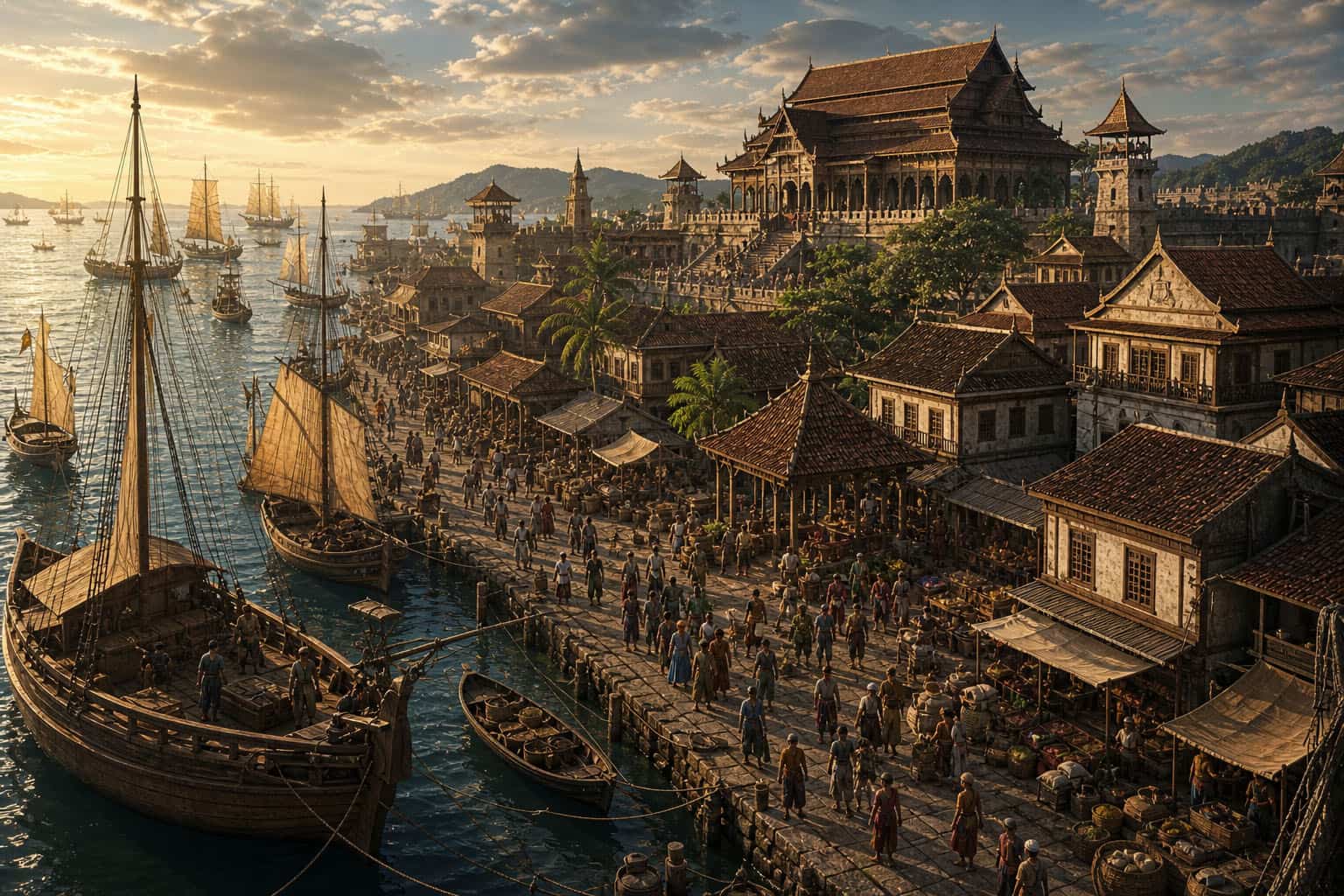
Most Malaysians visit Malacca for the cendol, the chicken rice balls, and maybe a trishaw ride with questionable K-pop music blasting from the speakers. You walk along Jonker Street, take a few photos, complain about the heat, and head home thinking you've done your patriotic duty as a Malaysian tourist.
But here's something your sejarah teacher probably glossed over between the chapters you were busy memorising for SPM: there was a time when Malacca wasn't just a heritage town with good food. It was arguably the most important city on the entire planet.
No, seriously. Not Southeast Asia. The planet.
From Fishing Village to Global Powerhouse
The Malacca Sultanate was founded around 1400 by Parameswara, a prince who fled Sumatra and set up shop on the southwest coast of the Malay Peninsula. What he built on what was essentially a fishing village would go on to reshape world history.
The secret weapon? Geography. Located on the southern part of the Malay Peninsula, Malacca controlled access to the narrow Malaccan Straits, the most direct route between the Indian Ocean and the South China Sea. All trade moving between India, Southeast Asia, and China went through these waters.
Spices, silk, porcelain, tin, gold, everything the world wanted had to pass through Malacca. The Sultanate didn't just sit there and collect tolls either. They were smart about it. According to The Shipyard Blog, by enforcing transparent customs duties, fair judicial procedures, and low corruption, the port promised smooth sailing for merchants from across the world. Arab, Persian, Indian, Chinese, and Javanese traders didn't just visit. Many of them stayed permanently.
How cosmopolitan was Malacca at its peak? According to Portuguese apothecary Tomé Pires, who lived in Malacca between 1512 and 1514, as many as 84 dialects were spoken there. For context, Malaysia today officially recognises 137 languages and dialects across the whole country. Medieval Malacca was doing 84 in one port city alone. That's not multicultural, that's a medieval United Nations, except with better food and actual functioning trade agreements.
Contemporary accounts describe Malacca as rivalling Venice and Cairo in wealth and importance, with over 20,000 Arab traders visiting annually at the height of its prosperity. It was the chief centre of trade in Indian cloth, Chinese porcelain and silk, and Malay spices.
"Whoever Controls Malacca, Controls Venice"
Now here's the quote that should be on a mural somewhere in Bandar Hilir.
Venice was the economic superpower of Europe at the time. Their entire empire was built on controlling the flow of luxury goods from the East into Europe, including spices, silk and precious stones. Venice was essentially the middleman of the medieval world, and they were filthy rich because of it.
So when Portuguese chronicler Tomé Pires wrote in his landmark work Suma Oriental that "Whoever is lord of Malacca has his hand on the throat of Venice," that was not a compliment or poetic exaggeration. That was cold, hard geopolitical reality. Control Malacca, and you could strangle Europe's most powerful trading republic without firing a single cannon.
In 1509, a Portuguese fleet arrived in Malacca with orders from the king of Portugal to establish trade there, because doing so would allow Portugal to replace Venice as the centre of the spice trade in Europe. The Europeans weren't just passing through the region on a sightseeing tour. They came specifically because Malacca was the key to dominating global commerce.
As historians note, the scale of the trading network in the Southeast Asian region at the time was something that simply could not be compared to anything in Europe. And Malacca was sitting right at the centre of all of it.
The Fall of a Giant
Of course, every golden age eventually ends. Sometimes with a whimper, sometimes with a bang. In Malacca's case, it was very much a bang.
In 1511, a fleet led by Afonso de Albuquerque captured the port by firing their superior cannons and burning at least 12 ships at anchor in the harbour. The last Sultan of Malacca fled the city.
This wasn't a random act of colonial aggression. It was a calculated economic strike. The Portuguese weren't interested in Malacca's beaches or its food scene. They wanted control of the world's most strategically important trade artery, and they got it.
As documented by the World History Encyclopedia, Albuquerque himself described his intention clearly: if they could take Malacca out of the hands of its rulers, Cairo and Mecca would be ruined, and Venice would then be unable to obtain spices except through Portugal. In one military campaign, Portugal intended to redraw the entire map of global trade. And they did.
The fall of Malacca in 1511 is considered one of the most significant turning points in Asian and world history. It marked the beginning of European dominance over Asian sea trade, a dominance that would last for centuries.
So Next Time You're in Malacca...
...sitting by the Malacca River with cendol dripping down your bowl, take a moment. You're not just in a heritage city with good Nyonya food and Instagram-worthy street art. You're standing in what was once the New York City of the medieval world. A place so economically critical, so strategically irreplaceable, that the most powerful naval empire in Europe crossed oceans specifically to take it from us.
The chicken rice balls hit different when you know that, don't they?
Sources: Wikipedia — Malacca Sultanate | World History Encyclopedia — Portuguese Malacca | OpenStax World History | History Rise — Strait of Malacca | Wikipedia — Capture of Malacca 1511 | The Shipyard Blog
Share hidden facts about Malaysia and stand a chance to win prizes worth up to RM4,300! Find out how to join here. T&Cs apply.
Kamarul Azwan (k.azwan@gmail.com) is a content creator under the Newswav Creator programme, where you get to express yourself, be a citizen journalist, and at the same time monetize your content & reach millions of users on Newswav. Log in to creator.newswav.com and become a Newswav Creator now!
The User Content (as defined on Newswav Terms of Use) above including the views expressed and media (pictures, videos, citations etc) were submitted & posted by the author. Newswav is solely an aggregation platform that hosts the User Content. If you have any questions about the content, copyright or other issues of the work, please contact creator@newswav.com.