
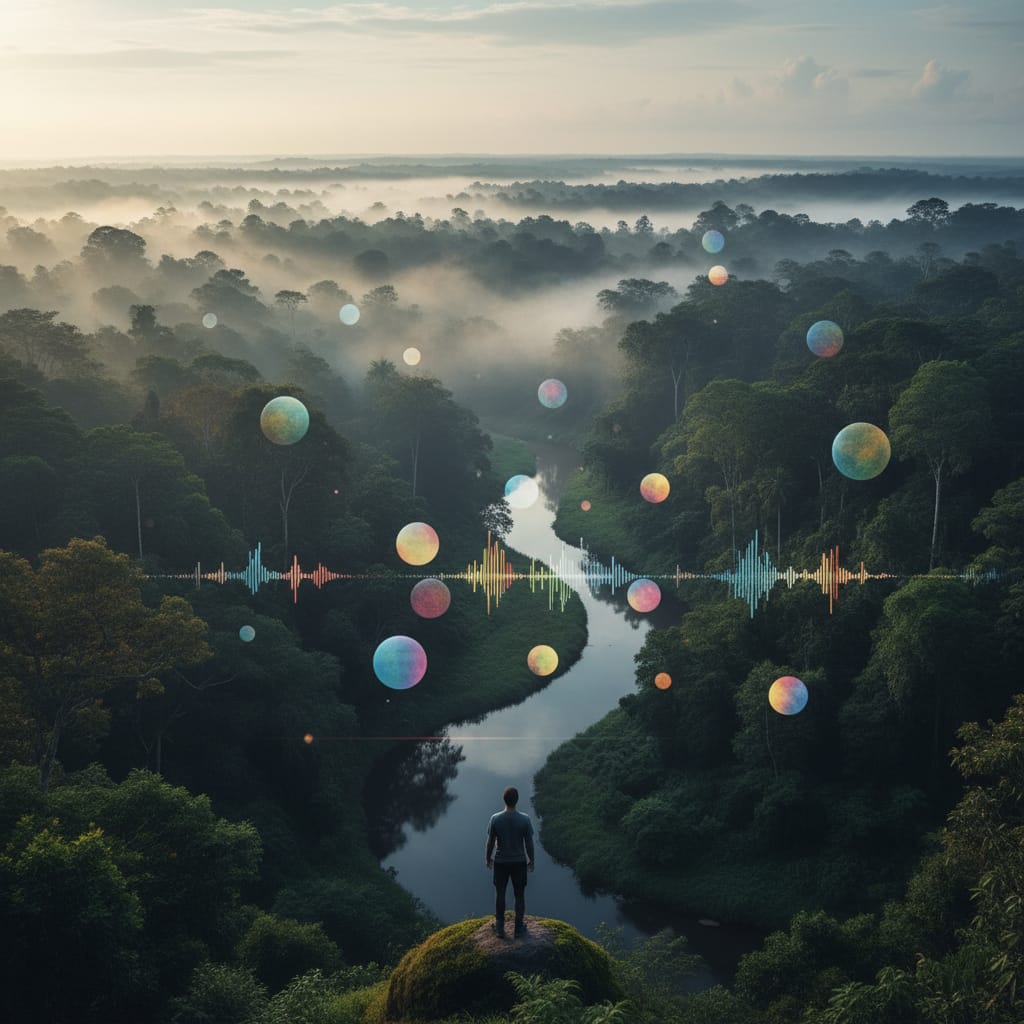
“A Rainforest of Voices: Where Languages Grow Wild and Free”
Malaysia is not just a country—it is a rainforest of languages, dense, layered, and alive with unseen connections.
Walk through Kuala Lumpur or Penang, and you are not merely hearing conversations—you are listening to a river that splits and rejoins, flowing from Malay to English to Mandarin within a single breath. Words ripple and merge like currents meeting at a delta.
For many Malaysians, especially among the Chinese and Indian communities, multilingualism is not a medal—it is the air they breathe. From a young age, they grow up holding three linguistic keys. Bahasa Melayu opens the door to the nation, English unlocks the wider world, and Mandarin or Tamil connects them to their roots. Each language is a different lens: one for belonging, one for opportunity, one for memory.
But beneath this surface lies an even richer soil. Within Chinese families, dialects grow like ancient roots beneath a modern city. Cantonese, Hakka, Hokkien, and Teochew are not just spoken—they echo. A grandmother’s Hokkien may sound like an old melody, while a parent’s Cantonese beats like a steady drum. The child, replying in Mandarin, becomes a bridge—linking past and present. Conversations turn into woven tapestries, each thread a different dialect crossing in intricate patterns.
In George Town, Hokkien flows through the streets like a local tide, while in Kuala Lumpur, Cantonese rises like the hum of a marketplace. Hakka lingers like a mountain breeze, and Teochew survives like a porcelain heirloom, carefully passed down through generations.
Then come the winds from afar. Foreign languages such as Japanese, Korean, or French arrive like migrating birds, landing in curious minds. Some are inspired by pop culture, others by travel or study, but each new language becomes another window to the world. The more languages one learns, the wider the horizon stretches.
Family heritage can turn this into a constellation. A Malaysian Chinese with a Thai or Vietnamese mother may speak Thai or Vietnamese at home. In such families, language is not studied—it is inherited, like the rhythm of a lullaby. It flows naturally, without effort.
This is how you may meet someone who speaks Mandarin, Malay, English, Cantonese, Hakka, Hokkien, Teochew, Japanese, and Thai—nine languages or dialects carried in one mind. Such a person is like a living library, each language a different book, each dialect a different chapter.
To foreigners, this feels astonishing. In many countries, speaking two languages is already impressive. In Malaysia, switching between three or four is as natural as changing lanes on a familiar road. Conversations often become “rojak language,” where Malay, English, and Chinese dialects are mixed together like a vibrant dish—colorful, spontaneous, and full of flavor.
This richness is rooted in history. Malaysia has long been a crossroads, a harbor where traders from China, India, the Middle East, and Europe once arrived, bringing not only goods but words and stories. Instead of replacing one another, these languages settled side by side, like ships anchored in the same bay.
In the end, Malaysia’s multilingualism is not just a skill—it is a landscape. People grow up in it like trees in a rainforest, their roots touching many languages at once. They do not force themselves to switch; they simply adapt, like leaves turning toward the sun.
moykokming@gmail.com
Share hidden facts about Malaysia and stand a chance to win prizes worth up to RM4,300! Find out how to join here. T&Cs apply.
Moy Kok Ming (moykokming@gmail.com) is a content creator under the Newswav Creator programme, where you get to express yourself, be a citizen journalist, and at the same time monetize your content & reach millions of users on Newswav. Log in to creator.newswav.com and become a Newswav Creator now!
The User Content (as defined on Newswav Terms of Use) above including the views expressed and media (pictures, videos, citations etc) were submitted & posted by the author. Newswav is solely an aggregation platform that hosts the User Content. If you have any questions about the content, copyright or other issues of the work, please contact creator@newswav.com.