
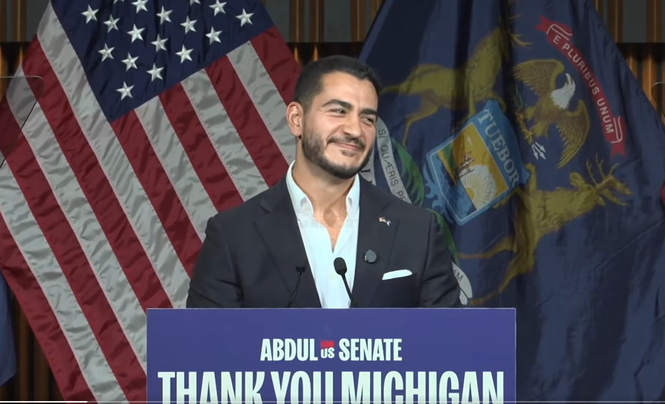
KUALA LUMPUR – Abdul El-Sayed turned his campaign catchphrase “Inshallah” into “Alhamdulillah” as he celebrated a historic victory in Michigan’s US Senate race, becoming the first Muslim elected to the upper chamber of the US Congress.
Addressing jubilant supporters at his election night gathering in Detroit early Wednesday, the 42-year-old Democrat said the result marked the triumph of a grassroots movement after a fiercely contested campaign against Republican former congressman Mike Rogers.
“Up until right about now, you might have noticed that I always say ‘Inshallah’—or ‘God willing’… But tonight we can turn that Inshallah into a… Alhamdulillah!” he said, drawing cheers from the crowd.
The phrase, which means “praise be to God”, was met with chants from supporters as El-Sayed embraced the significance of the moment.
“Michigan, we did it. I am so proud and honoured to stand here as the newly elected senator from this great state of Michigan,” he said.
“We just showed them that a movement of the people, by the people, and for the people will ultimately win,” he added.
“They tried to confuse you. So let me just set the record this straight. I love America. I know exactly what America gave to me. Michiganders believe in Michigan, and I believe in Michiganders, and I am so honoured that Michiganders believed in me.”
His victory came despite a bruising campaign marked by substantial outside spending and criticism from President Donald Trump and Vice-President JD Vance.
El-Sayed also faced an unexpected setback shortly before polling day when Congresswoman Haley Stevens, whom he defeated in the Democratic primary, endorsed Rogers.
If confirmed, he will take office in January, succeeding retiring Democratic Senator Gary Peters. The result would also mark Rogers' second consecutive defeat in a Senate election, following his loss to Democrat Elissa Slotkin in 2024.
A physician and former public health commissioner, El-Sayed is a progressive Democrat whose political allies include New York Congresswoman Alexandria Ocasio-Cortez and independent Senator Bernie Sanders of Vermont.
His campaign focused on prioritising domestic investment over overseas military spending, arguing that taxpayers' money should address pressing needs at home.
“We want our taxes spent here. For schools here, and healthcare here, and infrastructure here. We don't want our money sent to do apartheid, or genocide, or war,” he told supporters.
His policy agenda includes expanding the Affordable Care Act towards a Medicare for All system, ending the war in Iran and fundamentally changing Washington's relationship with Israel.
El-Sayed has repeatedly accused Israel of committing genocide against Palestinians during its war with Hamas in Gaza. The allegation remains contested, although several international organisations, including Amnesty International, Doctors Without Borders and a United Nations commission, have supported it.
His position on Israel became a prominent issue during the campaign, with polling commissioned by The Jewish Majority suggesting he attracted less support among Jewish early voters than fellow Democrat Jocelyn Benson.
The survey, conducted between October 25 and 31 among 482 Jewish voters who had already cast their ballots, found that 57% supported El-Sayed, compared with 78% for Benson.
It also found that 99% of Jewish Democrats who did not support El-Sayed said they would probably have backed another Democratic candidate.
Nevertheless, his appeal extended beyond foreign policy, with economic concerns, the rising cost of living and opposition to Trump's agenda also featuring prominently in voters' considerations.
Although El-Sayed describes himself as a capitalist seeking to tackle corporate greed and wealth concentration among the richest 1%, several of his proposals overlap with policies advocated by democratic socialists.
He is not a member of the Democratic Socialists of America, although Ocasio-Cortez and Detroit Congresswoman Rashida Tlaib, both associated with the organisation, have backed his political agenda.
With allies in both chambers of Congress, El-Sayed is expected to push for significant changes to domestic and foreign policy. However, delivering on his proposals will require support beyond the progressive wing of the Democratic Party.
His victory could provide fresh momentum for progressive politics in Washington, although the extent of his influence will become clearer as he prepares to begin his six-year Senate term. – November 4, 2026
The post El-Sayed turns ‘Inshallah’ into ‘Alhamdulillah’ after historic US Senate victory appeared first on Scoop.

