
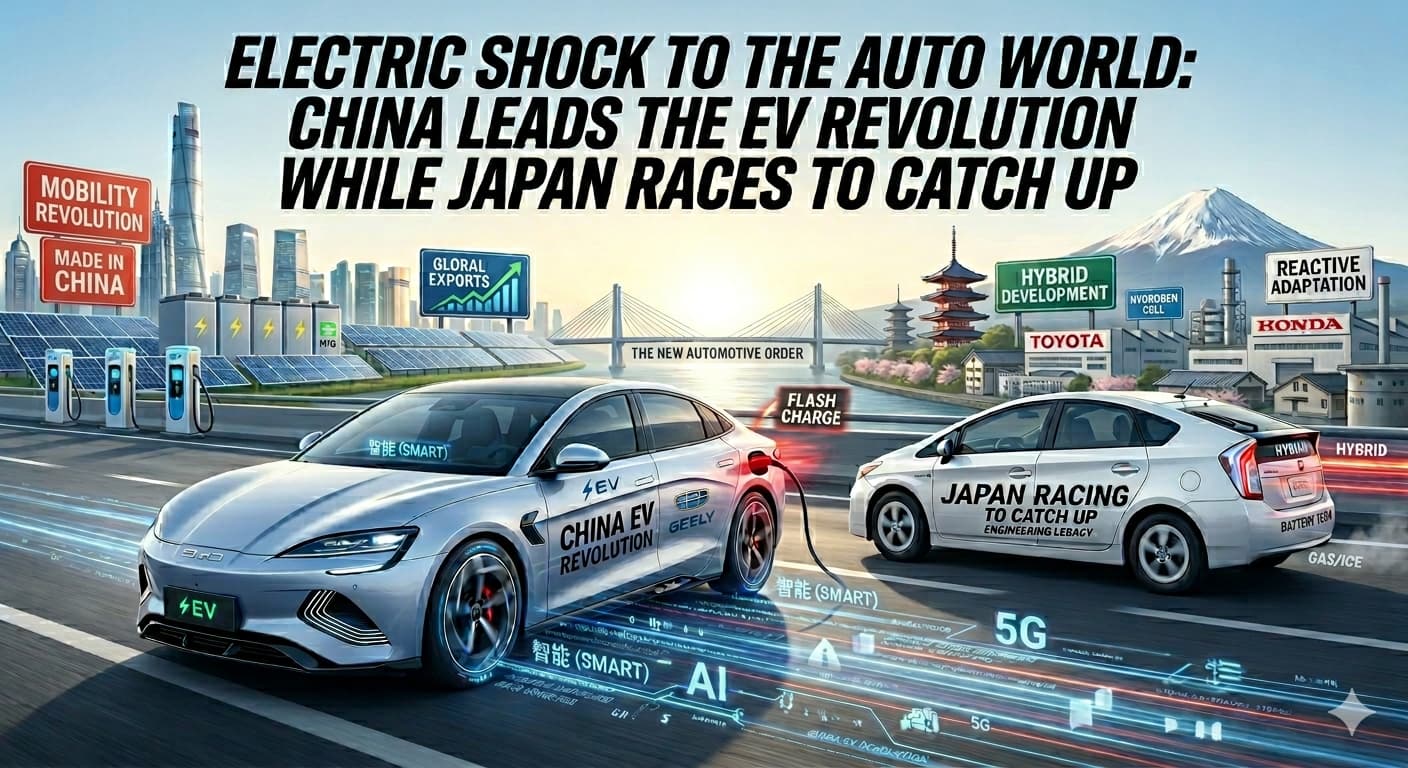
The global automotive industry is undergoing its most dramatic transformation in a century - and at the centre of this seismic shift stands China.
Once dismissed as a follower in car manufacturing, China has not only caught up but surged ahead, reshaping the future of mobility through electric vehicles (EVs), smart technologies, and aggressive industrial strategy.
Meanwhile, Japan - long regarded as a titan of automotive engineering - is now scrambling to adapt to a new reality it did not fully anticipate.
China’s EV Surge: From Catch-Up to Commanding Lead
China’s rise in the EV sector is no accident. Backed by long-term state policies such as “Made in China 2025,” the country has strategically positioned EVs as a pillar of its industrial future.
Today, China is the world’s largest EV market and producer, accounting for over half of global EV sales - more than 11 million units in 2024. However, this momentum appears to be slowing in the China domestic market, with an 18% drop recorded in the first quarter compared to last year, and growth is expected to remain stagnant or decline further in the foreseeable future.
Nevertheless, global expansion is set to become the key driver of future growth. Exports, currently at 5.8 million units, have surged by over 20% year-on-year, according to industry data.
This dominance is driven by a powerful combination of factors: massive domestic demand, government subsidies, and a thriving ecosystem of private players like BYD, Geely, and NIO. These companies have leveraged economies of scale and modular production techniques - similar to the smartphone industry - to accelerate innovation and reduce costs.
At the cutting edge, Chinese firms are pushing boundaries in battery technology, autonomous driving, and ultra-fast charging. At the 2026 Beijing Auto Show, innovations included batteries capable of near-full charge in under 10 minutes and AI-powered driving systems that edge closer to full autonomy.
Companies like BYD are even rolling out “flash charging” systems that can recharge vehicles in minutes, tackling one of the biggest barriers to EV adoption - range anxiety.
In short, China is no longer just manufacturing cars - it is redefining what a car is: a software-driven, intelligent mobility platform.
Japan’s Dilemma: Legacy Strength, Future Uncertainty
Japan’s automotive giants - Toyota, Honda, and Nissan - built their global dominance on internal combustion engines (ICE) and hybrid technologies. However, this legacy strength has become a strategic constraint in the EV era.
For years, Japanese automakers focused heavily on hybrid vehicles and hydrogen fuel cells, betting that these technologies would dominate the transition. But the global market moved faster toward full battery electric vehicles, leaving Japan behind the curve.
Now, the consequences are evident. Chinese brands are rapidly gaining market share both domestically and internationally, while Japanese exports have been overtaken by China’s automotive boom.
To respond, Japanese companies are cautiously accelerating EV development, forming partnerships, and even adopting Chinese technologies in batteries and digital systems to remain competitive. Nissan, for example, plans to launch multiple EV models tailored specifically for China, integrating AI features through local collaborations.
Yet, this shift is reactive rather than proactive - highlighting how quickly the balance of power has changed.
The Future: A New Automotive Order
The EV revolution is not just about replacing petrol engines - it is about redefining the entire automotive ecosystem. Software, batteries, artificial intelligence, and user experience are now as critical as mechanical engineering.
China’s advantage lies in its ability to integrate all these elements at scale, supported by policy alignment and industrial coordination. Its companies are already expanding globally, targeting Europe, Southeast Asia, and beyond, with exports surging over 60% in early 2026 alone. China’s automakers have firmly dominated the domestic EV market and are becoming increasingly prominent on the global stage. Now, they are shifting their focus to what they see as the next frontier of mobility - autonomous driving.
Japan, on the other hand, still possesses deep engineering expertise and global brand trust. But to remain relevant, it must reinvent itself - not just as a car manufacturer, but as a mobility innovator in a digital-first era.
Revolution vs Adaptation
The global EV race has exposed a stark contrast: China represents revolution, while Japan embodies adaptation. One is shaping the future; the other is racing not to be left behind.
As the world accelerates toward electrification, the question is no longer whether EVs will dominate - but who will define their future. Right now, the answer is increasingly unmistakable: China has taken the driver’s seat, and Japan is pressing hard on the accelerator to catch up.
By: Kpost
Information Source:
WeForum , Icct , GlobalandMail(Reuters) , Rieti , AP , Reuters , Forbes , Scmp , Scmp , GlobalTimes , Guardian
Kpost (ckhorsk@gmail.com) is a content creator under the Newswav Creator programme, where you get to express yourself, be a citizen journalist, and at the same time monetize your content & reach millions of users on Newswav. Log in to creator.newswav.com and become a Newswav Creator now!
The User Content (as defined on Newswav Terms of Use) above including the views expressed and media (pictures, videos, citations etc) were submitted & posted by the author. Newswav is solely an aggregation platform that hosts the User Content. If you have any questions about the content, copyright or other issues of the work, please contact creator@newswav.com.