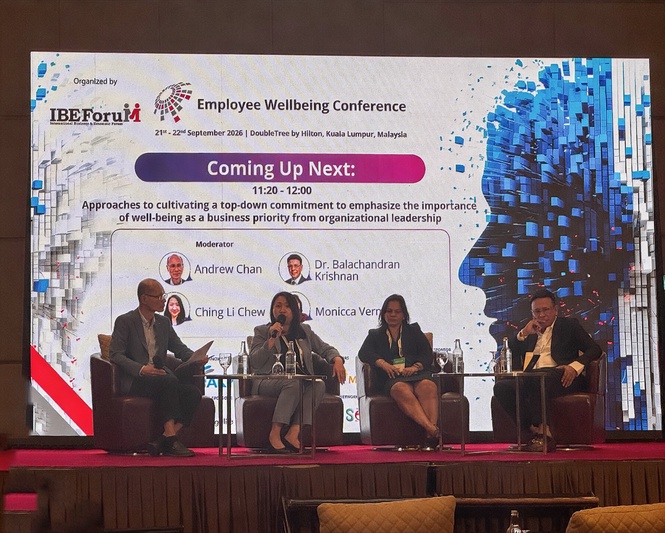
The Employee Wellbeing Conference Malaysia 2026 concluded on 22 September at the DoubleTree by Hilton, Kuala Lumpur, bringing together senior human resources, occupational health and people leaders to discuss workplace wellbeing, employee engagement and retention.
Organised by the IBE Forum and supported by Tourism Malaysia, the two-day conference featured speakers and representatives from organisations including PETRONAS, Press Metal, Unilever, CelcomDigi, Takaful Malaysia, Valiram and U Mobile. PP Health Malaysia (PPHM) served as one of the official media partners and supporting associations, alongside the Malaysian Mental Health Association (MMHA).
Among the speakers were Dr Nik Khairol Reza bin Md Yazin, Head of the Occupational Safety and Health Sector, Disease Control Division, Ministry of Health Malaysia; Dr Rajinderjit Singh Hullon, Deputy Director of the Occupational Health Division, Department of Occupational Safety and Health Malaysia; Andrew Chan, Chief Human Resource Officer of Press Metal; Lily Sabrina Kuang Abdullah, Chief People Officer of Takaful Malaysia; Chen Fong Tuan, Group Chief People Officer of Valiram; M Shahfree M Yusof, General Manager of Employee Relations at PETRONAS; and Nirmala Supramaniam, Head of the Household Financial Education Department at the Credit Counselling and Debt Management Agency (AKPK).
Other speakers and contributors also shared perspectives on mental health, occupational health, employee engagement, financial wellbeing, workplace culture, leadership and organisational resilience.
The conference focused on mental health, psychosocial safety and the need for organisations to create workplaces where employees feel safe raising concerns and seeking support.
Among the distinguished speakers was Nurul Ilham Anwar, daughter of the Prime Minister of Malaysia, Anwar Ibrahim, who spoke about psychosocial safety in the workplace and the importance of asking questions that are often overlooked.
“We should be asking ourselves: what are we not asking that we are supposed to ask? Sometimes, the issues affecting employees remain unseen because organisations do not create enough opportunities for honest conversations,” she said.
Speaking to PP Health Malaysia, Nurul Ilham said employees speaking up about workplace concerns was important for both individuals and organisations.
“It is important for employees to speak out about their concerns in the workplace. This allows employees to receive the support they need, while helping organisations understand the issues that may be affecting their people, culture and performance,” she said.
She added that organisations should create environments where employees feel heard, respected and safe when raising concerns.
Professor Dato’ Dr Andrew Mohanraj Chandrasekaran, Psychiatrist and President of the Malaysian Mental Health Association, highlighted the importance of supporting employees through personal challenges.
“Supporting employees through personal challenges requires empathy, understanding and practical support from the organisation,” he said.
Speaking to PP Health Malaysia, Professor Dato’ Dr Andrew said promoting good mental health at work required employers to establish channels that encouraged conversations about mental health.
“Organisations need to create accessible and trusted channels that encourage employees to talk about mental health. These conversations should be treated as a normal and important part of workplace wellbeing,” he said.
He identified stigma as one of the main obstacles preventing employees from seeking help.
“The major obstacle is still stigma. Many employees worry about being judged, misunderstood or viewed as less capable if they speak about their mental health. Employers must work to reduce this stigma through awareness, education and a supportive workplace culture,” he said.
Laavenia Ramasegar, Head of Wellbeing at CelcomDigi, shared insights on The Holistic Wellbeing Advantage: Strategies for Mental Health and Resilience.
In response to a question from PP Health Malaysia about the main obstacles preventing people from seeking help for mental health concerns, she said society needed to change the way mental health was discussed.
“We have to change the narrative. Mental health issues should not be framed as a sign of weakness. Seeking help is not a weakness; it is an important step towards building resilience and supporting holistic wellbeing,” she said.
Laavenia emphasised that employee resilience should be viewed as part of a broader approach to wellbeing, rather than as an expectation that employees manage difficulties on their own.
“Resilience is not simply about expecting employees to cope with everything by themselves. It is about creating the right conditions, support systems and culture so that employees can manage challenges while maintaining their mental, emotional, physical and social wellbeing,” she said.
The conference also examined flexible working arrangements, workplace culture, rewards and benefits, employee engagement and retention, financial wellbeing, occupational health, and strategies for building high-performing and resilient teams.
The event was supported by sponsors and partners including Quantum Nexis, AKPK, Sentuh, Ziloy, MindNexis, International Psychology Centre, Engage Life, The Good Health Coach, Anari and Solh.
The conference also coincided with the recent launch of PP Health Malaysia’s new “Healthy Workplace” column, which aims to advance discussion on employee wellbeing in Malaysia. The column will provide a platform for examining workplace mental health, employee support and practical approaches to building healthier, safer and more supportive organisations.
Commenting on the initiative, the Editor-in-Chief of PP Health Malaysia, Tony Y said the publication hoped to encourage informed dialogue while addressing persistent misconceptions surrounding mental health at workplace.
“We hope to advance discussion and communication regarding employee wellbeing and mental health, while helping to fight stigma and misinformation through evidence-based strategies, including media, public communication and discussion. Employees and employers need access to accurate information and practical approaches that can support healthier, safer and more inclusive workplaces,” the editor-in-chief said.
The conference concluded with a call for employers to place psychosocial safety, employee resilience and holistic wellbeing at the centre of workplace strategy, while ensuring employees have meaningful opportunities to raise concerns and access support without fear of stigma or negative consequences.
The post Employee Wellbeing Conference Calls for Stronger Mental Health Support and Psychosocial Safety in Malaysian Workplaces first appeared on PP Health Malaysia.