.jpeg)
Datuk Seri Anwar Ibrahim made waves in Indonesia recently during his first official foreign trip as Malaysia’s 10th Prime Minister. During the two-day visit to Indonesia’s capital of Jakarta, Anwar met with his counterpart, Joko “Jokowi” Widodo and discussed pressing matters between our two countries, from economic cooperation to regional security issues.
One of the more notable issues addressed was the strengthening of the protection of migrant workers in Malaysia. As reported by The Star, Anwar said that the matter has hurt the feelings of the Indonesian people and their government and promised a more comprehensive solution.
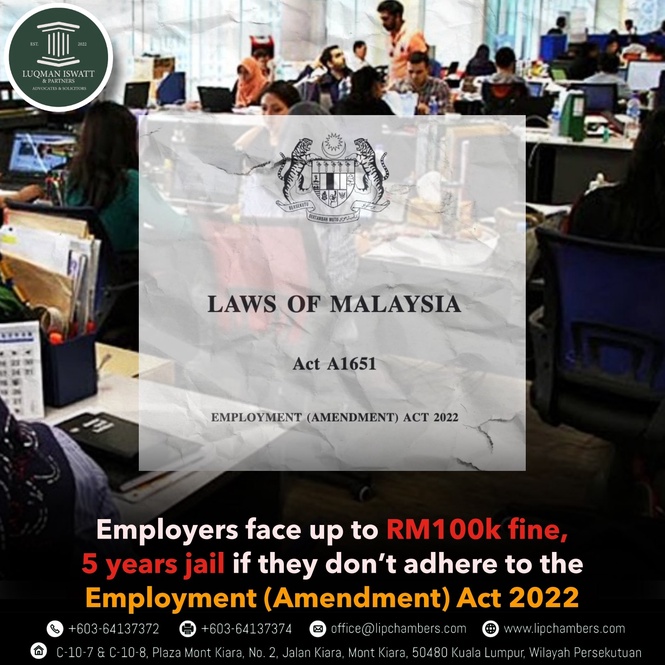
Indeed, such an issue was directly addressed in an Act that recently came into force on New Year’s Day, the Employment (Amendment) Act 2022. Tabled in the Dewan Rakyat in October 2021 and passed via a majority voice vote in March 2022, the amendments entail more than just increased protection for foreign workers but also improvements on the overall welfare of the workforce in Malaysia.

Although it was passed in 2022, the enforcement of the Amendment Act was previously deferred by former Human Resources Minister Datuk Seri M. Saravanan to 1 January 2023. His successor, V. Sivakumar then continued with the enforcement date despite calls from various parties to further postpone it to 2024. Furthermore, he also stressed the importance of the Act and how most of the amendments were based on the International Labour Organisation (ILO) convention.
So, what does the Employment (Amendment) Act 2022 entail, and how does it affect employees and employers in our country? Well, here’s everything you need to know:
Significant changes brought forth by the Employment (Amendment) Act 2022
An Act to amend the Employment Act 1955, it basically brings forth necessary changes to the outdated scope and wording of the latter to be in line with current times and working standards. Hence, it is necessary for employers to revise their employees’ employment contracts to be consistent with the Amendment Act.
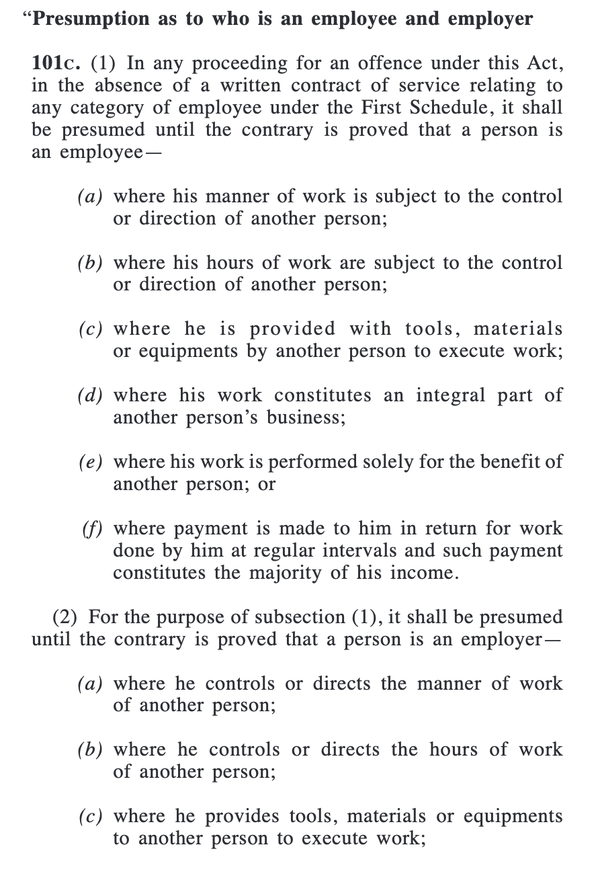
Firstly, the amendment now ensures that the Employment Act 1955 now covers all employees, regardless of income level. Moreover, it added a new section 101c to the Employment Act 1955 to define the presumptions as to who is an employer and employee. Section 101c reads as below:
Another big change is the reduction of maximum working hours per week from 48 hours to 45 hours. Speaking of which, the Amendment Act also prescribes new provisions for flexible working arrangements between an employer and their employee. This is governed under a new Part XIIc of the Employment Act 1955 below:
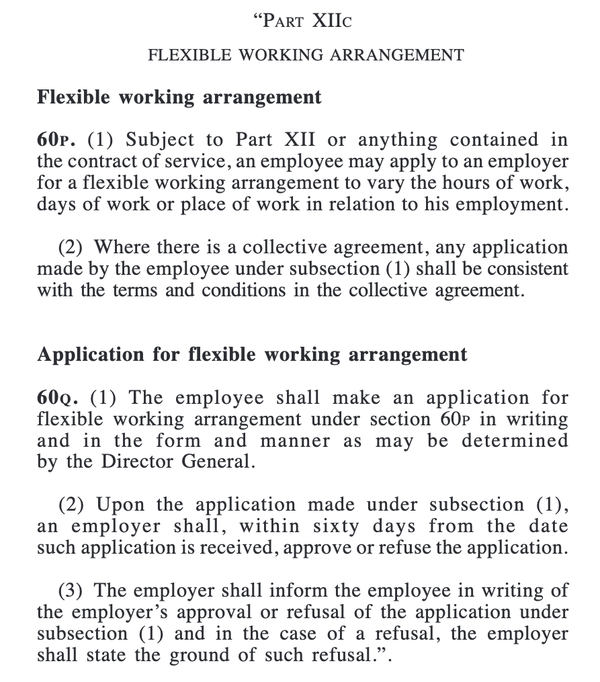
In short, employees may now apply to their employers in writing to vary their hours of work, days of work or place of work. Upon the application’s submission, the employer has 60 days to approve or refuse the application. Should the request be refused, the employer must inform the employee in writing and provide supporting documents to the reasons for the refusal or they may face legal repercussions for the refusal.
The Amendment Act also prescribes better welfare for employees that are earning RM4,000 or less per month, as they are now entitled to:
- Overtime rates when working on rest days through Section 60(3)
- Overtime rates when working outside of working hours through Section 60A(3)
- Overtime rates when working on public holidays through Section 60D(3)
- Overtime rates for working half days on holidays through Section 60D(4)
- Allowance for shift-based work through Section 60C(2A)
- Termination, lay-off and retirement benefits through Section 60J
Besides that, the Amendment Act also increased paid maternity leave from 60 days to 98 days. In relation to that, employers can also no longer terminate pregnant women or women with pregnancy-related illnesses unless it is due to either breach of contract, misconduct or closure of business.
Women are also now allowed to engage in night work or any underground work as the Amendment Act removed Part VIII of the Employment Act 1955. Previously, employers were prohibited from requiring any female employee to do night work (work in any industrial or agricultural undertaking between 10pm and 5am or commence work for the day without 11 hours of rest) and employ females in any underground work.

As for male employees, paid paternity leave of 7 days is now safeguarded for the first time ever with the insertion of a new Section 60FA in the Employment Act 1955. However, this is only applicable for up to 5 children per employee while also requiring the employee to:
- Be married to the mother of the child
- Be employed by the company for at least 12 months
- Inform the employer at least 30 days in advance
In hiring foreign employees, employers must now obtain prior approval from the Director General of Labour. Furthermore, employers must also inform the Director General within 30 days of the termination of service of a foreign employee by the employer, by the expiry of the employment pass or by repatriation or deportation. If the foreign employee’s service is terminated due to them absconding from their place of employment, the employer must inform the Director General of the termination of service within 14 days of the foreign employee’s absence.
Other noteworthy changes brought forth by the Amendment Act include:
- Employees are now entitled to their 60 days of sick leave if they are hospitalised without affecting their regular sick leave benefits
- Employers must now display notices for the awareness of sexual harassment in the workplace at all times and in noticeable spots
- Contracts between 6 to 24 months are now recognised as apprenticeship contracts instead of only contracts over 24 months
- Removing the draconic term “domestic servants” and replacing it with “domestic employees”
Increased punishment for employers that do not comply
Besides the changes and additions above, the Amendment Act also increased the punishment for several offences under the Employment Act 1955. The most notable of which is the increased penalty for employers that did not obtain prior approval from the Director General of Labour in employing a foreign employee.
According to Section 60K(5), any employer who commits such an offence shall, on conviction, be liable for a fine of up to RM100,000, or imprisonment of up to 5 years or both. In relation to that, failure to comply with any order made by the Director General is now an offence which upon conviction prescribes a fine of up to RM50,000, In the case of a continuing offence after conviction, the employer is liable to a daily fine of RM1,000.
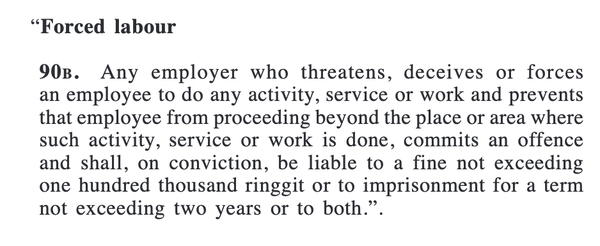
Another offence that would now incur a maximum fine of RM100,000 is in regard to “Forced Labour” under a new Section 90B. This is in regard to any employer who threatens, deceives or forces an employee to do any activity, service or work and prevents them from leaving the workplace. Besides the aforementioned fine, employers convicted of this offence are also liable for up to 2 years imprisonment or both.
The Amendment Act also increased the fine for employers that failed to inquire into complaints of sexual harassment from RM10,000 to RM50,000. Accordingly, the general penalty under the Employment Act 1955 has also increased from RM10,000 to RM50,000.
Besides that, the Amendment Act allows the Court to order employers to make any payment due to the employee in relation to a conviction by the Court. If the employer fails to comply, the employee may apply to the Court to issue a warrant to levy the employer’s property for payments due and owing to them. This is done by way of distress and sale of property or by way of a fine provided under the Criminal Procedure Code.

The lack of enforcement by the authorities
While the changes and harsher punishments introduced by the Amendment Act are definitely welcomed, they are all for nought if not accompanied by stricter enforcement by the relevant authorities. Just recently, the Malaysian Trades Union Congress (MTUC) revealed that it received various complaints from workers and unions regarding employers’ failure to abide by the Amendment Act.
As reported by NST, these include some employers trying to utilise other methods to ensure that employees spend at least 48 hours each week at the office by not paying them for their break hours. In fact, some employers even quietly changed their employees’ terms of employment without notifying them.
Therefore, the Ministry of Human Resources and relevant agencies should do more to ensure employers adhere to the Employers Act 1955 and its amendments. After all, not only must Justice be done; it must also be seen to be done.
For more insights into the Malaysian legal system such as this, do make sure to follow us on Facebook and Instagram or visit our official website. You can also read our articles on the popular Malaysian news aggregator app Newswav here.
About us

Luqman Iswatt & Partners is an esteemed law firm that delivers best-in-class legal solutions to individuals, businesses and legal entities in Malaysia and beyond. We offer ease of mind to our wide range of clients by dismantling complex legal challenges with novel solutions through exceptional legal advisory and representation.
Our distinguished partners of diverse backgrounds and expertise have achieved significantly favourable results in all levels of courts in Malaysia, from high-profile civil and criminal litigation proceedings to complex cases in which the outcomes have become binding precedents for the laws of the country. Backed by a growing team of exceptional lawyers and capable support staff, we aspire to be at the forefront of the legal sphere to satisfy our clients’ dynamic demands and ever-increasing complexity.
LIP Chambers is a content creator under the Newswav Creator programme, where you get to express yourself, be a citizen journalist, and at the same time monetize your content & reach millions of users on Newswav. Log in to creator.newswav.com and become a Newswav Creator now!
The User Content (as defined on Newswav Terms of Use) above including the views expressed and media (pictures, videos, citations etc) were submitted & posted by the author. Newswav is solely an aggregation platform that hosts the User Content. If you have any questions about the content, copyright or other issues of the work, please contact Newswav.


