
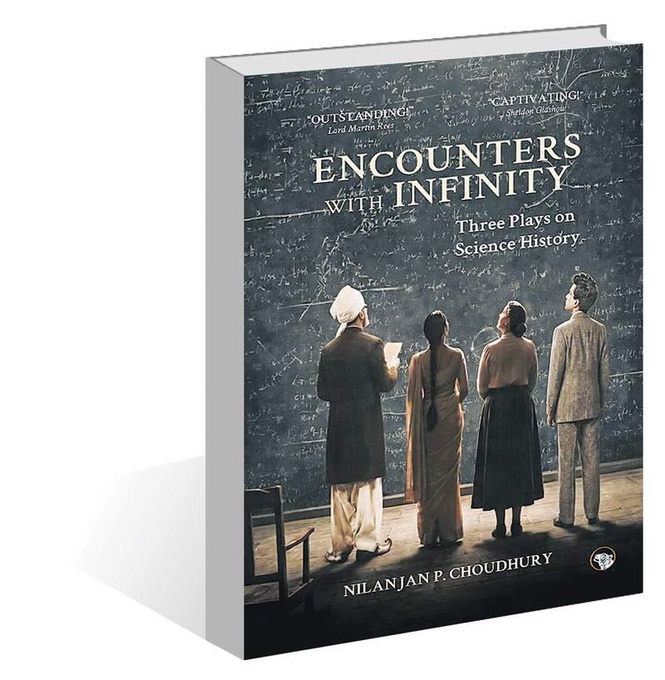
‘Encounters with Infinity’ is a pleasant and delectable collection of three plays that bring to life some of the most compelling figures in the history of modern science. Through ‘The Square Root of a Sonnet’, ‘The Trial of Abdus Salam’, and ‘Invisible Particles’, Nilanjan P Choudhury explores the lives of Subrahmanyan Chandrasekhar, Abdus Salam, Bibha Chowdhuri, and Marietta Blau. Far from being conventional biographical narratives, these plays examine the human dramas that lie behind scientific discovery, ambition, friendship, prejudice, exile, recognition, and the relentless pursuit of truth. In doing so, Choudhury demonstrates how theatre can illuminate not only scientific ideas but also the social, political, and ethical worlds in which science is practised.
The three plays have clever and imaginative narrative architecture. ‘The Square Root of a Sonnet’ is a ghost play. Chandrasekhar, Lalitha and Eddington revisit the past from an afterlife-like setting, with some flashbacks thrown in. The structure is explicitly indebted to Michael Frayn’s ‘Copenhagen’. ‘The Trial of Abdus Salam’ is a courtroom-like interrogation. The mysterious “Voice” acts as prosecutor, judge, fanatical nation, fundamentalist religion, friend and memory all at once. But who is on trial? At first glance, it appears that Salam is under inquisition. Soon, it becomes clear that it is the fanatical state (Pakistan) and fundamentalist religious orthodoxy that are under trial. The third play, ‘Invisible Particles’, is a historical reconstruction culminating in a ghostly reunion. Taken together, they form a trilogy about how knowledge and power interact.
Choudhury does not merely insert scientific facts, but skilfully dramatises scientific notions. This is the collection’s greatest strength. For example, Eddington explains relativity through tablecloths, apples and conversation. Salam’s electroweak work is linked to his philosophical and religious search for unity. Basic notions of modern particle physics emerge through Bibha and Marietta’s discussions of experiments and instruments.
Rather than being staid and serious, the scripts repeatedly use wit to prevent the narrative from becoming didactic. Chandra recalls gifting Lalitha a copy of Sommerfeld’s ‘Atomic Structure and Spectral Lines’ during their courtship. Lalitha teases him mercilessly: “You know what they call people like you these days?… Nerd. N-E-R-D.” The exchange humanises the young Chandrasekhar and gently mocks the stereotype of the socially awkward scientist. Similarly, in ‘The Trial of Abdus Salam’, much of the humour arises from the banter between Salam and the mysterious “Voice”. Although the profound issues of religion, nationalism, and scientific responsibility are addressed, the dialogue is peppered with Urdu-Hindustani repartee and self-deprecating jokes, preventing the play from becoming solemn or preachy. In this sense, humour becomes an important dramatic device in Choudhury’s hands, making difficult ideas accessible while simultaneously revealing the personalities behind them.
In ‘Science on Stage: From Doctor Faustus to Copenhagen’, Kirsten Shepherd-Barr traces the historical transformation of the portrayal of scientists on stage during the European Renaissance, from Marlowe’s ‘Doctor Faustus’ (first performed c 1592) to Ben Jonson’s ‘The Alchemist’ (first performed 1610), as seekers of forbidden knowledge who are comic, deluded, or dangerously ambitious figures. By the 20th century, science had become culturally prestigious and politically consequential. In plays such as ‘An Enemy of the People’ (Henrik Ibsen, 1882), Bertolt Brecht’s ‘Life of Galileo’ (first performed in 1943), ‘In the Matter of J Robert Oppenheimer’ (‘In der Sache’ J Robert Oppenheimer) by Heinar Kipphardt (1964), ‘Copenhagen’ (2000) by Michael Frayn, the tragic hero wrestles with moral dilemmas. Should they speak truth to power? They are victims of political forces or a tragic participant in war and destruction. The focus shifts from “Should humans seek this knowledge?” to “What responsibilities follow from possessing this knowledge?”
‘Encounters with Infinity’ takes a new turn. The dominant theme of the three plays is the politics of recognition and the historical grievances of marginalised groups. In these plays, scientists are not objects of ridicule or subjects of despair over their actions, but rather protagonists seeking recognition and representation. The protagonists are ‘outsiders’. Chandrasekhar: a colonial Indian in Cambridge struggling with betrayal and intellectual isolation. Salam: Ahmadi Muslim in Pakistan confronting the painful contradiction between scientific universalism and political exclusion. Blau: Jewish woman in Nazi Europe. Bibha: Indian woman. Both in a male-dominated scientific culture and are facing the erasure of their contributions from scientific memory. The conflicts are not between science and society alone, but between truth and recognition, conviction and compromise, ambition and justice.
In search of recognition and representation, all three plays are haunted by the fear of being forgotten. Lalitha literally carries a “box of memories” into the afterlife. Salam worries about how history will remember him and whether Pakistan will erase him. Bibha and Marietta explicitly discuss the “long list of women made invisible by history”. The book repeatedly asks: Who gets remembered? Who gets erased? Who writes scientific history?
The book repeatedly examines how institutions exclude people even as they benefit from their work. Nonetheless, Choudhury resists simplistic binaries of villains and victims. The author’s note to ‘The Square Root of a Sonnet’ reveals his effort to move beyond portraying Eddington as a mere antagonist and Chandrasekhar as a wronged hero. It explores the nuances rather than painting a simplistic black-and-white picture. This is a welcome deviation from many simplistic victim-villain narratives.
It was sometime in the mid-1980s that I first encountered Kerala Sasthra Sahitya Parishad (KSSP), which grew into one of the most influential people’s science movements in the country. For many of us committed to nurturing a scientific temper, KSSP represented a pioneering experiment in taking science beyond classrooms and laboratories and into the public sphere. What particularly fascinated us was KSSP’s innovative use of art, especially folk forms and street theatre, as a medium for public engagement. Its engagement with theatre went back to the dark days of the Emergency (1975–77), when oppositional voices were routinely branded “anti-national”, and civil liberties were curtailed. Political activists, intellectuals, and journalists were imprisoned under the Maintenance of Internal Security Act (MISA). In that climate of censorship and fear, KSSP, under the leadership of MP Parameswaran and others, turned to theatre as a vehicle for public reflection and civic resistance.
Among its notable productions was an adaptation of Bertolt Brecht’s ‘Galileo’. Audiences immediately grasped the subtext. ‘The Inquisition’ represented the authoritarian machinery of the Emergency. Galileo’s struggle against orthodoxy echoed the predicament of India’s silenced intellectuals, journalists, scientists, and social activists. Staging Galileo’s refusal to surrender truth before power became, in itself, an act of democratic defiance. Another notable play was ‘Ekalavyante Peruviral’ (‘Eklavya’s Thumb’) and ‘Visham’ (‘Poison’). These plays did far more than communicate scientific facts or popularise scientific ideas. They encouraged audiences to reflect. They raised questions about exploitation, caste oppression, gender justice, environmental degradation, public health, institutional failures, and the complex ways in which science, technology, and society shape one another.
To many of us, however, the idea was initially met with scepticism. What could a drama really achieve? Could theatre contribute meaningfully to the cultivation of a scientific temper? Science communication, as we then understood it, was properly done through lectures, demonstrations, books, and articles. Yet our doubts vanished when we witnessed these performances. The response from the audience was euphoric. The plays generated not merely understanding but reflection, debate, and emotional engagement. They transformed abstract questions into lived human experiences.
Those experiences taught many of us a lesson: theatre possesses a unique ability to illuminate the social and ethical dimensions of science. Theatre can humanise abstract concepts, embody social contradictions, and foster emotional engagement with questions at the intersection of science and society. It can reveal how scientific knowledge is entangled with power, prejudice, justice, and human aspiration in ways that conventional forms of science communication often cannot. The success of these productions led to adaptations in several Indian languages and performances across the country by the then-fledgling people’s science movements, leaving a lasting imprint on a generation of science communicators, including myself. It was therefore with a sense of familiarity and anticipation that I began reading Nilanjan P Choudhury’s ‘Encounters with Infinity’.
Whereas early modern European drama often treated the pursuit of knowledge as a potentially dangerous challenge to divine and social authority, classical Indian drama generally accepted the legitimacy of knowledge-seeking. Instead, it satirised philosophers, ascetics, and scholars when they became dogmatic, hypocritical, sectarian, or disconnected from lived experience. This tendency is evident in ‘Mattavilāsa-Prahasana’ (‘The Farce of Drunken Sport’), attributed to the Pallava king Mahendravarman I (c 7th century CE), where Buddhist monks, Kāpālika ascetics, and other sectarian figures are portrayed as comic characters whose lofty rhetoric stands in sharp contrast to their all-too-human weaknesses. Similarly, ‘Bhagavadajjukam’ (‘The Hermit and the Harlot’) employs the device of a soul-body exchange to expose the absurdities of excessive metaphysical speculation and scholastic pedantry. In these works, the dramatic question is not whether one should seek knowledge, but what kind of knowledge leads to wisdom and what happens when truth claims become instruments of authority and power.
By juxtaposing the ascetic and the courtesan, ‘Bhagavadajjukam’ destabilises conventional hierarchies of knowledge and virtue. The play suggests that wisdom cannot be inferred solely from social status, religious affiliation, or philosophical learning. Instead, it opens a space for a more inclusive understanding of knowledge, one in which claims to truth are tested through lived experience rather than accepted based on authority alone. Likewise, ‘Mattavilāsa-Prahasana’ and ‘Bhagavadajjukam’ do not attack knowledge itself; rather, they question the monopolisation of knowledge and truth by particular groups and institutions. If European drama often asks, “Should humans seek forbidden knowledge?”, in a deeply fragmented Indian society classical farces seem more inclined to ask, “Who gets to claim authority over knowledge?” and “How should claims to truth be judged?” These questions resonate strongly with contemporary concerns about scientific temper, inclusivity, and public engagement with knowledge.
Seen in this light, the scientists who inhabit Nilanjan P Choudhury’s ‘Encounters with Infinity’ appear closer to the philosophers, ascetics, and truth-seekers of ‘Mattavilāsa-Prahasana’ and ‘Bhagavadajjukam’ than to ‘Faustus’ or ‘Copenhagen’. The central tension in these plays lies not in the dangers of knowledge itself, but in the human, social, and institutional forces that shape who is recognised, who is excluded, and whose claims to truth are ultimately heard.
This fascinating, gripping, and deeply moving collection of three plays revived memories of those earlier experiments in science theatre in India. At the same time, it revealed how contemporary Indian science theatre is carving out a distinctive voice of its own. While drawing upon established traditions of science theatre, Choudhury’s scripts move beyond familiar questions of scientific discovery and its moral, ethical, and environmental implications. Across the three plays, he foregrounds issues of scientific temper, exclusion, recognition, and social justice. Equally important is his insistence on a genuinely universal vision of science, one that acknowledges the contributions of individuals across cultures, nations, religions, and genders. In doing so, ‘Encounters with Infinity’ presents science not merely as a body of knowledge, but as a profoundly human and collective enterprise, shaped by both its triumphs and its silences.
— The reviewer is a visiting professor, IISER, Mohali