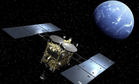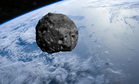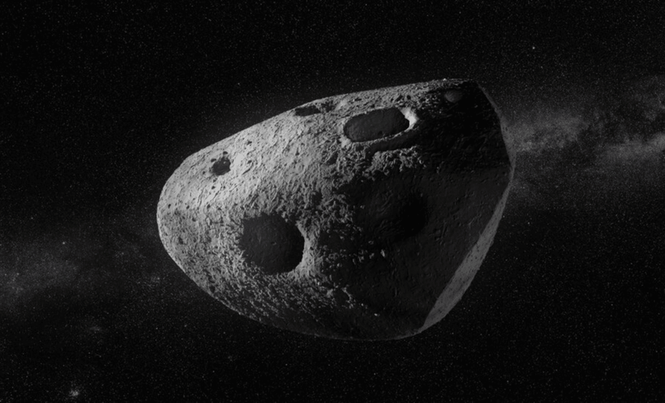
The European Space Agency (ESA) has taken a major step toward one of the most ambitious planetary defense missions ever attempted by awarding the contract for Don Quijote, the first CubeSat specifically designed to land on the surface of an asteroid. The miniature spacecraft will travel with the Ramses mission to 99942 Apophis, which will make an extraordinarily close pass by Earth on April 13, 2029. According to ESA, the mission will allow scientists to observe, from directly on the asteroid’s surface, how Earth’s gravity influences a large near-Earth object during a once-in-a-lifetime encounter.
A Once-in-a-Lifetime Opportunity to Study Apophis Up Close
The 375-meter-wide Apophis is among the most closely watched asteroids in the Solar System because of its remarkable approach to Earth in 2029. During the flyby, it will pass at an altitude of only about 32,000 kilometers, placing it closer than many geostationary satellites. Rather than viewing this event simply as an astronomical spectacle, ESA intends to transform it into an unprecedented scientific experiment by placing instruments directly on the asteroid before the encounter takes place.
“The arrival of Apophis represents a unique opportunity,” said ESA’s programme manager for Mars and Beyond, Orson Sutherland. “It is exceedingly rare for such a large asteroid – at 375 m across, about the size of a cruise liner – to pass so near to Earth. Flying past at an altitude of 32 000 km, its trajectory will take it within the orbit of our geostationary satellites.”
He continued: “It’s really a free experiment because the tug of Earth’s gravity is forecast to trigger deformation and potentially set off asteroid quakes, that Don Quijote will now be able to monitor right on the spot.”
These conditions create an opportunity that cannot be reproduced in laboratories or simulated perfectly with computer models. Scientists expect Earth’s gravitational pull to alter the asteroid’s structure in measurable ways, offering new insights into the internal properties of rocky bodies that have remained largely unchanged since the Solar System formed. Such observations could improve future planetary defense strategies while expanding our understanding of asteroid evolution.
As reported by ESA, this flyby represents one of the most scientifically valuable natural experiments expected to occur during the coming decades.
A Tiny Spacecraft Built for an Extraordinary Landing
Although Don Quijote is only about the size of a shoebox, it represents one of the most technically demanding CubeSats ever developed. Unlike conventional CubeSats operating in Earth orbit, this spacecraft must travel through deep space, navigate around a small rotating asteroid, identify a safe landing site without human intervention, survive the landing, and immediately begin conducting scientific measurements under conditions never before experienced by a CubeSat.
The spacecraft carries three major scientific instruments. The GRASS gravimeter, developed by the Royal Observatory of Belgium with EMXYS, will measure Apophis’ extremely weak gravitational field. The MARIE magnetometer, developed through the German Space Science Programme, will investigate whether Apophis possesses a measurable magnetic field and whether Earth’s magnetic environment influences it during the close approach. A third instrument, the Seismic Instrument for Asteroids (SIA) from ISAE-SUPAERO in France, is designed to perform what could become the first seismic investigation ever conducted directly on an asteroid.
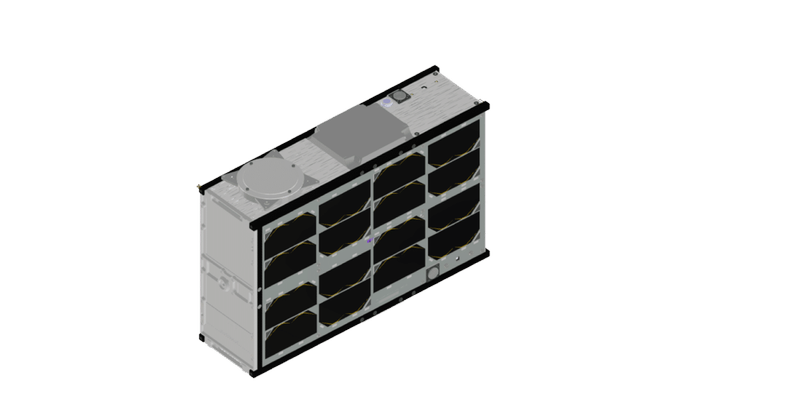
Packing all of these systems into such a compact spacecraft required significant engineering innovation.
EMXYS Chief Technology Officer Francisco García de Quirós explained: “We have to fit in all our instruments, plus the spacecraft electronics, batteries and inter-satellite links, along with eight thrusters for propulsion. At the same time we must maintain a carefully controlled centre of mass so the thrusters work with optimal efficiency as the CubeSat steers itself down to a safe landing.”
The spacecraft’s compact size is not simply a design preference. Every gram saved allows additional scientific capability while ensuring the probe can safely accompany the larger Ramses spacecraft throughout its journey toward Apophis.
Racing Against Time Before the Asteroid Arrives
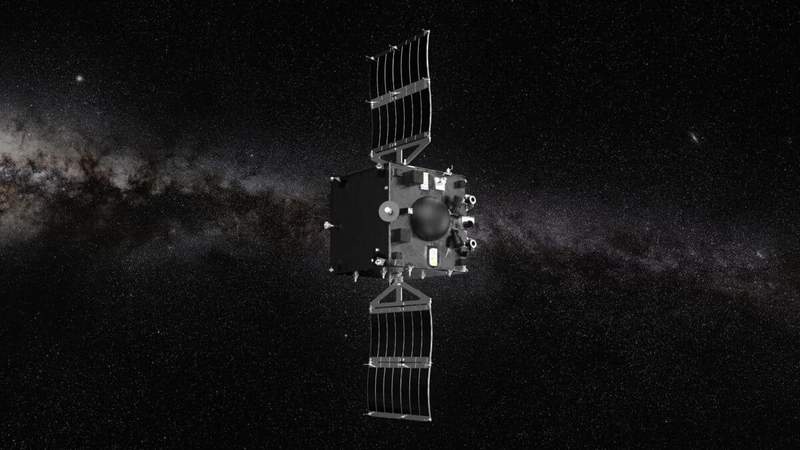
The mission faces an unusually compressed development schedule. Ramses is expected to launch aboard Japan’s H3 rocket in the spring of 2028, leaving engineers less than two years to complete spacecraft construction, integration, and qualification before departure.
To meet this demanding timeline, ESA has incorporated technology already developed for the Hera asteroid mission, which is traveling toward the Dimorphos asteroid following NASA’s successful DART impact experiment. Reusing proven hardware and mission architecture reduces technical risk while allowing engineers to focus on the new challenges posed by Apophis.
ESA’s confidence in the project increased after the final primary contract was completed.
Ramses mission manager Paolo Martino said: “Now that also the last main contract has been signed, the team can get on with implementing the mission within an unavoidably tight timescale – because the asteroid will not be waiting around for us!”
Every milestone must now be achieved on schedule because the celestial mechanics of Apophis offer no flexibility. Missing the launch window would mean missing the historic encounter entirely.
Landing on a Tumbling World With No Human Pilot
The most dramatic phase of the mission will begin once Don Quijote separates from Ramses and starts its descent toward the asteroid. Communication delays make real-time control impossible, meaning the CubeSat must complete the landing entirely on its own using autonomous navigation and feature-tracking technology.
Francesca Ingiosi, who oversees Ramses’ CubeSats, explained: “There won’t be time for sustained human oversight: Don Quijote is going to take itself down on a completely autonomous basis, relying on feature tracking to find a safe place to land. It will be running its gravimeter and magnetometer when it flies, but we have high expectations for its scientific work on the surface.”
She also described the uncertainties awaiting the spacecraft after touchdown.
“It will come down quite slowly, but in the ultra-low gravity of Apophis some bouncing along the surface is possible. The CubeSat is therefore designed to operate from any orientation, although the precise nature of the surface remains a question mark: there is even a small possibility that Don Quijote sinks into the ground, which would not be good!”
The asteroid itself introduces another layer of complexity.
“The asteroid is likely to be tumbling chaotically, and passing from local day to night should mean big temperature shifts. To maximise our surface lifetime we would want to be on a spot experiencing both day and night, to allow us to recharge our batteries without overheating. But if we did end up in sustained shadow Don Quijote also has non-rechargeable batteries as a backup power source.”
If successful, Don Quijote will become the first CubeSat ever to operate directly from the surface of an asteroid while recording how a close encounter with Earth physically reshapes one of the Solar System’s most closely studied near-Earth objects. The mission could redefine what small spacecraft are capable of achieving in deep space and provide scientists with data that no previous asteroid mission has ever been able to collect.