by Dr Victor SL Tan
Justin once struggled so badly with handwriting that he would break his pencils. An assessment placed his written expression at an extremely low level. It would have been easy to conclude that writing simply wasn't one of his strengths. His mother, Olivia, chose not to make that conclusion. Day after day, she sat beside him. She helped him practise holding a pencil, forming letters and putting words together. There was no overnight miracle—only repetition, frustration, patience and love.
After about eight months, Justin wrote his first journal entry. He began writing about his day. Then he began writing about his feelings. In time, the boy who had once struggled to put words on paper became a writer and author. His voice found its way onto the page, including in the work presented as My Voice: What I Wish People Understood.
That story has stayed with me.
Meeting the Gunawan Family
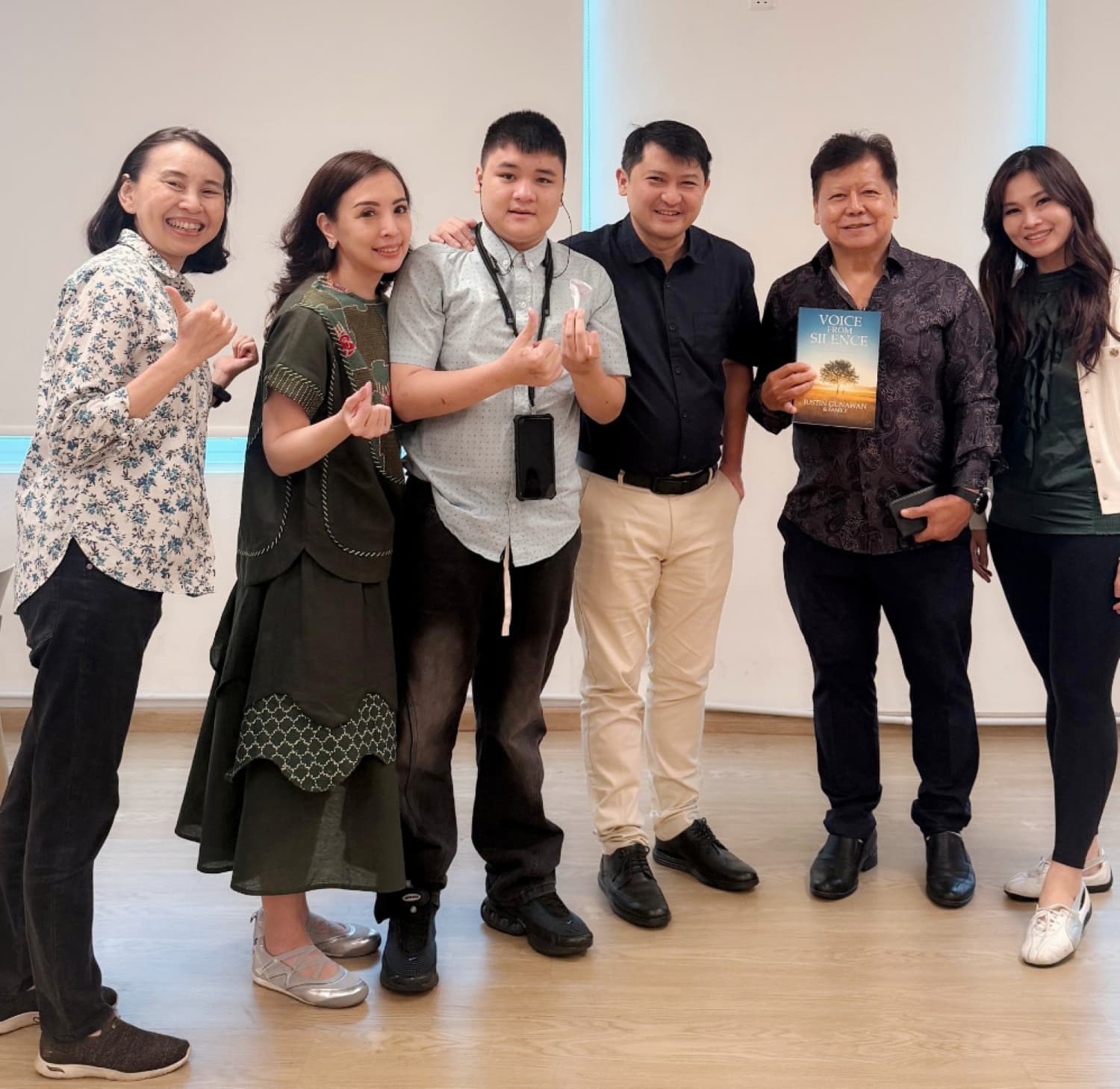
On 5 September 2026, I attended a sharing session by the Gunawan family—father Philip, mother Olivia and their son Justin. I went there as a writer, hoping to capture a story that could raise awareness about neurodivergent children and perhaps offer some encouragement to parents. I left with something more.
I was reminded that behind every diagnosis is a human being—a person with dignity, feelings, gifts and a voice waiting to be heard. This subject is personal to me. I have previously written about autism through the story of my own brother, and I know how easily society can focus on what a person cannot do.
The Gunawan family's journey reinforced something I have come to believe deeply:
A child should never be reduced to a label, a test score or a list of limitations.
Philip and Olivia began noticing developmental differences in Justin when he was around 18 months old. He lost eye contact and some of his early words. Their search for answers eventually led them to specialist help and years of intensive therapy. For a period, the family committed to about 40 hours of therapy a week.
It demanded time. It demanded money. It demanded energy. Most of all, it demanded perseverance. Yet one of the most powerful lessons I took away from their story had little to do with therapy. It was about that pencil.
The Pencil That Changed Everything
Justin's journey reminds us that sometimes an ability we cannot yet see is not necessarily absent. It may simply need more time, trust, opportunity and the right environment to emerge. Olivia could have accepted the assessment as a definition of what her son would always be able—or unable—to do. Instead, she saw it as a starting point.
Her persistence did not come from denying Justin's difficulties. She recognised them. She simply refused to believe that his present limitations necessarily represented the limits of his future possibilities. There is a lesson here that goes far beyond autism.
Human potential does not always announce itself early.
Sometimes it is hidden beneath frustration.
Sometimes beneath fear.
Sometimes beneath an inability to communicate in the way the world expects.
And sometimes it takes another human being who is willing to keep believing long enough for that potential to emerge.
Communication Is More Than Speech
Olivia shared another insight that deserves to travel far beyond the room where we gathered:
Speech is not the only form of communication.
A child may communicate through writing, typing, gestures, pictures, facial expressions or by leading someone towards what he needs. When we insist that communication must look only one way, we may fail to hear a child who has been speaking to us all along.
I was equally struck by the idea that behaviour itself may sometimes be communication. A child who screams, refuses, pushes or shuts down may sometimes be communicating:
I don't understand.
This is too noisy.
I need a break.
I need more time.
That doesn't mean every behaviour should simply be accepted. It means that before rushing to judge the behaviour, perhaps we should first ask:
What is this child trying to tell us?
That small change in perspective can make an enormous difference. Instead of asking only, "How do I stop this behaviour?", we begin asking, "What need might be behind it?" And when we understand the need, we have a better chance of helping the person.
Sometimes Love Means Waiting
One of the simplest lessons from the Gunawan family's sharing was also one of the most profound:
Ask, then wait.
Some neurodivergent children need additional time to process what has been said to them. As adults, we can become impatient.
We ask a question. When there is no immediate answer, we ask it again. Then we rephrase it. Then we add another instruction. Yet every additional sentence may restart the child's processing. Sometimes the most helpful thing we can do is stop talking. Sometimes love looks like silence. Sometimes care means giving another person the dignity of time.
The Gunawans also spoke about routines, visual schedules, preparing children before outings and helping them regulate before trying to reason with them or teach them.
These may sound like small techniques. But together they communicate something much bigger:
I will try to understand your world instead of demanding that you always fit into mine.
A Family Journey
Raising a neurodivergent child should not become the responsibility of one exhausted parent. It is a family journey.
Philip spoke about sharing the parenting responsibilities and about the importance of also giving attention to their other son, Jason. That point deserves more attention than it often receives. Siblings have needs too. They need explanation. They need inclusion. They need reassurance. And they need individual attention and love.
When a family faces extraordinary challenges, it is natural for much of the attention to go towards the child who needs the greatest support. But families become stronger when no one is forgotten. A child thrives not simply because one heroic parent sacrifices everything, but because a family learns to support one another.
Don't Just Try to Fix the Child—Discover the Child
Perhaps the deepest lesson I took away from the Gunawan family's story was the difference between trying to fix a child and trying to discover a child.
Parents naturally worry about milestones. They want their children to speak, learn, make friends, grow in confidence and eventually become as independent as possible. Professional assessments and appropriate interventions are important. But if we look only at what is missing, we may overlook what is already growing.
The Gunawan story challenges us to ask a different kind of question.
Instead of asking only:
"What can't this child do?"
Perhaps we should also ask:
"What strength is waiting to be discovered?"
Justin's journey from a child who struggled to communicate and broke pencils to a young writer is not a promise that every neurodivergent child will become an author.
That is not the point.
Every child has a different journey.
The point is that every child has potential—and potential often reveals itself in unexpected ways when surrounded by patience, encouragement, structure, opportunity and love.
To Parents Who Are Worried About the Future
To parents who are exhausted, worried or afraid about what the future may hold, I hope the Gunawan family's story gives you courage.
You don't have to be a perfect parent. You need to remain present. You need to keep learning. And, perhaps most importantly, you need to keep seeing the child beyond the diagnosis.
Your child's journey may not look like another child's journey. Progress may come differently. Communication may come differently. Strengths may emerge where you least expected them. And sometimes what appears today to be a limitation may simply be an ability whose time has not yet arrived.
The Responsibility Belongs to All of Us
The responsibility, however, doesn't belong only to parents. It belongs to all of us.
We need homes, schools, churches and communities where neurodivergent children are not hidden, pitied or dismissed. They should be welcomed.
They should be included. They should be given opportunities to participate, contribute and grow. Most of all, they should be treated first as human beings—not diagnoses.
Every child has a voice. That voice may come through speech. It may come through writing. It may come through movement, gestures, pictures or expressions. It may take longer than we expect to emerge.
Our task is not to decide what that voice should sound like.
Our task is to listen long enough, love deeply enough and believe patiently enough for that voice to emerge.
Dr Victor SL Tan is the Chief Executive Officer of KL Strategic Change Consulting Group. He is an author 21 books including Changing Mindsets, Releasing Trapped Minds, Changing Your Corporate Culture and Lessons of Tan Sri Teh Hong Piow (the late founder of Public Bank Berhad). KL Strategic Change Consulting Group is the winner of The Brandlaureate Award for the company that makes the most positive and profitable impact on organisations through corporate training. For further information he can be contacted at victorsltan@klsc.com or 0123903168.
Dr Victor SL Tan (victorsltan@klscc.com) is a content creator under the Newswav Creator programme, where you get to express yourself, be a citizen journalist, and at the same time monetize your content & reach millions of users on Newswav. Log in to creator.newswav.com and become a Newswav Creator now!
The User Content (as defined on Newswav Terms of Use) above including the views expressed and media (pictures, videos, citations etc) were submitted & posted by the author. Newswav is solely an aggregation platform that hosts the User Content. If you have any questions about the content, copyright or other issues of the work, please contact creator@newswav.com.