"Taiwan's AIDC supply chain is the most complete in the world, and its pace of development is the fastest."
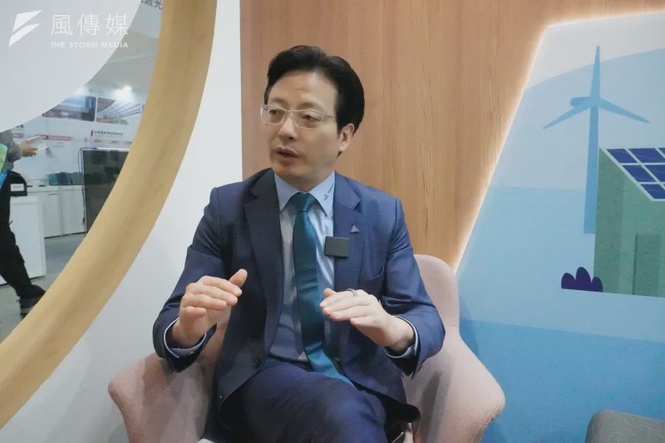
Taiwan has the world's most complete supply chain for AI data centers (AIDC), and the island is set to lead every other market as demand for the facilities soars, TÜV Rheinland Senior Vice President Li Wei-chun told Storm Media in an exclusive interview on October 14.
The German testing and certification group is preparing a white paper on technology development and quality issues across the AIDC industry chain to map its risks and the need for standards, Li said, adding that many of the technologies now being deployed still have none.
The interview took place on the sidelines of Energy Taiwan and Net-Zero Taiwan, two co-located trade shows held October 14 to 16 at the Taipei Nangang Exhibition Center, where exhibitors focused on power infrastructure, smart energy management, and system integration as global demand for AI data centers climbs. The conversation centered on the standards and certification hurdles Taiwanese suppliers face as they expand into global markets.
Li is senior vice president of solar and commercial products services for Greater China and senior vice president of the global power electronics business at TÜV Rheinland. His division covers solar, energy storage, fuel cells, new materials, semiconductor chip components, and power stations.
He said the explosive growth of AI has made AIDC demand "very large" and development "very fast." TÜV Rheinland has committed substantial staff, resources, and research to the field over the past year or two and will make it a priority going forward, he said.
White Paper Targets Risks In An Early-Stage Industry
Li said the AIDC sector as a whole is still in its infancy, with technology, project execution, standards, and solutions all immature. "There are many opportunities, but also many challenges and difficulties," he said. "We hope that by preparing this white paper, we can lay out the entire industry chain clearly."
The paper is expected to cover where the industry is heading, how projects are carried out, the technologies used, and emerging risks and how to avoid them, he said. He hopes it will become "a document that can serve as guidance." TÜV Rheinland said the white paper is expected next year and its title has not been finalized.
According to a profile provided by TÜV Rheinland, Li's expertise spans photovoltaics, energy storage, electric vehicle charging, hydrogen, and power supply and safety verification for AI data centers. He is also involved in drafting several white papers, still in progress, on new energy and AIDC technologies, covering power supply, power distribution, liquid cooling, solid-state transformers, and energy storage.
Asked why the company is acting now, Li said TÜV Rheinland steps in early when new industries and technologies emerge. "Our hallmark is that we get involved early," he said. "As a globally authoritative third party, we can support an industry's healthy development, and in return we earn recognition [from the industry], and our value can be demonstrated."
Because testing and certification is TÜV Rheinland's core business, the white paper and the standards it helps set are directly tied to the services the company sells.
Solid-State Transformers And 800V Parts Lack Standards
As AI computing power rises, AIDCs consume far more electricity than conventional data centers, and leading companies already recognize the need to upgrade the technology, Li said. Among the more mature options are high-voltage direct current (HVDC) systems and solid-state transformers (SST), he said, with SST "the most widely recognized" and the likeliest to better support AIDC power supply in the future.
But he said standards are missing. "Whether it's SST or HFT [high-frequency isolation transformers], or all the materials and components for 800 volts or medium voltage, including cables and connectors, as well as liquid-cooling equipment and components, none of them has standards," Li said.
The industry needs standards to scale up, bring costs down, and improve quality and reliability, he argued, and TÜV Rheinland will set them so the industry has "standards to follow." Asked which risk is most underestimated, he did not single out any one risk, instead stressing that the lack of standards across these technologies is a priority for the company.
In a post on its Greater China blog, TÜV Rheinland outlined "2 PfG 3175," its own safety evaluation specification for AI power supplies, which draws on parts of the IEC 62477-2 and UL 2877 standards. The company's SST service page lists the specification among those applicable to evaluating SSTs and other new technologies, and TÜV Rheinland offers test reports and TÜV Rheinland Test Mark services.
Li Ranks Taiwan's AIDC Supply Chain First Worldwide
Asked which country has the most AIDC potential, Li said markets everywhere are hot, but "being hot and being able to take off are different things." He named Europe, the United States, China, the Middle East, and Southeast Asia as the main application markets, while the supply chain serving them still relies mainly on Taiwan.
China's market is large and its technology is advancing quickly, he said, and the dominance of its leading players "will also be very obvious." But its supply chain lags Taiwan's in maturity and pace of development. On industrial completeness and sophistication, "Taiwan should be ahead," he said.
"Taiwan's AIDC supply chain is the most complete in the world, and its pace of development is the fastest," Li said, naming Nvidia, Taiwan Semiconductor Manufacturing Co. (TSMC), Quanta Computer, and Delta Electronics as leaders at various stages of the chain. He expects Taiwan to "be ahead of every market in the world" in AIDC, though the key application markets will remain the United States, China, and Southeast Asia.
The Market Intelligence & Consulting Institute (MIC), the research arm of Taiwan's Institute for Information Industry, said at an April 29 forum that Taiwanese manufacturers already have broad coverage of the liquid-cooling supply chain and are investing in new data center power technologies, including battery backup units (BBU), HVDC, solid oxide fuel cells (SOFC), and SST. MIC also urged Taiwanese server makers to move from hardware shipments to becoming AIDC integrated solution providers and to consider entering other countries' AIDC markets.
Asked about U.S. and European regulatory concerns over the Chinese market, Li did not address regulation directly. The global market is large, he said, and "every market is actually open." What matters is not a market's size or openness but whether AIDC infrastructure can become stronger and whether power efficiency and supply can keep up with computing demand, he said. "The most important thing is to use the most advanced and best technology, with safe, reliable, high-quality solutions, to support and serve the industry."
Li said his trip to Taiwan was for AIDC projects and gave him a chance to meet leading companies up close and understand their needs and the difficulties of deployment. He has met several companies, described the exchanges as "very thorough," and said broader and even closer cooperation is possible.
He described Taiwan as a key market where advanced applications, and the problems of deploying them, surface first, and said solving those problems through commercial partnerships would be "the fastest" route. TÜV Rheinland has operated in Greater China for 40 years, he said, and plans to consolidate its Taiwan resources to serve customers faster and more closely.
Social Media Links & Editor Tag - Penny