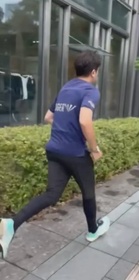
Taiwan's opposition Kuomintang (KMT) now accepts that the "Yang Wave" lifting Democratic Progressive Party (DPP) Taipei mayoral candidate Puma Shen is real, and Taipei Mayor Chiang Wan-an's camp has dropped its low-key campaign in favor of an all-out blue-versus-green fight, according to KMT campaign officials interviewed by Storm Media.
Shen, whose Chinese given name is Po-yang, was written off as a long shot when the DPP nominated him. Since mid-September, an online craze nicknamed "Yang Wave" (a pun on the Chinese word for ocean current and the "yang" in his name) has pulled him close to Chiang, who had been widely expected to cruise to a second term. With the November 28 local elections less than two months away, the DPP is pushing the phenomenon hard, hoping it can rival the "Han Wave" that carried KMT politician Han Kuo-yu, now Taiwan's legislative speaker, to the Kaohsiung mayor's office in 2018.
The KMT's first reaction was contempt. Party officials and lawmakers dismissed the buzz as a morale-boosting stunt by a struggling campaign, and one KMT campaign aide predicted it would end in embarrassment for Shen. That view has now been revised after the party's campaign team pooled reports from its local organizations, public opinion data, grassroots feedback and polling.
Chiang's Camp Scraps Its Cautious Playbook
Chiang's team has accepted that the gap with Shen has narrowed and that the cool-headed strategy it used until now is finished, sources said. The consensus among his advisers is that a hot campaign cannot be avoided. They plan to frame the race as blue against green to push out as many KMT and Taiwan People's Party (TPP) voters as possible.
To keep Shen from winning over centrist and light-blue voters with his calm, rational image, the KMT also plans an air campaign aimed at stripping away his polish. It will revisit what the party says were Shen's extreme remarks during the 2025 mass recall campaign, when, KMT officials allege, he cast blue-camp supporters as local collaborators of the Chinese Communist Party. The goal is to make Taipei residents ask which Shen is the real one. The message the party wants voters to take away: "A year ago he was like Satan, and now, for the election, he has turned into an angel."
People close to Chiang said he will keep his current pace: promoting four years of city administration and debating Shen's policy proposals directly. He will not stop campaigning for allies in tight races outside Taipei, including New Taipei City, Yilan County, Hsinchu County and Taitung County.
Wang Wei-chung Interview Pushed KMT To Rethink
The turning point, KMT officials said, was Shen's appearance on a program hosted by the pan-blue-leaning broadcaster Wang Wei-chung, which drew 3 million views in about two weeks and sent his online profile soaring. Shen's walkabouts at night markets and traditional markets in Shipai, Gongguan and Jingmei then drew large crowds who followed him and took photos. The slogan that party officials had treated as a DPP talking point was turning into political momentum both online and on the street.
The KMT's conclusion is that the phenomenon is real, though one rooted mainly in a highly energized Green base. Several KMT city councilors sent young aides to Shen's events to see for themselves. They all reported the same routine: a core of supporters crowds around him, waving small flags and shouting "dongsuan," Taiwanese slang for "he will be elected," which draws in passersby and makes the scene look packed.
The wider ring of onlookers, which outsiders often count as part of the wave, was noticeably cooler, the aides said, and many were there out of curiosity. A KMT councilor from the Neihu and Nangang area said that coming out to feel the excitement is not the same thing as voting for Shen.
Han Wave Was A Tsunami, Yang Wave Is Still Contained
KMT campaign officials who worked through the 2018 Han Wave say the comparison flatters Shen. Han broke through class lines and the KMT's traditional boundaries with appeals such as "don't forget the many suffering people in the world" and "get rich," at a time when voters were broadly fed up with the DPP. Working-class voters, stall owners, centrists and even light-green voters came out on their own, and some who had never followed politics publicly backed him.
In Kaohsiung, one official recalled, thousands upon thousands of people gathered wherever Han went without any mobilization, and endless "snake" convoys of motorcycles stretching for kilometers followed him through the streets. The scale left the DPP, its friendly media and its commentators angry, baffled and short of answers. Aides to Han were there to hold back crowds pressing in from every direction, while Shen's fans are there to build the atmosphere around him, the Neihu and Nangang councilor said.
The Yang Wave, by contrast, began largely as an online creation of Shen's most loyal backers, the pro-Green "Black Bear" and "Bluebird" camps, KMT officials said. They argue that Shen is running a positive, rational campaign this time, yet many Taipei voters still remember how he painted opponents of the DPP as sympathizers of Beijing during the 2025 recall. His camp has also offered no compelling vision, the officials said, mainly attacking Chiang's record on rats and what it calls a "hell for women and children," charges that please committed Green voters but do not match the everyday experience of many city residents and could backfire.
Shen Likely Clears 40% But Faces A Hard Ceiling
A veteran KMT campaign figure said the party's own tracking shows Chiang's lead over Shen has clearly shrunk. When Shen was first nominated, he trailed by more than 10 points, and many in the DPP doubted he could match the 35.89% that former Executive Yuan Secretary-General Lee Ying-yuan won in 2002 against then incumbent Taipei Mayor Ma Ying-jeou, who later became president. The KMT initially believed Shen would struggle to reach 40%, "at best between 37% and 39%."
That has changed. "Chiang's support trend is relatively stable and the decline is not significant," the KMT figure said. "The main reason is that Shen is rising, because Green voters have been encouraged by the Yang Wave effect to speak up." In the party's assessment, the wave has done its job of consolidating the DPP's base in Taipei, which it puts at about 35%, and Shen should now clear 40%.
Whether he can break through the 43.81% that former Premier Su Tseng-chang won against incumbent KMT Mayor Hau Lung-pin in 2010 depends on whether the wave crosses the Green echo chamber and wins over centrist and light-blue voters, the official said. A person close to Chiang put the DPP's base ceiling in Taipei at around 43%, and said breaking it will be extremely difficult once blue voters feel the danger. So far, the KMT sees no sign of the kind of cross-party emotion that defined 2018.
Councilors Say The Wave Is Mobilizing Blue Voters
A senior KMT campaign official said the greater danger is apathy in the blue camp rather than the Yang Wave itself. Grassroots interest in the local elections has been low since the 2025 recall campaign, and supporters in the comparatively safe cities of Taipei, New Taipei, Keelung and Taoyuan have been especially relaxed. Chiang and Taoyuan Mayor Chang San-cheng have played down the campaign, and even KMT New Taipei candidate Lee Szu-chuan has been more defensive than aggressive. The party worries that turnout could be so weak that it loses not only mayoral races but also several city council seats.
The official said that by hyping the wave, the DPP is helping the KMT, because it stirs a sense of crisis that spreads from core blue voters to ordinary residents who like Chiang. The official called the DPP's haste a strategic error, and accused pro-Green voters of repeating the bullying of opponents they showed during the 2025 recall, when they believed victory was certain. There is also talk among Green supporters of insinuating questions about Chiang's family background, the official said, which would only anger blue voters and strike centrists as going too far.
KMT councilors in Taipei say they feel the shift most. One sitting councilor said that a month ago voters were indifferent and would say "you're safe, relax." Now many voters volunteer that "Chiang Wan-an is in danger," ask the councilor to defend him strongly, and promise to call relatives living elsewhere back to vote. One voter even postponed a planned November 28 trip abroad by a day after hearing Shen might threaten Chiang. All KMT council candidates, including those aligned with the TPP, are beaming, the councilor said: "The more the Yang Wave is hyped, the bigger the free get-out-the-vote effect."
New Taipei Faces The Biggest Spillover Risk
Chiang's allies say the Yang Wave's reach beyond Taipei is the bigger worry, especially in neighboring New Taipei City, just across the river, where blue and green are tightly matched. DPP candidate Su Chiao-hui could gain in her home districts of Tucheng, Shulin and Yingge, they said, while the Green lead in Xinzhuang and Sanchong, where the vote already leans Green, could widen. That would put more pressure on Lee.
A senior KMT campaign official argued that Lee must adjust his strategy to match Chiang's and create a blue-versus-green contest across both cities, so that Shen and Su can no longer play down their DPP colors and run as moderates. Once KMT grassroots supporters feel the danger and mobilize, the official said, the DPP will have to keep stoking the wave. That would sharpen the divide between blue and green voters and, in the official's view, encourage pro-Green supporters who treat the KMT as an enemy to show their more extreme side, repeating the backlash that turned centrists against them during the 2025 recall.
KMT Eyes Kaohsiung If DPP Shifts Resources To Taipei
A former KMT party official said the DPP nominated Shen mainly to tie down Chiang, the KMT's top campaigner, rather than to win Taipei. But now that Green voters have invested real hope in the Yang Wave, the party will be forced to redirect resources to Taipei or risk disappointing his supporters. That would mean abandoning its original plan to attack New Taipei while defending Kaohsiung, and the KMT could use the opening to push harder in Kaohsiung.
The former official added that if both camps shift their focus to Taipei, New Taipei and Keelung, media and public attention will follow. Given its solid candidates and a base that leans blue by a small margin, he assessed that the KMT would hold a slight edge in those contests.
Insiders Compare The Race To 2010, Not 2014
Many in the KMT are debating whether this year's mood resembles 2014, when the party suffered a rout in the local elections, or 2010, when it narrowly prevailed in the five special municipality mayoral races after a grueling fight. The former party official, who has helped run several presidential campaigns, would not say the result will match 2010. But he argued that Chiang is clearly stronger than Lien Sheng-wen, the KMT's Taipei candidate in 2014, and that Shen lacks the momentum former Taiwan People's Party Chairman Ko Wen-je had in his first run that year.
He also said Su's personal appeal in New Taipei falls short of what former President Tsai Ing-wen had in 2010, while Lee is roughly on par with Eric Chu, the former KMT chairman who narrowly beat Tsai that year. There is reason to believe, he said, that the double contest in Taipei and New Taipei will end differently from 2014.
Social Media Links & Editor Tag - Penny