
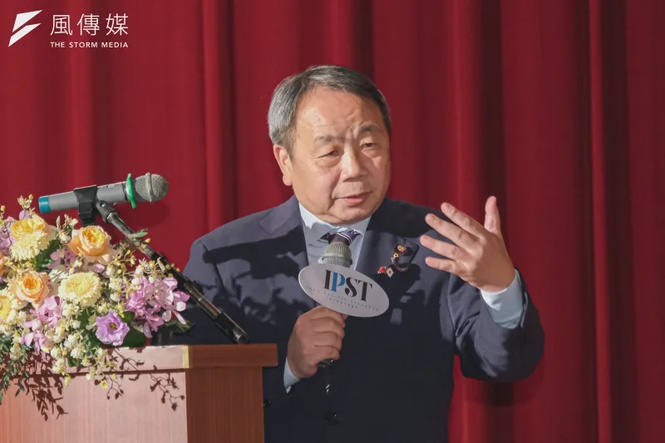
Seki Hei, a China-born Japanese lawmaker from the ruling coalition partner Japan Innovation Party (Nippon Ishin no Kai), told Storm Media in an exclusive interview that a cross-party group of Japanese legislators has completed a first draft of a Japanese version of the Taiwan Relations Act and plans to submit it to the Diet no later than the ordinary session that opens in January 2027.
Seki, a member of the House of Councillors and a longtime critic of the Chinese Communist Party, also said he will use the Diet's foreign affairs and defense committee to openly call for a review of Japan's Three Non-Nuclear Principles. He argued that Taiwan has no reason to panic over Beijing's military pressure, citing sweeping purges inside the People's Liberation Army (PLA), the natural barrier of the Taiwan Strait, and the global importance of Taiwan Semiconductor Manufacturing Co. (TSMC).
A Japanese Taiwan Relations Act Moves Toward The Diet
Seki said the United States has kept up normal exchanges with Taiwan since ending formal diplomatic ties in 1979 because of its Taiwan Relations Act, while Japan, though equally a country governed by the rule of law, has no comparable legislation. That gap, he said, leaves Tokyo and Taipei facing many off-limits areas in defense cooperation and in planning for a "Taiwan contingency."
He declined to disclose details of the draft. The next step, he said, is to present it to lawmakers across parties, explain the motive behind it, gather feedback, and revise the text to build the broadest possible support. Because the extraordinary Diet session convened in October leaves little time, the group intends to table the bill in the ordinary session starting in January 2027 at the latest.
Seki said a crisis in Taiwan would involve the protection and evacuation of roughly 20,000 Japanese nationals living there, disaster cooperation, and the stability of the Taiwan Strait. Mechanisms cannot be improvised once trouble begins, he said; regular, institutionalized consultation channels must exist in peacetime, and that urgently requires a legal basis in Japan.
The Cross-Party Caucus Behind The Bill
The bill is being driven by the Parliamentary Group for Considering Peace and Stability in the Taiwan Strait, a cross-party caucus formed in the Diet on June 15, 2026. It is chaired by Haruo Kitamura, a House of Councillors member from the Conservative Party of Japan, with Seki serving as secretary-general.
Its members span four parties in and out of government: the Conservative Party of Japan, the Japan Innovation Party, the Democratic Party for the People, and Sanseito. They include upper house members Yoshihiko Yamada of the Democratic Party for the People and Mizuho Umemura of Sanseito, as well as Japan Innovation Party lower house members Kaoru Nishida, Mitsuhiro Yokota, and Keie Miki. The group says its aims are to respond to shifts in the Taiwan Strait, break through longstanding official taboos to deepen practical Japan-Taiwan security cooperation, and enact the Japanese Taiwan Relations Act as its top legislative goal.
Seki first visited Taiwan alone in January 2026, after Beijing sanctioned him, to show that while he cannot enter the People's Republic of China, he can travel freely to the Republic of China. President Lai Ching-te responded at the time with remarks affirming that the two sides of the Strait are not subordinate to each other. In early September, Seki returned with the caucus for a four-day visit, meeting Lai, Defense Minister Wellington Koo, National Security Council Secretary-General Joseph Wu, Ministry of Foreign Affairs officials, and Democratic Progressive Party legislator Wang Ting-yu, a convener of the Legislative Yuan's Foreign Affairs and National Defense Committee.
Seki Says Xi's Purges Have Hollowed Out The PLA
Taiwan must stay alert and keep strengthening its defenses, Seki said, but excessive anxiety is unwarranted because an attack would be far from easy for Beijing. He pointed to Russia, which he described as the world's second-ranked military power and a nuclear state, yet one that has failed to conquer Ukraine after four to five years of fighting across open plains with no natural barriers. As long as Ukraine fights bravely, he said, the world supports it, and Chinese President Xi Jinping has surely noticed that lesson and cannot be confident of victory.
Taiwan, by contrast, sits behind more than 100 kilometers of open water, and its military is no weaker than Ukraine's, he said, and arguably stronger than Ukraine's was before the war. Seki said Xi's purges of recent years have sent most of the PLA's combat-capable senior officers to prison. In the PLA Rocket Force, which would spearhead any attack on Taiwan, "every single commander was arrested; not one was left," he said.
According to Seki, the force was at one point in early 2026 left without a commander, and the Eastern Theater Command, which oversees the front facing Taiwan, has also seen its commanders detained one after another. He said successive heads of the Central Military Commission's Equipment Development Department and its predecessor, which oversee weapons procurement, from Zhang Youxia to Li Shangfu and the officer who followed, have all been taken down. That suggests half or more of procurement budgets for aircraft carriers, fighter jets, tanks, and submarines may have been lost to graft, he said, leaving serious doubts about the quality of the PLA's equipment.
TSMC And US Stakes Make A Blockade Costly
"As long as the Taiwanese people have a firm resolve to defend their own country, I think Taiwan should be fine," Seki said. He noted that TSMC, often called Taiwan's "sacred mountain that protects the nation," makes even a blockade costly for Beijing: if chips could not leave the island, America's high-tech and defense industries, which rely heavily on TSMC, would be the first to react, and the world would not stand for it.
Quoting Mao Zedong's maxim to "despise the enemy strategically, but take him seriously tactically," Seki urged Taiwan to prepare thoroughly at the tactical level while keeping strategic confidence and refusing to be intimidated by China.
He said Xi cannot be sure whether the United States would intervene militarily, and that uncertainty itself is a powerful deterrent. Any clear-headed US president would help Taiwan, Seki argued, because if Taiwan were absorbed by China, America's standing as a world power and its defense architecture in Asia would collapse.
Japan Would Act Alongside US Forces, Not Alone
On the idea that a Taiwan emergency is also an emergency for Japan, Seki said it is not legally viable for Japan to send its forces to defend Taiwan on its own, citing both constitutional limits and questions of capability. The most likely scenario, he said, is joint operations with the US military. Once US forces are deployed, Japan would be obliged to act under the Japan-US alliance, the legal category of a "survival-threatening situation," and the right of collective self-defense.
Seki Will Press To Review Japan's Non-Nuclear Principles
Seki said that since the Japan Innovation Party joined the governing coalition, Japan has moved past its taboo on weapons exports and lifted defense spending well beyond the old ceiling of 1% of GDP. The party's next goal, he said, is to revise Japan's three core national security documents. He also plans to lead off in the foreign affairs and defense committee by publicly proposing a review of the Three Non-Nuclear Principles, Japan's postwar pledge not to possess, produce, or permit the introduction of nuclear weapons.
Japan is surrounded by nuclear-armed "rogue states," China, North Korea, and Russia, he said, and the purpose of nuclear weapons is deterrence. "If you have nuclear weapons, others will not dare use them against you. If you don't, others can blackmail and bully you," Seki said, adding that he is not afraid of criticism and is determined to raise the issue formally in the Diet.
Seki also described a shift in Japanese politics. Some Liberal Democratic Party lawmakers, he said, have compromised with China on economic matters out of concern for business groups whose corporate donations they accept, because "those who take gifts have soft hands and soft mouths." The Japan Innovation Party has refused corporate donations from the start, he said, so it is "neither soft in the mouth nor soft in the hand" and will not bow to pressure from Beijing.
In the 1980s, about 80% of Japanese people felt favorably toward China, Seki said; today the figure has flipped, with about 80% holding negative views. No one in Japanese politics now dares to be openly pro-China, he said, and those who are must act quietly, while calls to stand up to China and strengthen defense enjoy broad public support. "The Japanese public has woken up," he said.
Seki Pushes For An Anti-Espionage Law
Seki called Japan's lack of an anti-espionage law highly abnormal. The National Intelligence Agency established in 2026 under Prime Minister Sanae Takaichi is only a beginning, he said, and an anti-espionage law must follow. He suggested that if Japanese citizens could see the activities of Chinese secret police or spies in Japan, it would help the bill advance, and he challenged fellow lawmakers directly: "If any lawmaker opposes an anti-espionage law, aren't you admitting that you are a spy?"
Beijing's Sanctions Are A Badge Of Honor, Seki Says
China's Foreign Ministry placed Seki on its sanctions list in September 2025, freezing any assets he holds in China and barring him from entry. He laughed off the move, noting that US Secretary of State Marco Rubio, who was sanctioned by Beijing while still a senator, and Japanese lawmaker Keiji Furuya have also been targeted, and that none of them hold assets in China. Beijing did not dare block Rubio when he later accompanied President Donald Trump to China, Seki said, calling the sanctions farcical, unlawful, and a display of the Communist regime's thuggish nature.
He likened the sanctions to a medal that has raised his profile in Japanese politics, and he often half-jokingly encourages colleagues to criticize Beijing: "Once you're sanctioned, you don't have to worry about the next election." When he met Joseph Wu, who has also been sanctioned by China, during his September trip to Taiwan, the two joked about founding a "Sanctioned Club."
From Chengdu To Japan's Upper House
Born in Chengdu, in China's Sichuan province, in 1962, Seki graduated from Peking University's philosophy department in 1984 and moved to Japan to study in 1988. He earned a master's degree in education from Kobe University in 1991 and completed doctoral coursework there before becoming a naturalized Japanese citizen in 2007.
Before entering politics, he was a prominent commentator and author on international affairs, writing extensively on the Chinese Communist Party and Japan-China relations. In 2014 he won the 23rd Yamamoto Shichihei Prize for a book arguing that Japan fares better when it distances itself from China. In July 2025, he was elected to the House of Councillors on the Japan Innovation Party's national proportional representation list.
Original Article In Chinese: 專訪》破「台灣有事」時諸多禁區 中國出身日本國會議員石平出招