
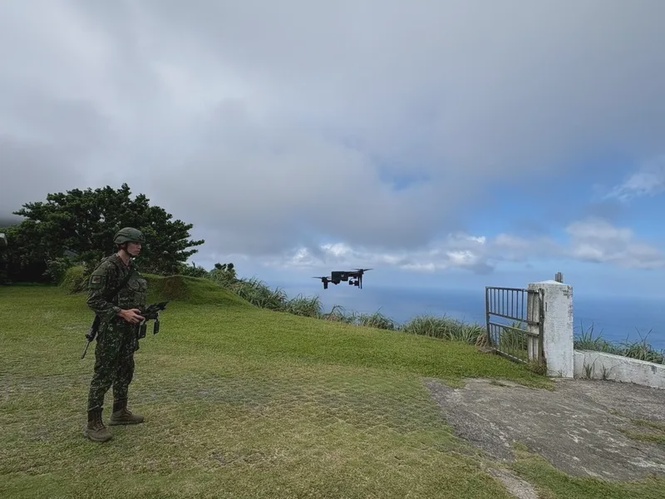
Taiwan's armed forces have poured money into unmanned aircraft for asymmetric defense. On the other side of the same fight — stopping the other side's drones — the picture is far less reassuring. Defense and intelligence sources now warn that Taipei risks falling into what they call an "anti-asymmetric trap": spending scarce funds on expensive, low-volume counter-drone systems that cheap, mass-produced attack drones can still overwhelm.
The warning is no longer theoretical. A domestic contractor that won a nearly NT$988 million contract to protect outlying islands and key bases has failed three consecutive acceptance tests. The Ministry of National Defense has moved to cancel the deal and retender. At the same time, the ministry has separately planned a much larger buy of U.S.-style man-portable jammers — a purchase military sources inside the system say may be too costly, too thin on the ground, and poorly matched to the People's Liberation Army's drone inventory.
Combat in Ukraine and in the Middle East has already shown that small unmanned aircraft can change a war between unequal powers. Taiwan's Han Kuang Exercise No. 42, held in 2026, put drone combat at the center of the drill. What has not been settled is whether the island's counter-unmanned aerial system (C-UAS) plan can survive contact with a PLA drone force built for volume, rapid software updates, and saturation.
A Real-World Test the Homegrown System Could Not Pass
Taiwan has been building C-UAS in three layers: fixed-site emplacements, vehicle-mounted mobile systems, and man-portable kits for troops. The cancelled contract covered the first layer — 26 fixed-site systems intended for Kinmen, Matsu, Penghu, and military installations on Taiwan proper.
The winner was Tron Future Tech Inc., a Hsinchu-based startup. In January 2025 it was awarded the Army contract at NT$987.81 million. According to a military source, the Army's minimum threshold was operational, not decorative: detect small, low-flying drones at six kilometers, and jam multiple incoming aircraft at four kilometers — ranges calibrated against Ukraine's battlefield, not a brochure.
The system never cleared that bar. After delivery, it failed acceptance testing and two retests. A separate military source said that when the soft-kill jammer was run against only ten Chinese-made drones in a low-intensity saturation profile, it was overrun and judged to have failed its defensive mission. The Army has sent the result to the defense procurement office and begun contract termination.
The embarrassment is real. The surprise, analysts say, should not be. The United States, European NATO members, and Israel are still searching for reliable ways to stop swarms of small loitering munitions. A company designing in isolation, without live combat data, was always unlikely to succeed where much larger programs have struggled. Reliability and effectiveness, one intelligence source said, matter more than novelty. Buy a warehouse of systems that do not work, and the bill comes due in the opening hours of a war.
Why Losing the Counter-Drone Fight Threatens Force Preservation
China is the world's dominant drone power. The PLA has treated unmanned warfare as a core combined-arms tool for more than a decade. In a cross-strait campaign, the ability to throw drones across every size class — from micro FPV aircraft to large reconnaissance and strike platforms — would aim directly at Taiwan's ability to keep forces alive through the first wave.
If front-line units cannot shield themselves, missile transporter-erector-launchers, self-propelled artillery, radar sites, and airfields can be attrited before a coherent defense is organized. Force preservation is not a supporting task in Taiwan's concept of protracted resistance. It is the concept.
Soft-Kill Alone Cannot Stop Fiber-Optic Drones or a Swarm
Military analysts describe a clean split. Soft-kill systems find a drone's radio signature and try to jam, spoof, or seize the control link. Hard-kill systems physically destroy or disable the aircraft — guns, nets, interceptors, lasers, high-power microwaves. A serious architecture needs both. Taiwan's current path, sources say, leans too far toward soft-kill, in part because that is the American preference.
That preference is a poor fit for every army, and a worse fit for one that cannot buy its way out of a miss. Attack drones are cheap to design, build, and update. Change the software or firmware and a platform can add autonomous navigation, visual targeting, or frequency hopping — enough to age out a jammer that cost hundreds of millions to field. Defense has to do the hard things first: detect a low, small object; tell a drone from a bird; then hit the right band before the aircraft hops away. Miss the window, and the "shield" becomes a beacon.
More and more attack drones now fly on pre-planned routes or onboard vision and do not take a command signal at all. There is nothing to jam. Fiber-optic FPV drones, widely used in Ukraine, pass guidance down a physical cable. Electromagnetic attack is useless against them by design. Add saturation — many drones at once against a finite number of jammers — and even a strong per-target system fails because it cannot look every way at once.
That is what happened in the Army's test. Ten drones were enough.
The Planned Buy: 635 Portable Systems at NT$9.67 Billion
The collapse of the homegrown fixed-site program has not, so far, produced a turn toward hard-kill. According to a public review posted on the government e-procurement site, the ministry has planned to buy 635 portable C-UAS units with special-budget money in 2026 through 2028. The package is listed at NT$9.669 billion, or about US$296 million. The unit price is NT$15.227 million — roughly US$466,000 each.
The review documents assign 242 sets to the Army, 213 to the Navy, 72 to the Air Force, and 108 to the Information, Communications and Electronic Force. The stated specifications are those of a high-end American soft-kill kit: passive detection to four kilometers, 360-degree coverage, active jamming beyond two kilometers, simultaneous engagement of more than ten low-altitude targets, and the ability to take over a hostile drone.
Military sources familiar with internal debate say the leading candidate is Anduril Industries, the California defense startup whose founder, Palmer Luckey, has cultivated close ties with Taiwan's defense establishment. Taipei has already taken delivery of 291 Anduril ALTIUS-600M anti-armor loitering munitions. A follow-on C-UAS order would be a logical next step. Anduril's Lattice AI battle-management software is already in U.S. field trials; Taiwan's military has looked at it closely.
Skepticism inside the armed forces is blunt. The unit cost limits how many kits Taiwan can actually field. The core trick — matching and breaking an incoming drone's frequency signature against a live intelligence database — assumes that database stays current. The PLA fields many types and updates them quickly. If a kit sees the drone but cannot lock the band in the short window it has, the expensive box is scrap.
Coverage is the other problem. Even if the advertised figures are real — four kilometers of detection, two kilometers of jamming — the protected footprint per set is only about 12.5 square kilometers. That is point defense. It cannot throw a continuous screen over Taiwan's radar stations, airfields, guns, and missile vehicles. Faced with thousands of PLA drones in mixed sizes, aircraft will come through the gaps the system does not cover. Sources say that even if political leaders later swallowed another several hundred billion New Taiwan dollars to buy two or three thousand more kits, the math still would not close.
Copying the U.S. Squad Kit Would Blow the Budget
Price is not only the sticker. After the buy come batteries, software updates, spare parts, and multi-year maintenance — costs sources put in the tens of billions of New Taiwan dollars on top of the hardware. One officer who opposes the portable purchase put it this way: Taiwan would be paying American officials and contractors for a capability that still would not cover the force.
The same sources point to Project Flytrap, the U.S. and NATO effort to give every squad a wearable warning sensor, a backpack or handheld jammer, and a smart optic. The minimum kit, they say, runs about US$120,000 per squad. Taiwan's mobilizable force at the outset of a war is on the order of 100,000 troops, or about 10,000 squads. Equip them to that standard and the hardware bill alone is about US$1.2 billion — roughly NT$38 billion — before consumables and upkeep. That is not a bill Taiwan's defense budget can absorb. It also does nothing about fiber-optic drones.
There is a lock-in risk as well. Award the portable layer to a U.S. vendor, and political and industrial momentum tends to pull the fixed-site and vehicle-mounted layers onto the same line. Taiwan would then own an integrated American architecture that is expensive, numerically thin, and still blind to a cable-guided FPV.
Ukraine's Cheap Layer May Fit Taiwan Better Than America's Premium One
Retired senior officers argue that Ukraine is the relevant model, not U.S. procurement culture. Ukrainian and Russian units use both soft-kill and hard-kill, and they do not pretend a jammer must see a drone at several kilometers to be useful. Ukraine's "Olga" handheld warner, built around commercial sensor chips, costs under US$200 and alerts a soldier when a small UAV is a few hundred meters out — enough time to get down or shoot. For the last hundred meters they issue semi-automatic shotguns and net guns, which have killed FPV and fiber-optic drones in actual fighting. Two or three such weapons per Taiwanese squad would cost a rounding error next to an Anduril-style kit and would close the fiber-optic gap that jamming cannot touch.
At positions and bases, the same officers want physical effectors with a wider footprint: high-energy lasers, rapid-fire close-in guns, and high-power microwave weapons that can rake a swarm. They say Taiwan's research base can field competitive hard-kill systems on a short timeline if the ministry funds the problem instead of the brochure. Cheap warning sensors and shotguns for the infantry are not a technology challenge. They are a choice.
None of this is an argument against every American system. Taipei has already bought the MQ-9B Sea Guardian and the ALTIUS-600M. Those high-end platforms can stay in the mix. What should not be copied, the retired commanders say, is the U.S. plan to hang a premium electronic shield on every rifle squad. That is how a defender spends a rich country's money to lose a poor country's fight.
The Anti-Asymmetric Trap
Taiwan's advantage in unmanned war, if it has one, is supposed to be the same advantage Ukraine used: cheap mass that imposes ugly costs on a larger enemy. Paying billions for a small number of exquisite jammers — jammers that a fiber-optic drone and a saturation raid can still beat — reverses that logic. It is using scarce, expensive systems to counter cheap, abundant ones. That is the trap.
Taiwan should still work with U.S. programs, learn the software, and try to enter the supply chain. Those systems have value in a low-intensity incident and as a technology bridge. They are a weak answer to a wartime swarm. The better use of the same money, sources argue, is physical intercept: lasers, guns, microwaves, and enough simple shotguns and warners that a squad is not helpless when the radio goes quiet.
The political file is only half settled. When the Chinese version of this report was first published on August 21, the legislature had still not agreed on the Cabinet's unmanned-vehicle bill. On August 27 lawmakers passed an opposition-drafted Act on Strengthening Defense Autonomy and Developing the Unmanned Vehicles Industry, funding unmanned systems through the regular budget at a six-year envelope of about NT$240 billion rather than through the Cabinet's original special-budget design. That vote does not, by itself, decide the C-UAS architecture. It only decides that the argument over how Taiwan will stop drones — and how much it will pay to do it — now runs through the annual budget fight.
Han Kuang 42 treated drone combat as a central problem. The remaining question is whether the people who write the checks will accept a plan that is cheap enough, dense enough, and violent enough to match the PLA's inventory — and whether they will resist a U.S. template that looks advanced on a slide and thin on a beach.
Social Media Links & Editor Tag - Penny