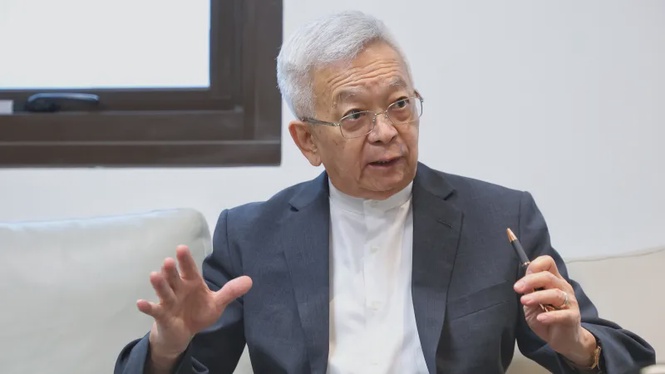
Some US customers now require that not a single small part in the products they buy come from China, says Shen Kuo-jung, president of Taiwan's Hota Group and chairman of GUS Technology, as Hota moves production into a plant near Buffalo, New York. In an exclusive interview with Storm Media, Shen said such "non-red supply chain" demands, shorthand for supply chains with no Chinese content, reach materials and tiny components, not just the place of final assembly.
Shen heads GUS Technology, a Taoyuan-based maker of lithium battery cells that trades on the Taipei Exchange's emerging board. Hota Industrial Mfg. Co., a Taichung maker of gears and shafts, is moving into an existing factory in the Buffalo area to serve American customers who are pressing suppliers to build closer to home as tariffs bite.
Non-Red Supply Chain Rules Reach Small Parts
Beyond tariffs, Shen is more concerned about what customers demand of their suppliers' sourcing. Some US customers, he said, ask for a non-red supply chain, and their limits on Chinese content cover materials and tiny parts as well as the final assembly location.
"Not a single small part can come from China," Shen said, describing what such customers require. For a supplier, shifting only the last production step to another country may not satisfy those purchasing terms, which means upstream materials and components have to be re-examined.
Shen argues that GUS Technology is positioned to meet such demands because it develops its own cell materials and production technology. He wants to connect its battery capability with existing customer experience in electric vehicles, robots and unmanned vehicles, which he says would make its supply offering more complete.
Shen was describing purchasing and supply chain conditions he meets when serving his own customers. Requirements differ by product, transaction and contract, and they should not be read as a rule across the US market.
Existing Buffalo Plant Shortens Hota's Build Time
American customers facing tariff costs want suppliers to produce nearby, Shen said. Building from scratch means buying land, then working through environmental review, water, power and other facilities, a process that often takes a long time, with years of construction still to follow. That cannot answer demand quickly.
So Shen chose an existing plant. A finished site trims the front-end construction and administrative steps, letting equipment and production plans move forward faster.
Hota said in March that its board had authorized a subsidiary, Hota Manufacturing (NY) Inc., to lease a plant in Buffalo, New York, from an affiliate for production. That lease is a transaction between the subsidiary and the affiliate, and it sits at a different corporate level from the group's broader site planning.
The interview did not name the site. Local US media reported on August 6 that Hota will be the first tenant at the former Sumitomo Rubber plant in the Town of Tonawanda, near Buffalo, a complex of nearly two million square feet where the company expects to create up to 50 jobs.
Tariff Shifts Change Customers' Sense Of Urgency
An investment already under way can lose its urgency. Shen recalled that customers earlier pushed Hota hard to speed up its move to the United States, then recently told him there was no need to hurry as the tariff situation changed.
On a recent trip to the United States, he said, customers praised how quickly Hota had cooperated but added that, under the tariff conditions at the time, the pressure was not what it had been. "There's no need to be in such a hurry," they told him, which left him asking why the urgency had shifted when the company was keeping to its schedule.
The episode shows that suppliers must commit to equipment, capacity and funding while customer needs and policy signals keep moving. Tariffs can push investment forward and customers' later reactions can change how urgent it feels, so companies have to weigh sites, equipment, sourcing and delivery requirements together if an overseas plan is to become real supply capacity.