
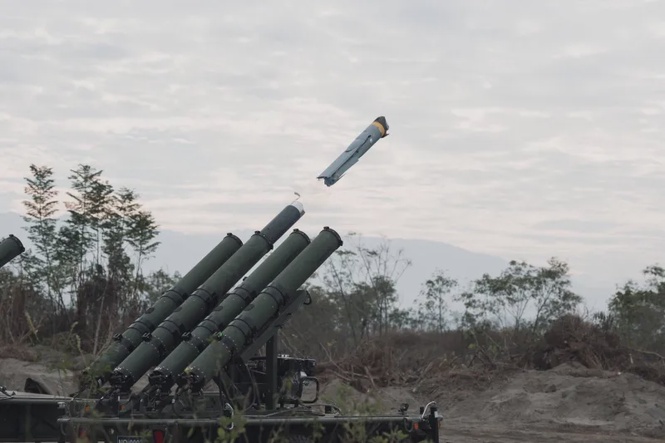
Since Russia's invasion of Ukraine and the recent US-Iran conflict, militaries around the world have rushed to build up their drone fleets, and Taiwan is no exception. Taiwan's Army has been pushing both homegrown development and direct purchases from the United States, buying Switchblade 300 loitering munitions and ALTIUS-600M attack drones through a program known as the Hunting Owl Project. Every ALTIUS-600M ordered has now been delivered, an event marked by Anduril founder Palmer Luckey personally flying to Taiwan for the handover and receiving a high-profile reception from Defense Minister Wellington Koo, a clear signal of how seriously the military is committing to unmanned systems.
At the same time, Taiwan's government e-procurement platform posted a much larger contract at the end of August 2026, worth roughly NT$26.9 billion, again with Anduril, this time for more than 2,000 ALTIUS-700M anti-armor attack drones and ALTIUS-600 ISR reconnaissance drones. The US military flies the same ALTIUS family. But a Storm Media investigation has found that Taiwan's own rollout of the ALTIUS-600M has run into problems serious enough to raise questions about combat readiness.
Hunting Owl Project's Price Gap Tops NT$6 Billion, Drawing Questions Even From Ruling Party Lawmakers
According to the Ministry of National Defense's latest five-year force-buildup report submitted to the Legislature, the ministry plans to keep taking delivery of attack drones such as the ALTIUS-600M and Switchblade 300, while adding ALTIUS-600 ISR and ALTIUS-700M drones to sharply expand its ability to strike in depth and hit targets as soon as they are spotted.
The ALTIUS-600M and Switchblade 300 were acquired by the Army in 2024 under the Hunting Owl Project. When the annual budget was first drawn up, it was based on an initial US quote of NT$11.5 billion, but the final price the United States charged came in at just over NT$5.5 billion, leaving a gap of more than NT$6 billion. Once lawmakers spotted the discrepancy, they questioned whether the military had padded its budget request, and even legislators from the ruling party pressed the Army for an explanation.
First Live Fire Test Saw Three Of Five Drones Crash, Military Later Claimed A Perfect Hit Rate
Every ALTIUS-600M ordered has now been delivered, though the Switchblade 300 has yet to arrive in Taiwan. The ALTIUS-600M has become the military's showcase attack drone, appearing at nearly every public event, but its actual performance has been a point of contention. Media reports in February 2026 revealed that during its first live-fire test, three of five drones crashed, well short of expectations. By June, the military released footage of its own showing more than ten launches with a claimed hit rate of 100 percent.
How well the ALTIUS-600M actually performs remains a subject of debate. Sources familiar with the matter say the choice of Anduril's drone over other options was driven from the top levels of government. The military had originally wanted to buy the combat-proven Switchblade 300 and Switchblade 600 from AeroVironment, a manufacturer with an established battlefield track record, but after intervention and negotiation at senior government levels, the deal was changed to a combination of the Switchblade 300 and the ALTIUS-600M instead.
Chargers Made In China Leave Drones Waiting On American Technicians To Power Up
Beyond the price discrepancy, Storm Media has learned that the ALTIUS-600M purchase carries a problem that could directly affect combat readiness. When the Army placed its order, chargers for the drones were not included in the procurement plan, and the omission only came to light after the equipment had already been delivered. When the Army asked Washington about it, American officials revealed an awkward truth: the manufacturer's chargers were made in China, which is why they had never been included in the price quote in the first place. In other words, the Army had simply followed the US quote sheet without realizing chargers had been left out from the start, let alone that the reason was their Chinese origin.
Because Taiwan's military has committed to avoiding Chinese-made components in its supply chain, the Army has since asked Washington to source chargers made outside China. As of April 2026, no alternative supplier had been found, meaning American technical representatives still have to travel to Taiwan to help charge the ALTIUS-600M. Since the drone is a single-use weapon that is consumed the moment it is fired, having to wait for American personnel to charge units that run low on power before they can even be launched raises real concerns about whether the fleet can respond quickly in a crisis.
Spare Batteries Ordered At Nearly Eight Times What The Fleet Actually Needs
The charger oversight was not the only procurement misstep. Sources say the Army's order for spare ALTIUS-600M batteries came to nearly eight times the number of airframes purchased, even though the drone is a single-use weapon that is expended with every launch or exercise. Under normal practice, each airframe would need only two or three spare batteries, making the actual order a significant overbuy. Since the drones cannot be reused, the surplus batteries risk becoming a waste of public funds. The military has reportedly asked Washington to reduce the quantity, but the United States has yet to decide whether it will agree.
Separately, the roughly NT$26.9 billion contract posted on the government e-procurement platform at the end of August 2026 covers 1,554 ALTIUS-700M anti-armor attack drones and 478 ALTIUS-600 ISR reconnaissance drones, all of which are slated to go to Army frontline units, according to the Ministry of National Defense's own procurement list. Deliveries are expected to begin in the fourth quarter of 2026 and continue through 2033.
The US military itself recently carried out a first-of-its-kind live exercise launching Anduril's ALTIUS-700 series drones from UH-60M Black Hawk helicopters in flight, a shift that could reshape how the drones are used and potentially upend existing approaches to asymmetric warfare. Taiwan's acquisition of the same family of drones could meaningfully strengthen its battlefield capabilities. But the recurring theme in this story is that when the United States drives the terms of Taiwan's own procurement, problems like these tend to follow, and that dynamic appears to be the military's biggest source of frustration.
YP