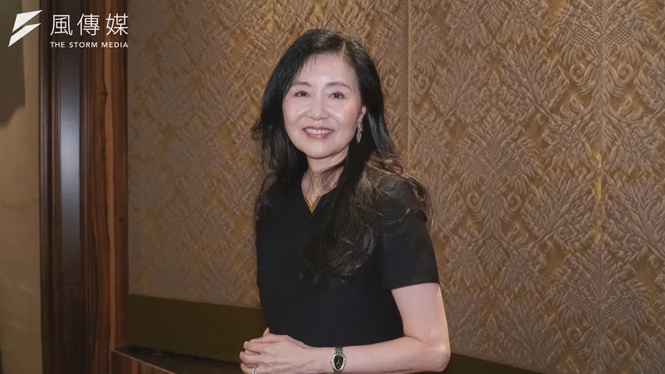
Asia's first Master of Wine is rewriting her best-known book, and Taiwan is going into it. Her argument: the island's street food is not the ceiling of its cuisine. It is the proof of what the cuisine could become.
Jeannie Cho Lee, the first Asian Master of Wine, will add Taiwan to the revised edition of Asian Palate, the book that established her as the leading authority on matching wine to Asian food. She disclosed the plan in an exclusive interview with Storm Media's English-language site and 1%Style on September 13, 2026, and said she hopes to finish the revision sometime next year.
The decision amounts to a public verdict on a market the global wine trade rarely names. "I see Taiwan as an untapped, potentially very important market — both for food and wine, both," said Lee, who was appointed a Knight of the National Order of the Legion of Honour by the French government in 2021.
Why Taipei's Night Markets Are The Evidence
Lee is direct about how little the international wine world understands Taiwanese cooking. Japanese cuisine has been decoded for global diners, from Kyoto kaiseki to Tokyo sushi. Taiwanese food has not. "There is a lack of understanding of what exactly is Taiwanese cuisine," she said.
Her answer to that gap is the night market — not as a limitation on how the world sees Taiwan, but as the strongest available case for the opposite view.
"What everyone understands when they come to visit, especially the night markets in Taipei, is that just everyday casual street food is just delicious," she said. "It's flavorful. It has richness and depth and a lot of umami. And so the potential for being able to pair with wine, and to becoming more refined cuisine, is tremendous."
Behind that everyday food sits a layered inheritance: migration from Fujian and the coastal Chinese provinces, half a century of Japanese rule, and later American and Western influence. "The whole history of Taiwan has its own gastronomic entity and an identity — very, very strong identity," she said.
Warm Tea At 45 Degrees Solves The Pairing Problem
Bringing wine to a communal Asian table takes engineering. Dishes arrive together rather than in sequence. The most expensive item — a suckling pig, a roast goose, a whole steamed grouper — usually lands in the first half of the meal, before anyone is too full to appreciate it. A wine list has to follow red meat back to seafood and then back again.
Lee's fix has two parts. First, group the dishes into two or three waves rather than serving every plate at once or forcing a course-by-course banquet. Lighter dishes and seafood travel together; richer dishes follow.
Second, insert a pause wherever the wine changes direction. Her preferred palate cleanser is neither sorbet nor anything sweet, and not scalding tea either. She wants tea at roughly 45 to 50 degrees Celsius, about 113 to 122 degrees Fahrenheit — warm enough to carry fragrance and clear the palate, cool enough not to burn the tongue.
"It is possible," she said. "It's challenging, but it's possible."
Western Food Needs Wine, Asian Food Does Not
The harder adjustment is philosophical. In the Western tradition, Lee said, wine is on the table because a correct match is believed to improve both the dish and the bottle. In Asia the ideal is quieter.
"The perfect pairing is when they're side by side," she said. "Not taking away and not adding too much, just being beside each other quietly, without having to have fireworks."
She puts the difference bluntly. "Western cuisine needs wine. A lot of the food needs wine. We do not need wine. We want wine. We choose wine. But we don't need wine."
So what does wine contribute at an Asian table? Her answer is tempo. "Wine allows you to slow down the meal," she said. "We eat too fast — that's one of our biggest flaws."
View this post on Instagram
Hong Kong And Singapore Had A Hub Advantage
Taiwan has never featured in the regional wine conversation the way Hong Kong and Singapore do, despite being larger than both. Lee's explanation is structural rather than cultural.
"Singapore acts as a hub for Southeast Asia, for the countries around them, and Hong Kong as a hub for Greater China," she said. "That is one of the reasons why both of these cities have developed so much." On import figures, she noted, Taiwan lags.
Size works against it in an unexpected way. With more land, more people and more natural resources, Taiwan is self-sufficient in a way the two city-states never could be. "In some ways you're more insular," she said. "You don't need outside people."
That is not a verdict on sophistication. At the top of the market, Lee said, Taiwan is already world class. "A lot of the big important collectors in Taiwan are as sophisticated as the ones I know in Singapore, Hong Kong, or Shanghai, or anywhere in the world — so Japan, Tokyo even."
The problem is the shape of the market beneath them. "That small core has not grown that much, and the sophisticated group has remained almost without a middle," she said — a peak with no slope. She expects the digital era to close that gap fast, citing multilingual news outlets as one accelerant; Storm Media currently publishes in Chinese, English and Japanese. "I think it can happen very quickly in the next generation."
What Korea Did In Ten Years With Government Help
Lee has watched the transformation she is describing happen once already, to her own food culture. Two decades ago Korean cooking barely registered internationally, dismissed as cheap street food.
"It's really only in the last 10 years" that the perception flipped, she said. "Twenty, thirty years ago it wasn't the case." Her estimate of how long the shift takes is deliberately short: "It only takes a decade or one generation, really, to change the cuisine."
It did not happen by accident. Lee credits coordination: the Korean government treated gastronomy as cultural heritage and pushed it through trade bodies and nonprofit organizations, while the private sector said the same thing at the same time.
"You have to get the tourism board, the cultural ministry, the agricultural ministry, the export ministry, as well as the private bodies and the restaurant associations to come together, because that's what Korea did," she said. "They got a lot of help from the government, so they didn't do it just in the private sector."
Told that streaming cooking shows had put Korean kitchens in front of global audiences, Lee agreed the exposure mattered — and said Taiwan is capable of exactly the same result. What it lacks is the coordination, not the material.
Younger Drinkers Are Asking Who Farmed The Grapes
The generation Taiwan would be selling to is changing its relationship with alcohol. Young people everywhere are drinking less, which Lee calls a production-side problem but not necessarily a public health one, since earlier consumption levels were arguably excessive. She also noted a global wine surplus that will take the industry a few years to correct.
What the same generation wants, she said, is authenticity — a scarce commodity in an era of AI-generated images and filtered social feeds. Wine happens to be well positioned to supply it.
More than 90% of the world's wine producers, counted by number rather than volume, are family-owned small and medium businesses rather than industrial groups. "The majority is made up of small, authentic craftsmen — maybe some are even artisans — the ones who are trying to make really top quality and express something about the place that's genuine and real," she said. "That message will ring true for the younger generation."
In practice that means buying decisions are moving past labels and scores. Younger Asian drinkers, Lee said, want to know whether the fruit was farmed organically or biodynamically, and whether a family or a conglomerate stands behind the bottle. "All of those little details about wine will matter."
The famous names are not going anywhere. "It's like in the world of fashion: you're always going to have Louis Vuitton," she said. But the next cohort will look well beyond them. "They'll be more open and they'll understand and appreciate quality in a different way."
That puts a burden on the people who write about wine. "We have to be honest about what is quality," she said. "What is worth your time? What is worth your palate? What is worth your health? Because every time you take alcohol, you want to make sure that if you are only drinking two or three glasses, then it's worth your time."
Women Will Reach Half The Market, Driving White Wine
Lee's most consequential prediction concerns who will be holding the glass. Women make up roughly 25% to 30% of wine consumers today, she estimates. She expects that to reach 50% "very quickly in our lifetime."
The reasoning rests on an asymmetry in how the two markets behave. Men distribute their drinking across whiskey, vodka, gin, soju and beer. Women who arrive at wine tend to stay. "Once they get into wine, they are loyal to wine, and they stay with wine all their life," she said.
Asked whether the preference for white wine among middle-aged Taiwanese women, in a climate of long, humid summers, could move the market, Lee said the pattern is regional rather than local. Women are becoming a decisive consumer group in every Asian market she visits — long established in Japan, and increasingly visible in Korea, Hong Kong, Singapore and the coastal cities of mainland China.
"One of the trends will be toward lighter, more elegant styles of wine, and more white wine than currently what we have right now, which is majority red," she said.
She uses herself as the worked example. "I eat everything, but oftentimes I would prefer to eat seafood," she said. "And so if this is what I'm eating, then what wine will pair with that kind of food? It's oftentimes either a white wine or a light-bodied red."
She is careful to frame the shift as dietary rather than simply gendered, pointing to Eleven Madison Park, the three-Michelin-star New York restaurant that abandoned its modern French menu for a vegetarian one — a bet, she said, that lighter and healthier is where global dining is heading.
Her own work has followed the same line. Lee now spends three to four months a year in Burgundy, where she serves as Le Grand Sénéchal of the Korea chapter of the Confrérie des Chevaliers du Tastevin. The region's delicate Pinot Noir and its whites, ranging from lean to opulent, suit the way she eats. The second edition of The 100 Burgundy has already been published in Chinese; English and Korean editions are due at the end of this year.
Social Media Links & Editor Tag - PennyHarvest 2026 at Château de Meursault
— Jeannie Cho Lee MW (@JeannieChoLee) September 3, 2026
Harvest 2026 at Château de Meursault, where owner Olivier Halley and CEO Stéphane Follin-Arbelet continue to invest ambitiously in the future of this historic estate.#harvest2026 #meursault #burgundy #bourgogne #wine pic.twitter.com/odw6KxaFQj