Taiwan's semiconductor trade with Singapore dominates the bilateral numbers, but the Taipei Representative Office has been building two quieter tracks for structural depth: embedding Taiwanese food culture across Singapore's retail and restaurant landscape, and a revised income tax treaty that takes effect January 1, 2027.
Tung Chen-yuan, representative of the Taipei Representative Office in Singapore, laid out both tracks in an exclusive interview with The Storm Media on August 24, 2026.
"Our 'iTaiwanFruit' group was enormously popular. Within one week we had more than 1,000 people join, which is the maximum capacity for a WhatsApp group in Singapore. We were completely full."
The anecdote points to a dimension of Taiwan-Singapore relations that sits apart from the headline numbers: bilateral trade surging 94.1% in the first half of 2026, driven by AI semiconductor supply chains. Alongside that economic momentum, Tung is simultaneously advancing two parallel tracks to deepen the relationship: an agricultural soft-power campaign that uses food culture as its primary instrument, and a revised tax treaty between Taiwan and Singapore set to take effect on January 1, 2027.
Supermarket Chains and WhatsApp Groups Power Taiwan's Singapore Food Push
Taiwanese agricultural products have historically faced three structural barriers in Singapore: small export volumes, inadequate cold-chain infrastructure, and limited retail access. Tung's first move after taking his post was to help Taiwanese business operators establish Xin Taiwan Galleria, a platform centered on imported Taiwanese vegetables, fruit, creative goods, and processed foods, built around an online order-and-delivery model that addressed the most basic commercial bottleneck.
In parallel, the representative office opened negotiations with Singapore's four major supermarket chains: NTUC FairPrice, the quasi-governmental market leader; Sheng Siong, the largest private chain, which has expanded from 64 stores in late 2023 to approximately 90 today; Cold Storage, which targets the premium consumer segment; and Bai Mei supermarket.
View this post on Instagram
On the digital front, the representative office created the "iTaiwanFruit" WhatsApp group. It hit the platform's 1,000-member ceiling within a week, forcing the launch of additional groups; the network now counts several thousand Singaporean members. The initiative has since been upgraded to "iTaiwanFruit+Food," broadening its scope to include vegetables, seafood, and processed goods. The result is a dual-channel sales model: supermarket retail running alongside community group-buying, with cold-chain home delivery for group orders.
Air freight provides a separate premium channel. Operators have long used direct flights to deliver top-grade fresh fruit to Singapore: sugar apples, wax apples, pineapples, pomelos, and jujubes, at price points that can reach S$150 for two boxes (approximately NT$4,000), with full replacement guarantees for any quality failure.
Having established retail and digital access, Tung's next step was to move Taiwanese produce from supermarket shelves onto fine-dining tables. In 2025, he brokered a three-month collaboration between Yangming Spring, a Taiwanese plant-based restaurant that had received the Michelin Green Star for six consecutive years, and a Singapore five-star hotel, with chefs interpreting Taiwanese mangoes, pineapples, water mimosa, green bamboo shoots, and Tainan orchids. "When produce reaches the dining table and becomes part of the tertiary sector, the value of Taiwan's delicious vegetables and fruits becomes even greater," Tung said.
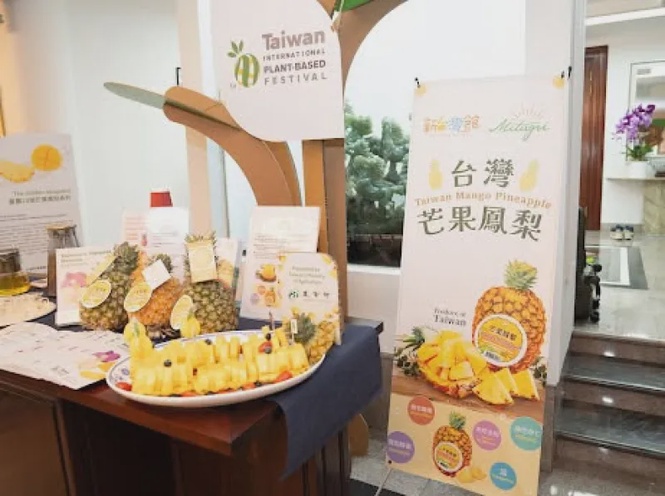
Religious networks have also been enlisted as promotional platforms. For Vesak Day 2026, the representative office partnered with Fo Guang Shan to host a three-day event that drew 40,000 attendees; traditional vegetarian rice balls and mushroom-and-bamboo-shoot congee sold out within the first hour of the first day, requiring immediate on-site replenishment. Through Tzu Chi's 16 volunteer groups in Singapore, Tung also organized an international vegetarian food education forum with participation from Thailand, Malaysia, Singapore, and Taiwan. The representative's residence, which hosts more than 300 receptions and over 4,000 guests each year, has become a regular showcase for Taiwanese vegetables, fruit, and flowers, with presentations jointly organized by Taiwan's Council of Agriculture, the Taiwan Agricultural and Food Agency, exporters, and distributors.
New Tax Treaty Slashes Dividend Withholding and Shields Regional Hubs
The revised income tax agreement between Taiwan and Singapore will enter into force on January 1, 2027, delivering its most immediate benefit in the form of reduced withholding tax rates. Ceilings on withholding taxes for dividends, interest, and royalties will all be lowered to 10%. The dividend rate had previously reached as high as 40%, while the royalty rate falls from 15% to 10%.
Tung identifies four dimensions of benefit from the revised treaty. The first is direct tax relief: the across-the-board reduction in withholding tax ceilings will materially reduce the cost of cross-border capital flows, and for Taiwanese companies that use Singapore as a regional holding hub, it represents a clear reduction in the cost of repatriating dividends. The second is institutional protection: the new agreement introduces transfer pricing corresponding adjustments and advance pricing agreement mechanisms, establishing a bilateral channel between tax authorities that reduces double-taxation risk and improves predictability for Taiwanese companies expanding across Southeast Asia.
The third benefit is a three-year transitional period from 2027 to 2029, giving companies sufficient time to restructure asset allocation and operational frameworks at a measured pace. The fourth is alignment with the global minimum tax regime's high-standard requirements, which the new treaty is designed to encourage by incentivizing companies to upgrade their overseas operations into substantive regional centers.
Tung summarized the agreement's utility directly: "I think these four aspects are what the new double taxation avoidance treaty can do to help Taiwanese companies."
The treaty's broader significance lies in the pattern of Taiwanese capital flows. Over the past five years, 60% of Taiwan's investment into ASEAN has gone to Singapore, with a portion of those funds subsequently channeled through Singapore into Vietnam, India, and other markets, leveraging Singapore's free-trade advantages and institutional protections to manage risk. "Now, because of the reduction in effective tax rates, this may make more of these businesses more willing to use Singapore as a base," Tung said.
From dining tables to tax law, both tracks point in the same direction: Taiwan is building a second layer of depth in its relationship with Singapore, one that operates beneath the visible momentum of AI and semiconductor trade. The goal, as Tung frames it, is to embed Taiwanese brands into Singaporean daily life in a tangible way, and to give Taiwanese businesses greater institutional security and financial flexibility. In his assessment, that is what will allow the Taiwan-Singapore relationship to deepen over the long term, beyond the fluctuations of any single business cycle.
[Editor's note] Michelin announced in May 2026 that it would discontinue the Green Star program entirely, with 2026 marking the final year of awards; the scheme will be succeeded by a sustainable dining platform called "Mindful Voices." Yangming Spring's Michelin Green Star record referenced in this article reflects its history of receiving the award for six consecutive years beginning in 2021. The collaboration described took place in 2025, when the Green Star program was still in operation.
Original Article in Chinese
Social Media Links & Editor Tag - Penny