
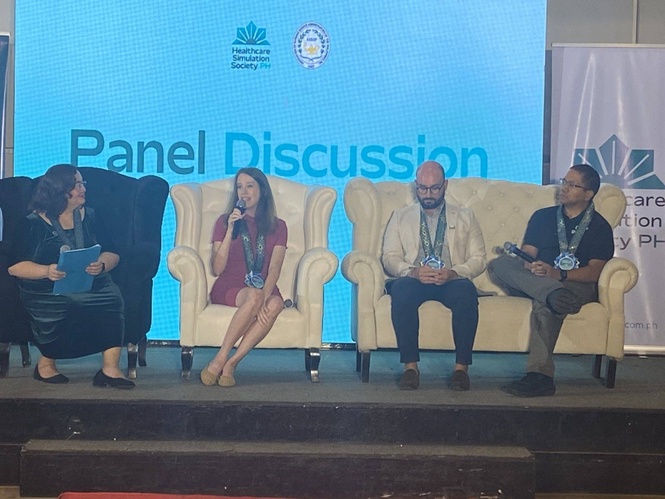
MANILA, Philippines — Healthcare simulation does not have to rely on expensive equipment to help prepare nursing students and health professionals for actual patient care, experts said.
The speakers pointed instead to realistic scenarios, trained facilitators and repeated practice as important elements of simulation-based learning.
The discussion was held as part of “Shaping the Future of Philippine Nursing Education through Simulation,” organized by the Healthcare Simulation Society of the Philippines (HSSP) in collaboration with the Healthcare and Technology Institute on Sept. 30 at Patio Victoria in Intramuros, Manila.
Armand Del Rosario, president of the HSSP, said simulation should not be equated with expensive technology.
“Expensive technology is not simulation. High fidelity is the scenario that is taught,” Del Rosario told reporters.
He said low-fidelity equipment can be used for simulation if faculty members understand the methodology and how to design scenarios for the intended learning outcomes.
Del Rosario also cited examples of simulation exercises using simple materials, including posters, as well as ChatGPT to develop scenarios and rubrics.
Practice before the pressure
Pedro Cartaxo Cintra of Hospital Clínic de Barcelona said simulation provides healthcare professionals with a safe space where they can learn from mistakes without putting patients at risk.
He said simulation helped his students understand the importance of “thinking about thinking” before making decisions, particularly in critical-care settings where healthcare professionals may have to make decisions under pressure.
Cintra also pointed to skills beyond technical procedures.
“The majority of our skills are social cognitive, about how to communicate, how to take decisions, how to work as a team, how to be a leader,” he said.
Cintra said simulation can also help healthcare professionals recognize decisions and actions they routinely perform correctly, while making areas for improvement more visible.
The speakers cited situations such as infectious disease outbreaks and other emergencies as examples of events that may not occur routinely but can require healthcare workers to respond quickly.
Ashley Franklin of Vanderbilt University School of Nursing and the International Nursing Association for Clinical Simulation and Learning said simulation scenarios can focus on conditions with broad applications, including diabetes-related complications, infection control and cardiac resuscitation.
Cintra also cited the COVID-19 pandemic, saying simulation had helped prepare healthcare professionals for time-sensitive situations and maintain their competencies.
Rodrigo Galindo Jr. of HSSP, CAPE at Stanford Medicine and SimGHOSTS discussed simulation's role in preparing healthcare professionals from different disciplines to work together during emergencies.
Building the people behind simulation
The discussion also covered what institutions need to sustain simulation programs, with the speakers emphasizing faculty and facilitator development alongside equipment.
Franklin said institutions need faculty members and facilitators who can design meaningful learning experiences and help develop other educators who can conduct simulation activities.
Mary Nellie Roa, vice president of HSSP, said the society seeks to promote simulation in nursing education, initially focusing on nursing before expanding to interprofessional healthcare education.
Roa also discussed the society's aim of helping bridge the gap between academic training and the healthcare industry.
The speakers said simulation gives healthcare learners an opportunity to practice clinical decision-making, communication and teamwork in a controlled setting before applying those skills in patient care.