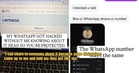
Communications Minister Datuk Seri Fahmi Fadzil wants WhatsApp to strengthen phone number verification to stop scammers from impersonating MCMC officers and deceiving the public.
KUALA LUMPUR: Communications Minister Datuk Seri Fahmi Fadzil wants WhatsApp to strengthen verification of telephone numbers linked to user accounts amid growing concerns over scammers exploiting the messaging platform to deceive the public.
He said the government was looking into the issue following reports of scammers misusing telephone numbers and WhatsApp accounts, including impersonating Malaysian Communications and Multimedia Commission (MCMC) officers.
“At the moment, WhatsApp does not require verification of the account.
“But recently, at the International Telecommunication Union (ITU), I heard from representatives of several countries raising concerns over the misuse of WhatsApp for scam calls.
“One measure being considered by many countries is to verify the identities of users and the telephone numbers linked to their WhatsApp accounts,” he told reporters after the launch of the Senior Citizen Safety System Pilot Project at 1 Razak Mansion.
Fahmi said MCMC would never call members of the public to warn them about telephone line disconnections or outstanding bills, stressing that such matters were handled directly by telecommunications companies.
“Many people have complained about receiving calls from individuals claiming to be MCMC officers and informing them about outstanding telephone bills.
“MCMC does not carry out such work. That is the responsibility of the telecommunications companies themselves,” he said.
He stressed that neither the Communications Ministry nor MCMC would make outgoing calls for enforcement purposes, adding that MCMC was not responsible for taking enforcement action over outstanding bills involving telecommunications companies.
Fahmi said authorities would take action against individuals involved in such scams, with suspects to be arrested and investigated before being charged in court if sufficient evidence of wrongdoing was found.
He added that the ministry was also examining additional measures at the network level to curb scam calls, following technical measures previously introduced by MCMC to restrict caller ID spoofing.
However, scammers had since shifted to other methods, prompting the need for further measures to address their evolving tactics.
Fahmi said scammers had been using WhatsApp to impersonate MCMC officers and deceive victims through various schemes, including fraudulent loan offers and online gambling-related scams.
He advised members of the public who received suspicious calls to hang up immediately and lodge a report with the police or MCMC.
They could also contact the National Scam Response Centre (NSRC) at 997 for assistance.
“One of the methods used is impersonating MCMC officers. Another involves calls offering loan facilities or promoting online gambling. So, please be careful,” he said.
His remarks came after police arrested 61 people suspected of involvement in three scam syndicates, including one believed to have impersonated MCMC officers in telephone scams.
Police said the suspects were detained during raids in Seri Kembangan, Selangor. Two other syndicates were allegedly involved in fraudulent part-time job offers targeting victims in Indonesia through WhatsApp.