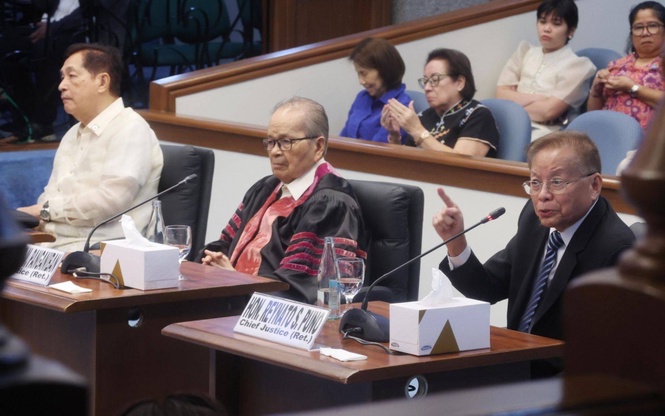
THREE of the four retired justices of the Supreme Court who were invited to share their thoughts with the Senate impeachment court trying Vice President Sara Duterte on Wednesday agreed that the Constitution’s two-thirds vote requirement for convicting an impeached official should not automatically mean 16 votes.
Speaking as amici curiae, or friends of the Senate impeachment court, retired Chief Justices Hilario Davide Jr., Artemio Panganiban and Reynato Puno argued that automatically requiring 16 votes — regardless of the number of senators able to serve due to legal incapacity, detention, suspension or other circumstances preventing them from discharging their functions — defies common sense, tolerates absurdity and defeats the spirit of the 1987 Constitution.
Article XI, Section 3(6) of the 1987 Constitution requires the concurrence of “two-thirds of all the members of the Senate” for conviction. The Senate currently has 24 members, but four senators are unable to attend or participate due to legal or physical constraints. Two are currently in jail over plunder charges — Senators Jinggoy Estrada and Rodante Marcoleta — while Sen. Ronald dela Rosa has been in hiding to avoid arrest on crimes against humanity charges by the International Criminal Court, and Sen. Loren Legarda has been on medical leave since Aug. 3.
Only those qualified to vote
In a legal memorandum read by Clerk of Court Renato Bantug Jr., Davide, who was part of the 1986 Constitutional Commission that drafted the 1987 Constitution, said the votes needed to convict in an impeachment trial should be based on the number of senators qualified to vote, “not the 24 in the present Senate.” Davide cited past Supreme Court decisions that bar public officers facing criminal cases in court from practicing their profession or holding office while in detention.
One of the cases mentioned was that of former senator Antonio Trillanes IV, who won the 2007 senatorial race while in detention on coup d’etat charges. A Makati court, however, junked his bid to participate in Senate sessions and hearings.
A portion of the court ruling Davide cited states that the “performance of legitimate and even essential duties by public officers has never been an excuse to free a person validly in prison.” The same ruling further states that “Congress continues to function well in the physical absence of one or a few of its members.”
“Clearly then, the basis of computing the two-thirds must be the number of senators who are qualified to vote, not the 24 in the present Senate,” Davide said.
“All those disqualified by reason of causes earlier mentioned should not be included,” added Davide, who served as the presiding officer during the impeachment trial of former president Joseph Estrada.
Davide said that when the Constitution mentioned two-thirds of all the members of the Senate, “it was presumed and assumed” that the word “members” refers to living persons, who are not suffering from any mental, physical or health conditions that render them incapable of exercising their powers or performing their duties as senators, or who are prohibited to do so by reason of some legal restraints or impediments.” “This is the spirit of the provision. It could not be otherwise,” he said. “Any interpretation to the contrary would defy reason, logic and common sense; tolerate an absurdity; and perpetuate an injustice.”
Davide also said the framers of the Constitutions of 1935, 1973 and 1987 could never have intended to include in “All Members” senators in a given Congress those who have resigned or have been expelled; those who suffer from any mental infirmity; those who are suffering from any physical incapacity; those who cannot participate in the hearings and deliberations on the impeachment such as those who are outside the jurisdiction of the Philippines, or whose whereabouts are unknown or in hiding to avoid arrests; and those who by reason of some legal impediments or restraints, cannot exercise or perform their rights and privileges as a public official or, more specifically, as a senator.
Included in the last group, he said, are those who are charged with plunder, graft and those “facing criminal charges in court or have been convicted and are serving their sentence.” Davide said those who did not attend or participate in the proceedings “for any reason whatsoever or who never acted or performed the duties as a senator-judge must be deemed to have never participated in the performance of the duties as such.”
“He should belong to the category of those who are outside the jurisdiction of the Philippines or in a foreign country or one whose whereabouts are unknown,” Davide said.
“As to those who did not substantially participate in the impeachment proceedings, the undersigned leaves this matter to the conscience and sense of duty to those involved,” he added.
Contextual interpretation
Puno urged the Impeachment Court to adopt a “contextual and functional interpretation” of the constitutional provision, warning that a rigid reading could lead to unacceptable consequences when senators are legally or physically unable to perform their duties.
“This approach will give the senators the right to consider whether senators who are already dead, resigned or expelled should still be counted in determining two-thirds of all the members of the Senate,” Puno said.
Puno said that if the framers intended to require exactly 16 votes under all circumstances, the Constitution could simply have stated that number.
“But Article XI, Section 3(6) did not say so. Instead, the language used a fraction. It says two-thirds of all members of the Senate. By using two-thirds, the number of votes to convict will have to move depending on certain factors,” he said.
“This approach will enable the senators to consider whether senators who are legally incapacitated, like senators charged with plunder, like senators under preventive suspension, should still be counted in determining the number of votes to convict,” Puno added.
Puno also questioned whether the Supreme Court could properly review the Senate’s interpretation of the constitutional voting requirement.
“In my view, that is a political question. It would be difficult to elevate that issue to the Supreme Court,” he said.
Senators have final say
Panganiban told senators hearing the impeachment case that they — not the Supreme Court — must decide whether to convict or acquit her, stressing that the Constitution vests the power of judgment in the Senate.
He said senators must exercise their authority as elected representatives of the people and decide the case based on their own judgment.
“It is you who must decide, not the Supreme Court,” Panganiban said.
He argued that the Constitution would have assigned impeachment decisions to the Supreme Court if it intended the high tribunal to exercise that power.
“That is not what our Constitution says; it states that the Senate shall make the decision regarding impeachment,” he said.
Panganiban urged senators to decide the case “from where you sit,” emphasizing that their role in the impeachment court does not transform them into Supreme Court justices.
He warned against allowing senators who cannot participate in the proceedings to automatically inflate the denominator, saying constitutional interpretation must account for fairness to both the impeached official and the Filipino people.
“Is it truthful and fair to allow senators to cast their votes despite being absent from the proceedings? Is it fair and truthful should senators be allowed to vote though they’re in hiding, abroad, legally detained, sick, hospitalized or otherwise absent, and have not been able to access and examine the documents; have not heard the testimonies and have not observed the demeanor of the witnesses?” Panganiban said.
“As the elected representatives of the Filipino people, the Senate’s mandate demands a commonsensical interpretation of the Constitution. Meaningful adjudication requires active participation in the search for truth and fairness,” he added.
He said the constitutional requirement cannot be reduced to simple classroom arithmetic divorced from the realities confronting the impeachment court.
Panganiban also said the Senate’s judgment is “final and unappealable” to the Supreme Court because there is no constitutional provision allowing such an appeal.
“The only way by which the Court can review a Senate decision or order is when the Senate commits grave abuse of discretion,” he added.
Puno emphasized that constitutional interpretation must go beyond numbers and consider the purpose and operation of the provision.
“Reality, sometimes, Your Honors, changes the denominator in mathematics. In the same way, constitutional interpretation cannot always stop at abstract mathematics. We must look at the intent and the purpose of constitutional provisions, the circumstances in which they operate, and the goals they seek to achieve,” Puno said.
The positions of the three former chief justices bear directly on Senator-Judge Erwin Tulfo’s appeal of Presiding Officer Francis Escudero’s ruling that 16 votes, or two-thirds of the full 24-member Senate, are necessary to convict Duterte.
Tulfo has asked the court to clarify whether senator-judges unable to participate in the final vote should remain part of the base used to compute the constitutional two-thirds requirement.
The issue has become consequential because some senator-judges are currently unable to regularly attend the proceedings for various reasons, including detention, medical leave and being in hiding.
Of the invited friends of the court, only former Supreme Court Associate Justice Adolfo Azcuna took the opposing position on the threshold question.
He said the phrase “all the members of the Senate” means all 24 senators who remain members of the chamber, regardless of whether they are physically present or able to participate in a particular proceeding.
“As long as they are members of the Senate, they constitute the denominator in computing the threshold of two-thirds because all means all,” Azcuna said.
For Azcuna, the supermajority requirement serves as an institutional safeguard against conviction by a temporary or narrow legislative majority.
Reducing the denominator to only participating senators, he argued, could effectively turn a two-thirds requirement into a simple majority in some circumstances.
For example, he said, if only 20 senators were counted, two-thirds would amount to roughly 13 or 14 votes, substantially below the 16 votes produced by applying the fraction to all 24 senators.
Azcuna therefore maintained that the threshold must remain anchored on the full membership of the Senate rather than fluctuate according to attendance.
“A threshold must be fixed, not variable. It must be determinable from the start. It cannot be something that will be figured out as we go along depending on how many are present,” Azcuna said.
Davao mayor subpoenaed
The Senate impeachment court on Wednesday granted the prosecution’s request to subpoena Davao City Mayor Sebastian Duterte to appear during the impeachment trial of his sister.
Escudero confirmed receipt of a manifestation with motion for the issuance of a subpoena requiring the appearance of six individuals to testify before the court.
In addition to Mayor Duterte, lawyer Gary Samonte and Police Maj. Jericson Sangalang have also been subpoenaed for Sept. 23, Escudero said.
Impeachment court spokesman Reginald Tongol said Mayor Duterte is expected to testify regarding transactions entered into by the city government of Davao with specific corporations.
He said the mayor is also expected to produce official records and contracts from 2020 to the present entered into by the city government with Gencorp Industries Inc., and any entity that owns or operates a Jollibee branch or establishment.
Meanwhile, Civil Service Commission (CSC) Assistant Commissioner Ariel Ronquillo and the Department of Budget and Management’s Philippine Government Electronic Procurement System Division chief Rendell Sopeña were subpoenaed for Sept. 21 to 23.
Tongol said Ronquillo will testify on the preparation, filing, and guidelines governing statements of assets, liabilities and net worth (SALNs).
The CSC official is also expected to confirm his role in drafting the relevant SALN guidelines and answer questions on their interpretation and application, he said.
On the other hand, Tongol said Sopeña will testify on government procurement transactions involving entities the vice president declared an interest in.
He is also expected to produce records, summaries and documents concerning contracts between Gencorp Industries Inc. and any government agency from 2020 to the present, he added.
On Monday, Sept. 21, the prosecution will continue presenting the testimony of Securities and Exchange Commission lawyer Gerardo Del Rosario, who will testify on the business interests of the vice president and her husband, Manases Carpio, during her vice presidency.
amicus