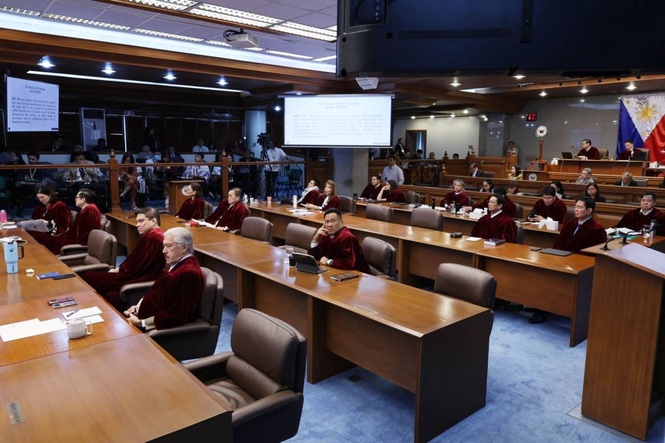
THE Senate impeachment court on Wednesday lowered the number of votes needed to convict Vice President Sara Duterte, overturning Presiding Officer Francis Escudero’s earlier ruling that 16 votes were required.
In Wednesday’s vote, 13 senator-judges agreed that the constitutional requirement of a two-thirds vote would be applied, not to all 24 members of the Senate, but on senators who are “legally and factually” able to take part when the court votes on the case.
The ruling followed an appeal by Senator-Judge Erwin Tulfo, who argued that the computation should account for changes in the circumstances of senators unable to participate in the proceedings.
Escudero announced that 13 senator-judges voted in favor of Tulfo’s appeal, while he cast the lone negative vote. Six senators did not participate in the vote: Senators Alan Cayetano, Pia Cayetano, Bong Go, Imee Marcos, Camille Villar and Robinhood Padilla.
Escudero said that although he disagreed with the court’s decision, he would enforce it.
“The presiding officer, after all, is not the court. He is merely the custodian of the process, not the proprietor of its outcome. This is the essence of democracy: the disagreement be preserved without obstruction, and that lawful result be obeyed without resentment,” Escudero said.
“This is the tradition that gives the strength and legitimacy to the Senate, whether we sit as a legislative body or as an impeachment court. We allow the fullest ventilation of views, even if those views differ sharply from our own. But at the end of the day, we vote. We abide by the judgment of the majority, even if we disagree with it,” he added.
Under the new controlling ruling, Escudero said that “all members of the Senate,” for the purpose of calculating the two-thirds requirement, refers to senators who “remain legally and factually capable of participating” when the vote is taken.
He said the computation may exclude senators who are detained or suspended, otherwise legally restrained from exercising their senatorial functions, whose whereabouts are unknown because they are being sought by authorities, physically or medically incapacitated, beyond the Senate’s coercive processes, or are similarly situated.
Escudero said the ruling is expressly limited to the present impeachment proceedings, adding that it would operate pro hac vice, or for this occasion only, and would not establish a binding precedent for future impeachment cases.
The court also directed that any fractional result in calculating two-thirds must be rounded up to the next whole number.
For example, if 20 senators remain legally and factually capable of participating, two-thirds would be 13.33. Because a fraction of a senator cannot vote, the required number would be rounded up to 14.
“This shall ensure that no person shall be convicted without the concurrence of two-thirds of all the members of the Senate, as determined by the court in this new controlling ruling and as required under Article XI, Section 3(6) of the Constitution,” Escudero said.
Tulfo had asked the impeachment court to reconsider Escudero’s July 6 ruling setting the threshold at 16 votes, based on the full 24-member Senate.
He argued that the Constitution establishes a fraction rather than a fixed numerical requirement and that the denominator can change depending on senators’ legal, medical and other circumstances.
Speaking to reporters on Wednesday, Tulfo clarified that the Senate court did not lower the two-thirds voting threshold required to convict an impeached official, saying the Constitution’s requirement remains unchanged.
“Just to correct the reports: the information circulating that the threshold was lowered is incorrect. We did not lower the threshold. It remains at two-thirds,” Tulfo said.
Tulfo said the Constitution clearly requires a two-thirds vote of all members of the Senate for conviction. He said senators who are currently unable to attend the proceedings could still participate if they become legally and physically able to return and vote.
The issue arose after several senator-judges became unable to participate in the trial. Senators Jinggoy Estrada and Rodante Marcoleta were detained, Ronald dela Rosa was in hiding to evade arrest by the International Criminal Court, while Loren Legarda was on extended medical leave abroad.
The House prosecution panel argued that keeping the denominator at all 24 senators could produce what it described as an “acquittal by default,” because senators who cannot participate in evaluating evidence would nevertheless effectively count against the votes needed for conviction.
Senator-Judge Alan Peter Cayetano opposed changing the threshold during the trial, arguing that the Supreme Court should ultimately resolve questions involving the constitutional voting requirement.
Cayetano said the issue should have been settled before the impeachment court adopted its rules and warned that changing the threshold in the middle of the proceedings could expose the trial to a challenge before the Supreme Court.
“Timing is essential,” Cayetano said, arguing that the parties should have been informed of the applicable threshold before the trial began and given an opportunity to seek judicial review.
Senator-Judge Risa Hontiveros likewise argued that only senators within the Senate’s coercive jurisdiction and actually present on voting day should be included in the computation.
She said the impeachment process should not be paralyzed by senators who are legally or physically unable to participate.
The court’s decision now makes the revised computation the controlling rule for the remainder of the impeachment proceedings.
Both sides argued
Before the vote, lawyers for the prosecution and defense clashed over whether the Senate impeachment court may change the 16-vote threshold for convicting or acquitting Duterte.
House prosecutor Rep. Chel Diokno presented the prosecution’s arguments, followed by defense lawyer Michael Poa, on Day 29 of Duterte’s impeachment trial.
The dispute centered on the interpretation of the 1987 Constitution, which requires the concurrence of “two-thirds of all the members of the Senate” for conviction. With a 24-member Senate, Escudero initially ruled that 16 votes are required.
Diokno argued that the number 16 should not be treated as an immutable figure if circumstances prevent some senator-judges from participating meaningfully in the proceedings.
“Yes, the Constitution deliberately makes conviction harder by imposing the two-thirds requirement. But making it harder is not the same as making it depend on senators who are not judges, or who are incapable of acting as judges,” he said.
“That would be tantamount to an acquittal by default — a failure to arrive at the threshold number, caused not by the judgment of the incapacitated senators, but by their mere inclusion in the denominator,” he added.
Diokno said active participation in an impeachment trial is essential, questioning how a senator-judge could properly perform the judicial role without taking the oath or attending hearings where witnesses testify and evidence is examined.
Poa, however, argued that the Constitution requires 16 votes to convict Duterte because the provision refers to all members of the Senate, not merely those present or participating when the final vote is taken.
He also pointed to Escudero’s July 6 ruling establishing the 16-vote threshold, noting that none of the senator-judges had objected to the ruling when it was issued. The ruling remains in force unless the impeachment court overturns it.
Poa invoked the 2012 impeachment trial of former Chief Justice Renato Corona, when the Senate had 23 sitting members because then-senator Benigno Aquino III had left the chamber after being elected president.
Despite the reduced membership, the Senate proceeded with a 16-vote requirement. Twenty senators ultimately voted to convict Corona, and three voted to acquit him.