Fighter jets scrambled and passenger planes diverted to military airfields across Europe on November 5, 2026, after a fresh wave of hoax bomb threats targeted flights from Dublin to Sofia. Every aircraft landed safely and searches turned up nothing dangerous, but the sheer number of alerts has sharpened suspicions of a coordinated effort to unsettle the continent.
More than 30 flights have now been disrupted this week, according to a tally by The Guardian. The threats touched 16 countries, from Ireland and Portugal to Finland and Greece, and 10 airlines: Ryanair, Aer Lingus, Wizz Air, Finnair, easyJet, Aegean Airlines, Iberia, Sky Express, Air Serbia, and LOT Polish Airlines.
Fighter Jets Escort Airliners To Safe Landings
The most dramatic episode involved an Aer Lingus flight from Dublin to Rome, which was diverted to a French air base in Évreux. The office of French Prime Minister Sébastien Lecornu said he ordered warplanes to intercept the jet because the pilot "didn't cooperate as expected with the authorities." Regional prosecutor Remi Coutin said the pilot and co-pilot had been questioned, and French aviation security authorities opened an investigation while military bomb disposal teams and sniffer dogs examined the aircraft.
A Finnair flight from Helsinki to Rome was picked up by a Croatian fighter in Croatian airspace and then handed over to Italian air force jets, which escorted it to Rome. Finnair said two of its flights had "faced unfounded hoax bomb scares"; the second, operated by Jettime between Helsinki and Vienna, landed normally.
In Bulgaria, three Ryanair flights bound for Sofia received military escorts. Two, from Copenhagen and Madrid, landed in the capital, while a third from London was diverted to Plovdiv, the country's second-largest city, The Associated Press reported.
Czech police searched four planes in Prague and found nothing. Flights by LOT from Warsaw to Brussels, Wizz Air from Milan to Bucharest, and Air Serbia from Belgrade to Bucharest were all inspected after landing and cleared. In London, the Metropolitan Police said threats had been made against four aircraft using Heathrow, but an assessment found "no security issues." Ireland's Cork airport received an anonymous phone threat that delayed a Ryanair arrival from London Stansted, and a Ryanair jet flying from Pescara, Italy, to Brussels-Charleroi was checked after the word "bomb" was found scrawled in its toilet.
The disruption followed earlier scares on November 2, when a flight from the U.K. to Bulgaria was diverted to Hungary, and on November 3, when seven planes were searched or diverted. Even so, the affected flights were a tiny share of the 27,400 scheduled across Europe on November 5, according to the air traffic agency Eurocontrol.
Threat Emails Bear The Name Of A Russian Misogynist Movement
Threats emailed to airports in Rome and Sofia were signed by "fighters of the Male State," according to sources at Aeroporti di Roma, which runs the Italian capital's two airports, and a copy seen by Agence France-Presse. "The explosion will occur in 60 minutes. Today, your skies will turn red," the message read. An official at a second European airport told the AP its threat also came from a self-described anti-feminist group using similar language.
Male State is a Russian ultranationalist and misogynistic movement founded in 2016 by Vladislav Pozdnyakov, a vocal backer of Russia's war in Ukraine. Pozdnyakov has not commented on or claimed the threats on his Telegram channel, and investigators said they had so far found no evidence that a terror group or a hostile state such as Russia or Iran was orchestrating the hoaxes.
European Union Transport Commissioner Apostolos Tzitzikostas said it was "too early to draw conclusions on whether the reported incidents are linked," adding that "national investigations remain ongoing." He said the EU had activated its information-sharing mechanism on aviation security. British Transport Secretary Heidi Alexander described the incidents as "malicious hoax threats."
Hybrid Warfare Fears Grow After Supermarket Cyberattacks
The alerts arrive in the same week as cyberattacks on supermarket refrigeration systems in several European countries, on top of recent drone incursions and fake warnings sent through emergency alert apps. European authorities have repeatedly warned that Russia may be stepping up so-called hybrid attacks on the continent.
Italian Defense Minister Guido Crosetto said: "It seems to me that every day now, from refrigerators to blood supplies in France, to these fake alarms, there's someone who has an interest in stoking tensions." Asked who was responsible, he replied: "It's called 'under-threshold warfare' because it's below the attribution threshold. It's done that way on purpose, so no one can pin the blame."
The Kremlin has rejected such suggestions. Spokesman Dmitry Peskov called it "absurd" to blame Moscow for the supermarket hacks, complaining of "baseless accusations against our country."
Jacob Funk Kirkegaard, a senior fellow at the Brussels think tank Bruegel, said the threats were "stress-testing" how European governments and airports respond and whether they coordinate. The goal "appears to be to sow chaos, uncertainty, about the reliability of air traffic across Europe," he said. The tactic is familiar in Taiwan, where officials have long described Chinese pressure that stops short of open conflict as "gray zone" warfare.
Each Diversion Can Cost Airlines Up To $250,000
Even empty threats carry a heavy bill. Philip Baum, a visiting professor of aviation security at Coventry University in England, estimated that each disrupted flight could cost an airline as much as $250,000. "You might end up with the crew going out of hours. You might need replacement crew. You have got passengers that miss their flight connections," he said. "It knocks everything out of sync for the rest of the day for the airline in question." Military escorts are paid for by governments.
Joji Waites, head of flight safety at the British Airline Pilots' Association, said the industry relies on "proved mechanisms," including assessors who grade each threat on a red, amber, and green scale. Nick Careen, senior vice president for operations, safety, and security at the International Air Transport Association, said: "Safety is the number one priority for the industry and we take all threats seriously."
Rhys Jones, an analyst at aviation intelligence firm Osprey Flight Solutions, called the hoaxes "a reasonably chaotic campaign with no particular region targeted." He warned that a steady stream of false alarms risks dulling future security responses, and that for those behind the threats, the disruption alone may count as a win.
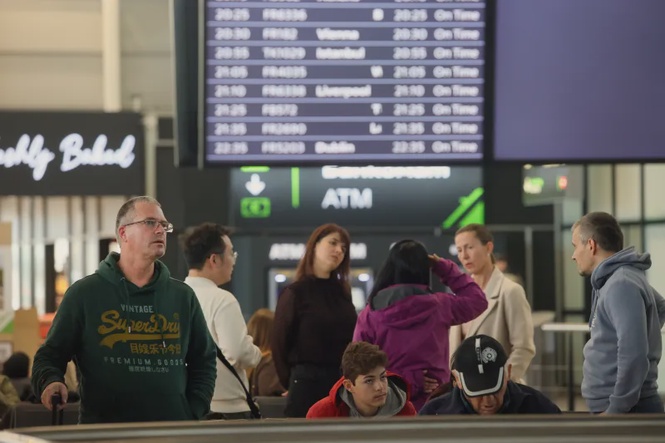
For some travelers, that unease is already setting in. "These things never used to happen here in Europe," Michael Romano, a 54-year-old passenger at Rome's airport, told the AP. "This is all new, so it is a little bit scary."
You've read it. Now join the conversation — follow us on X, Facebook and IG. Editor: Penny Wang