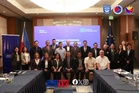
A FOUR-MEMBER Philippine team won the 2026 Cyber SEA Game, an annual cybersecurity competition among students and young engineers from ASEAN member states, with results announced on Oct. 27 in Bangkok, Thailand.
Singapore placed first runner-up, while Malaysia finished second runner-up at the competition, organized by the ASEAN-Japan Cybersecurity Capacity Building Centre with support from the Japanese government.
The Philippine team comprises Audre D. Montero of the University of the Cordilleras in Baguio City; Justin Clark H. Ong of Asia Pacific College in Makati City; Jiandale Ambal of Mindanao State University – Iligan Institute of Technology; and Glenn Castillejo of the University of Perpetual Help in Cauayan, Isabela.
They were accompanied by Rhean Joy B. Acupido, assistant school director of the University of Perpetual Help System in Cauayan.
The Cyber SEA Game uses a Capture the Flag format, in which national teams solve technical challenges across different cybersecurity disciplines. The competition aims to develop regional cybersecurity capabilities and foster cooperation among young professionals.
The Philippine team members were identified through regional competitions conducted by the Department of Information and Communications Technology (DICT), drawing participants from Luzon and Mindanao.
Ong, a recent Asia Pacific College graduate, was among the school's students who developed data analytics tools and dashboards for the National Citizens' Movement for Free Elections during the 2025 national and local elections.
Angel S. Averia Jr., president of the Philippine Computer Emergency Response Team and national chairperson of NAMFREL, welcomed the team's victory.
“I am delighted that Team Philippines captured first place in this year’s Cyber SEA Game,” Averia said. He noted that the results were announced at a reception for the ASEAN-Japan Cybersecurity Policy Meeting in Bangkok.
“This victory proves that our country has young, rising talent in cybersecurity, and not only in Metro Manila but in Baguio, Isabela, and Mindanao,” he said.
Averia said laws and technology can help protect critical systems and personal data, but public trust also depends on people with the skills and integrity to defend them. He cited partnerships between PhCERT, the National Association of Data Protection Officers of the Philippines and NAMFREL with academic institutions as one way to develop cybersecurity talent.
“We call on the relevant government agencies to support our state universities and colleges and our private academic institutions in developing the cybersecurity capabilities the country very much needs as we face growing challenges in the cyber domain,” Averia said.
The announcement coincided with a series of cybersecurity gatherings in Bangkok organized around regional cooperation between ASEAN member states and Japan.
The ASEAN Japan Cybersecurity Community Alliance was scheduled to hold its board meeting and annual general meeting on Oct. 28, followed by its third conference on Oct. 29 at the Crowne Plaza Bangkok Lumpini Park.
The alliance brings together cybersecurity communities from ASEAN and Japan under the motto “Cyber Security by All, for All.”