
Permit me, with humility, to offer some unsolicited but sincere advice on writing personal messages in wills – if you plan to do so.
Rest assured, this is free advice – an important fact, given that some lawyers tend to charge the moment they open their mouths.
As I am still driving a 16-year-old Honda Accord (not by choice), it is a clear testament that I do not fall into that special category.
Anyway, in nearly 29 years of practising estate law, I have seen hundreds of wills.
Most are perfunctory – stating who the testator appoints as executor and how the estate is to be distributed, subject to the constraints of the law, Syariah, or otherwise.
Occasionally, however, a will reveals deep anger.
Beyond naming an executor and outlining distribution, some use the document to air personal grievances – dissatisfaction over worldly matters, even a sense of not feeling loved by a spouse. Yes, this happens.
Legally, there is nothing wrong with such expressions. But as Muslims, perhaps we should reflect on the questions that await us in the grave.
My advice is simple – leave this world in peace, not only for yourself, but for those you leave behind, even if relationships are strained.
Let Allah deal with the living.
On the other hand, there are wills written with grace – by those who choose kindness over bitterness.
These are the ones truly worth reading. They remind us that despite life’s disappointments, we can still wish well for those around us. That, surely, is a legacy worth leaving behind.
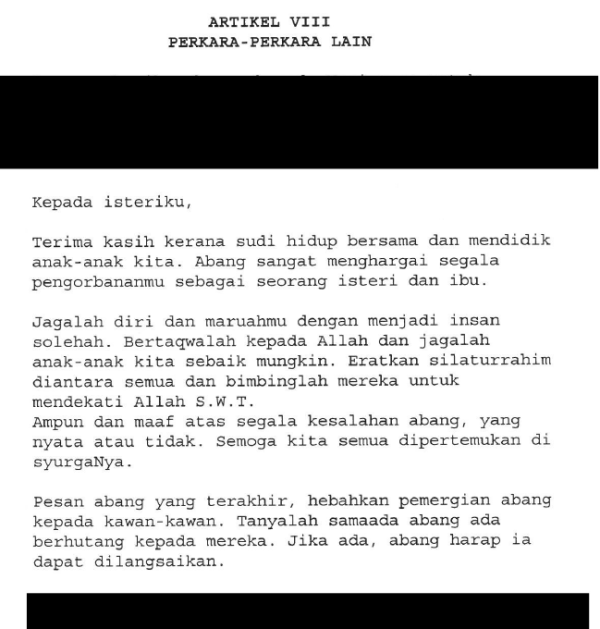
With that, I leave you with the moving words of a husband to his wife, preserved in his will – which I had the privilege of reading. I share them without identifying details, as I am the lawyer appointed to apply for probate. The husband passed away last year.
May we always strive to see the good in others. And perhaps, in doing so, they may see the good in us too, despite our imperfections.
The views expressed here are the personal opinion of the writer and do not represent that of Twentytwo13.