
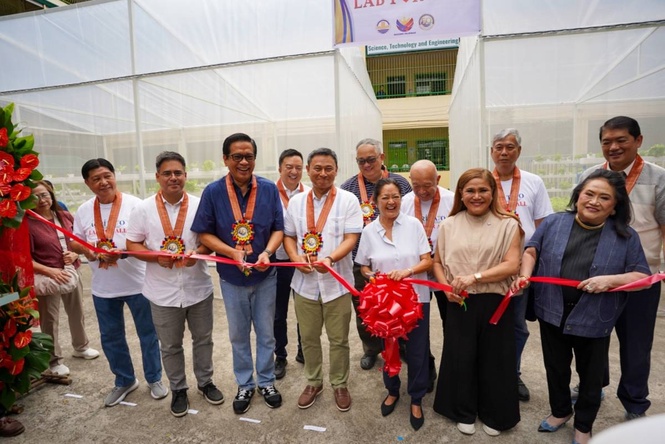
FIRST lady Liza Araneta-Marcos and Education Secretary Sonny Angara launched a nationwide school-based hydroponics project with the Philippine Reclamation Authority at the Las Piñas National High School and Parañaque National High School.
The initiative is part of the “Agri Tayo, Lab for All” program.
“The hydroponics project is a big contribution to make vegetable gardening in our schools more advanced and efficient. Not all schools have adequate space or fertile soil. So this initiative is important because the Gulayan sa Paaralan Program becomes possible even if space is limited,” Angara said in Filipino and English.
“This is also excellent for saving water. Hydroponics uses 90 percent less water than traditional farming, making it a critical buffer against climate extremes like Super El Niño. More than this, we can expand the knowledge of the community about modern farming,” he added.
The two schools received two hydroponics greenhouse facilities to maximize learner reach and community engagement.
The project was initiated through the Social Environmental Fund generated from reclamation projects. The first phase aims to establish hydroponics greenhouse facilities in 200 schools nationwide, scaling up to 700 units overall to tackle spatial and agricultural challenges in urban and coastal communities.
During the initial phase, beneficiary schools in Metro Manila and various provinces including Cavite, Cagayan, Pangasinan, Pampanga and Masbate will each receive a hydroponics greenhouse facility.
“Aside from supplementing the School-Based Feeding Program with freshly harvested vegetables, the greenhouse facilities are designed to serve as hands-on living laboratories. Through experiential learning, learners can directly observe plant growth, nutrient management, water utilization, and photosynthesis, thereby integrating real-world science into their lessons,” the Department of Education (DepEd) said.
The DepEd added that the project “supports Agri-Fishery Arts and agro-entrepreneurship electives under the strengthened Senior High School curriculum, helping learners cultivate practical livelihood and technical-vocational skills.” “DepEd and its partners look forward to expanding the collaboration to more institutions, ensuring that more Filipino learners gain practical agricultural skills while contributing to community food security,” it said.