
As Donald Trump’s war on Iran spreads further throughout the Middle East, the cost of oil has soared as traders show concerns over inflation.
The price of Brent Crude, treated as an industry benchmark for oil, soared past $100 a barrel for the first time since late July after the Houthis - an Iranian proxy group - struck energy sites in Saudi Arabia, threatening to drag the Kingdom deeper into conflict.
The US military said its destroyed five Iranian tankers carrying crude following attempts to strike a US Navy warship with ballistic missiles, while Iran claimed to have attacked two American vessels and eight oil tankers in the Gulf.
As well as this, Iranian-backed Houthi forces in Yemen launched strikes on several Saudi cities targeting energy infrastructure, including the 400,000-barrel-a-day Jazan refinery.
The Independent looks at the economic data that should be worrying Trump and other world leaders as he struggles to end the war he started in late February.
Oil prices
While Trump claimed on Tuesday in a Truth Social post that “oil prices will drop precipitously” should the US win the war with Iran, the above chart shows the seismic impact of the conflict on the global economy.
Before the conflict, the price of a barrel held steady at around $61.
It jumped to a high of $138 in April after Iran shut the Strait of Hormuz, through which a fifth of the world’s oil passed in peacetime, before declining in response to a prolonged ceasefire. The US and Iran announced an interim peace agreement in June that later collapsed.
The rising costs of Brent Crude have fanned inflation worries and curbed risk appetite while showing the demand for the commodity is on the up.
Meanwhile, the price of natural gas in the UK peaked at 197 pence per therm, the highest level since December 2022 as the conflict heightens concerns over further supply disruptions.
Gas prices
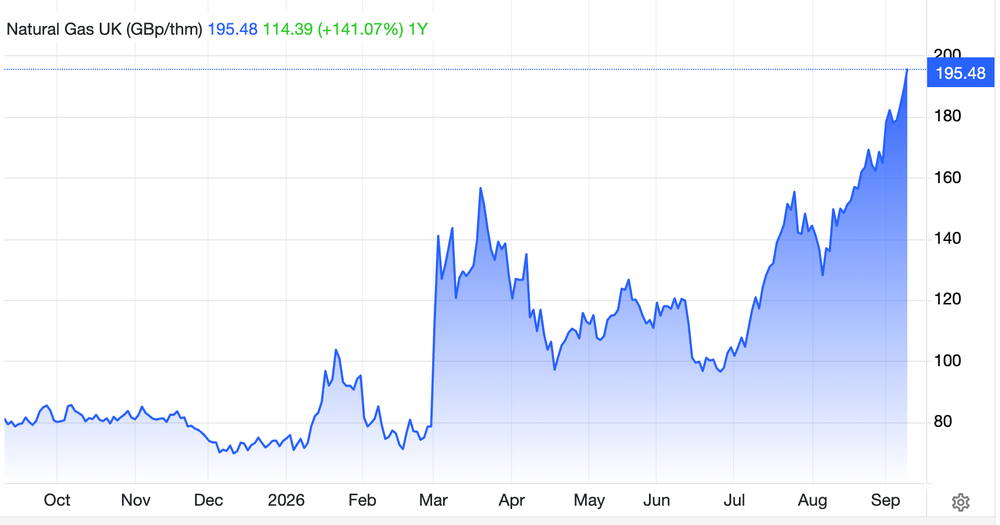
Sustained disruptions have forced Qatar to suspend shipments and extend a force majeure on cargoes to Europe and Asia through autumn.
This reduction in LNG deliveries has slowed European storage injections, with gas inventories remaining below the seasonal average, leaving the market increasingly vulnerable as the winter heating season approaches.
Ofgem, the UK’s energy regulator, warned that the price cap will rise by £60 per year – or £5 per month – to £1,723 for the average household using both electricity and gas if this level was sustained for a year.
Reacting to the energy price cap rise, Miatta Fahnbulleh said: “Families will be understandably concerned about the cost of energy bills this winter, which is being driven up by the Iran war.
“Energy is an everyday essential and it needs to be affordable for everyone, which is why we have cut VAT on electricity bills from October, to give families some breathing space.
“This has limited the rise in the price cap and follows the £150 in costs we removed from bills earlier this year, and we will keep looking at what more we can do to protect families from unaffordable bills.”
Falling GDP growth
This seemed to only indicate further difficulties for Britain’s economy, which has managed to remain somewhat resilient despite the cost pressures of the Iran war.
The World Cup and record hot weather in June are believed to have helped the economy, according to the latest quarterly data, which didn’t take as much of a hit as expected after impressive growth at the start of the year.
But chancellor John Healey warned on Monday that the Budget in the autumn could be tough as the war squeezes the British economy.
Inflation
Economists have predicted that the fiscal buffer Rachel Reeves built up in her last budget as chancellor, through a combination of tax rises and departmental spending cuts, will be squeezed by inflationary pressures.
Mr Healey told the Financial Times: “What’s happening in the Middle East is hitting inflation, it’s hitting growth, it’s hitting borrowing costs.”
He added: “It’s part of a more dangerous world that is more uncertain and it’s one of the challenges we have to meet in this country, but have to meet with other [countries].”
Meanwhile, inflation in the Euro area, made up of 21 European countries, was estimated at 3.3 per cent in August, up from 2.9 per cent in July, according to Eurostat, the statistical office of the European Union.
Energy was estimated to have the highest annual rate in August - 14.3 per cent compared to 10.3 per cent in July - followed by services (3.0 per cent, compared with 3.3 per cent in July), non-energy industrial goods (1.2 per cent, compared with 0.9 per cent in July) and food, alcohol & tobacco (1.2 per cent, stable compared with July).
The bond market
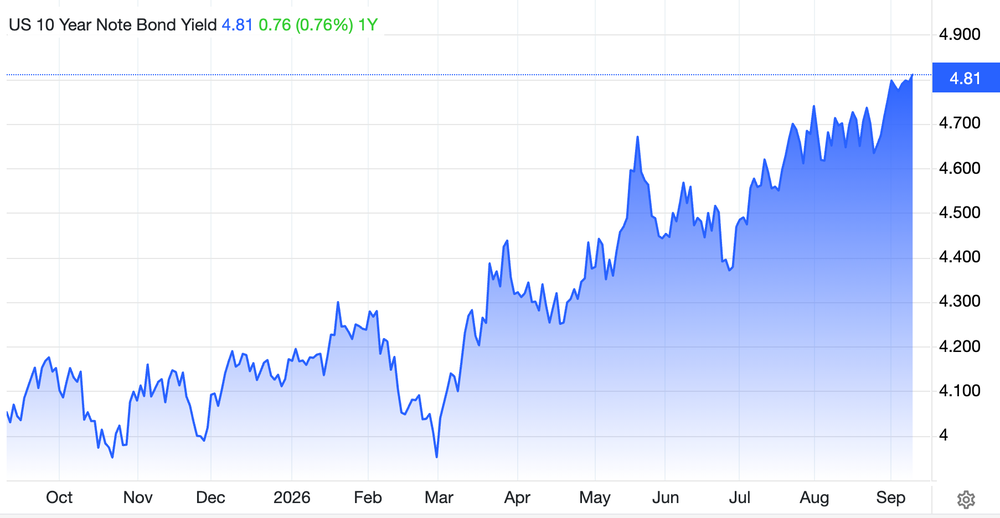
In another sign of financial anxiety across the globe, the yield on the 10-year US Treasury note rose past 4.8 per cent on Wednesday, the highest since October 2023.
Higher energy prices in the US drove interest rate hikes by the Federal Reserve this year.
Rising bond yields can make borrowing more expensive for consumers and businesses. They also heighten concerns about whether governments are issuing more debt than financial markets can handle.
The rise in the yield on the 10-year US Treasury not only has a major impact on the economy, it strongly influences mortgage rates.
The average contract rate for a 30-year fixed mortgage in the US rose to 6.85 per cent in the week ended 4 September, its highest level since June 2025, according to the Mortgage Bankers Association.
The death toll in Yemen prison airstrike rises to 23 with 7 still missing, Houthi rebels say
Zara owner brushes off heatwaves and Iran war trading pressures as sales jump
Yemen's Houthi rebels say Saudi-backed forces launched airstrikes, and other key Mideast news
MAGA merch is ‘just not worth a crap anymore,’ according to sellers
Exposure to second-hand smoke doubles in sub-Saharan Africa
Why fighting between the Houthis and Saudis is a disaster for Trump