
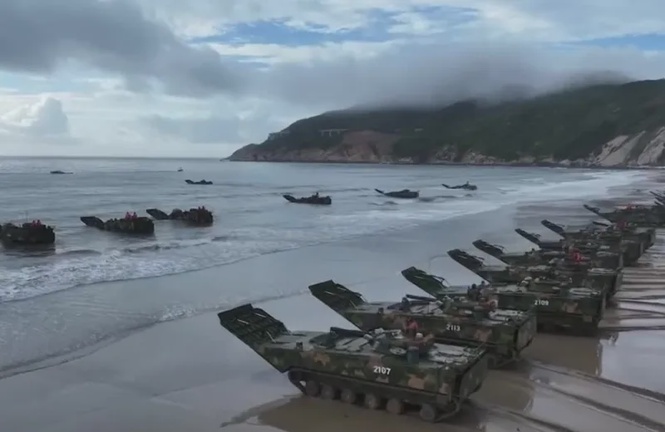
China has closed five stretches of its coastal waters for firing exercises between October 12 and 17, but none of the zones comes close to Taiwan. The nearest, off Wenzhou in Zhejiang province, lies about 150 nautical miles (278 km) from Taiwan's main island, according to Storm Media's analysis of the official navigation warnings.
China's Maritime Safety Administration began posting the warnings on October 8, covering the Bohai Sea, the northern and southern Yellow Sea, the East China Sea, and the South China Sea. The other four zones all sit more than 500 nautical miles away. Taiwan's Maritime and Port Bureau said shipping around the island has not been affected, and Defense Minister Wellington Koo described the activity as firing practice by coastal artillery and similar units.
Where China Drew Its Five No-Sail Zones
All five zones hug the Chinese coast, and each warning orders vessels not to enter. Storm Media plotted the coordinates published by the Maritime Safety Administration and used the great-circle formula to estimate each zone's distance to the nearest reference point on Taiwan's main island: Cape Fugui in the north or Cape Eluanbi in the south.
| Zone | Warning and issuing office | Closure period (2026) | Wording in warning | Size (est.) | Distance to Taiwan (est.) |
| Bohai Sea, off Qinhuangdao | Hebei warning 710/26, Qinhuangdao MSA, issued October 10, 13:44 | October 12, 06:00 to October 16, 24:00 | Live equipment operations | Six-point area, about 31 x 27 nm | About 841 nm (1,557 km) |
| Northern Yellow Sea, southeast of Dalian | Liaoning warning 419/26, Dalian MSA, issued October 10, 15:52 | October 12, 11:00 to 14:00 | Live-fire shooting | About 18 x 18 nm | About 810 nm (1,500 km) |
| Southern Yellow Sea, off Yancheng | Warning 168/26, Yancheng MSA, issued October 9, 17:14 | October 16, 07:00 to October 17, 18:00 | Live-fire shooting | About 7 x 5 nm | About 526 nm (974 km) |
| East China Sea, off Wenzhou | Zhejiang warning 908/26, Wenzhou MSA, issued October 8, 18:49 | October 13, 13:30 to 15:30; October 14, 14:30 to 16:30; October 15, 15:30 to 16:30 | Military training | About 4 x 10 nm | About 150 nm (278 km) |
| South China Sea, off Zhanjiang | Guangdong warning 725/26, Zhanjiang MSA, issued October 10, 12:19 | October 12 to 16, daily 08:00 to 18:00 | Live-fire shooting | About 5 x 5 nm | About 555 nm (1,028 km) to Cape Eluanbi |
Note: One nautical mile (nm) equals 1.852 km. Distances are Storm Media estimates based on the warning coordinates. Times are local.
Six Calendar Days, but No Zone Closed for Six
The exercise window spans six days on the calendar, yet no single zone is closed for that long. The Bohai Sea area runs from early on October 12 to midnight on October 16. The South China Sea zone is shut for 10 daylight hours each day from October 12 to 16. The southern Yellow Sea closure covers only October 16 and 17, the East China Sea zone is active for one to two hours on three afternoons, and the northern Yellow Sea zone was closed for just three hours on October 12.
The warnings also describe the activity differently. Only the northern Yellow Sea, southern Yellow Sea, and South China Sea notices specify live-fire shooting. The Bohai notice refers to live equipment operations, and the East China Sea notice says military training. Reuters described the whole set as live-fire exercises and noted that none of the five zones lies near Taiwan, with the closest off Zhejiang.
Maritime and Port Bureau Sees No Impact on Shipping
Taiwan's Maritime and Port Bureau said the three zones in the Bohai and Yellow seas are outside Taiwan's waters. It put the East China Sea and South China Sea zones at about 159 and 588 nautical miles from Taiwan respectively, both outside Taiwan's search and rescue region, west of the Taiwan Strait median line, and close to the Chinese coast. The bureau said shipping around Taiwan has not been affected and port traffic is normal, and that it will keep monitoring vessel movements and advise ships to reroute if needed.
Storm Media's estimates of 150 and 555 nautical miles differ slightly from the bureau's figures. The bureau did not say which reference points it used, which may explain the gap. Measured from Taiwan's outlying islands, the zones are closer: the East China Sea area is about 83 nautical miles (154 km) from Dongyin in the Matsu Islands, and the South China Sea area is about 322 nautical miles (596 km) from the Pratas Islands, according to Storm Media's calculations.
No Official Word Yet on Flights or Fishing Boats
All five notices are navigation warnings issued by maritime authorities and addressed to ships. None mentions airspace. Storm Media found no statement on the exercises from Taiwan's Civil Aviation Administration or Fisheries Agency, and the Maritime and Port Bureau's comments covered only port operations and shipping. Whether flights will be affected, or whether fishing boats should steer clear, remains unanswered until those agencies weigh in.
Warning Timeline Undercuts the National Day Narrative
Much of Taiwan's media has linked the drills to President Lai Ching-te's National Day address on October 10. The warning timestamps do not fully support that reading. The Wenzhou notice was issued on October 8 and the Yancheng notice on October 9, while the Qinhuangdao, Zhanjiang, and Dalian notices came out on October 10 itself. The timing does not prove the drills are unrelated to the speech, but the claim that they were announced after it does not hold for at least two of the five warnings.
In his speech, Lai said Taiwan cherishes peace but will not give up freedom, according to Reuters. Beijing has not tied the exercises to the address. On October 11, China's Ministry of National Defense accused Lai of exaggerating threats and seeking independence by force. Ministry spokesperson Chen Xi said the People's Liberation Army (PLA) routinely trains around Taiwan to deter "Taiwan independence" moves and foreign interference, calling the activity "perfectly justified and beyond reproach." His remarks addressed routine drills and did not mention the five zones.
Wellington Koo Calls It Coastal Artillery Training
Speaking to reporters on October 12 before a session of the Legislative Yuan's Foreign Affairs and National Defense Committee, Koo said the Ministry of National Defense has a full grasp of the situation. Its initial assessment, he said, is that the drills are firing practice by artillery and other units along China's coast, but the military will stay on close watch in keeping with its principle of preparing for the worst. He added that the PLA keeps staging threatening military drills that unsettle the Indo-Pacific and deserve condemnation, according to Taiwan's Central News Agency.
The Taipei Times summed up the drills as being "far from Taiwan" in its headline. That phrase was the newspaper's own framing, not a direct quote from Koo.
More Warnings Appear Beyond the Original Five
During the exercise window, the Maritime Safety Administration posted several more military drill warnings. They include Liaoning warning 421/26 from the Huludao office (Bohai Sea, October 13, 14:00 to 24:00), Liaoning warning 423/26 from the Dalian office (Bohai Sea, October 14, 06:00 to 18:00, within a 2 nm radius), Guangdong warning 736/26 from the Zhanjiang office (Beibu Gulf, October 14 to 16), and Zhejiang warning 936/26 from the Hangzhou office (Hangzhou Bay, October 21 to 22). Chinese authorities have not said whether these belong to the same round of training.
Reuters noted that the Chinese military operates around Taiwan almost daily but has not held a full-scale exercise since the large drills of late December 2025, which followed a US$11 billion US arms sale to Taiwan.