
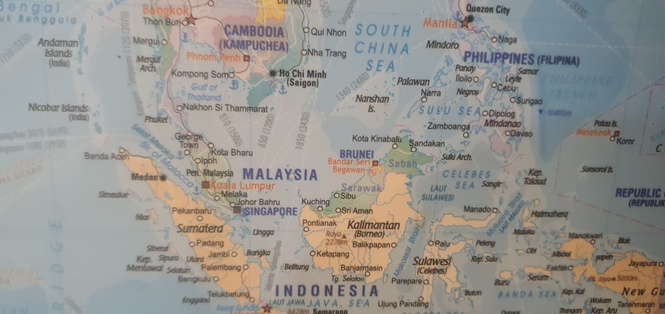
On the 28th of August, 2023, China's Ministry of Natural Resources announced the 2023 version of their standard map. Found on the map is the controversial Nine-Dash-Line. What is controversial about the Nine Dash Line is that the lines encroached into the Malaysian Exclusive Economic Zone (EEZ). On top of the controversial claim over the Malaysian EEZ, the same claim also impacts the Philippines, Vietnam, Brunei, the Republic of China (Taiwan), and Indonesia.
The Reaction
The governments of Malaysia, the Philippines, Taiwan, and Vietnam have since protested the inclusion of their respective waters in the Chinese map. Also protesting the map is India; the map also claims the Indian state of Arunachal Pradesh and the Chinese-controlled Aksai Chin. The one country that did not openly dispute the inclusion of their territory into the map is the Russian Federation.
History
The Chinese claim over the Malaysian EEZ is not a surprise; defence analysts have pointed out that the South China Sea, especially the Spratlys archipelago, is a likely flashpoint since at least the 80s. In 1988, the Chinese had forcibly taken over the Johnson South Reef in a skirmish against Vietnam, killing 64 Vietnamese soldiers and sailors while losing six of their own. In 1994, China also forcibly took over the Mischief Reef from the Philippines, albeit without casualties.
Past Malaysian governments' actions on the issue were somewhat mute; instead of openly identifying the potential threat and acting on it, the Malaysian government of the past coloured the actions with Wisma Putra submitting protest notes while calling China a big brother.
The obvious dilly-dallying on the potential threat, especially the laying down of arms by the communist insurgents, saw past Malaysian governments cosying up to the Chinese.
The cosying up also saw defence procurements sidelined after the 1980s, with the last meaningful procurement launched under the PERISTA programme. From an all-time high of 5.8% of the GDP in 1981, the Malaysian government only spent 0.9% on defence in 2019. The North Atlantic Treaty Organisation (NATO) outlined that for a nation's defence to be sustainable, i.e. sufficient for maintenance of capability and developing further capability, a nation must be willing to invest at least 2.0% of its GDP in defence. Expenditure between 1.0% and 2.0% could only sustain the existing capability. In contrast, any lower defence capability will deteriorate due to the cannibalisation of existing assets and further obsolescence, which the Malaysian Armed Forces, especially the Air Force and the Navy, face.
The politicisation of defence procurements and embezzlement further compounds the lack of political will in the Malaysian government to do what is right. Those supporting the government would defend defence procurements, while those supporting the opposition would continue politicising defence procurement as corrupt. The fact that the Malaysian public so quickly 'forgives' and 'condemns' any political figures that switch sides makes it easier for these political figures to politicise the procurement to the nation's detriment.
In contrast, the Vietnamese and the Philippines are all into ensuring their barks against China come with more giant sticks. Both countries have frequently protested against the Chinese claims into their territorial waters and strengthened their defence procurement to ensure that if push comes to shove, they can stand their ground. In 2021, Vietnam spent USD 5.5 billion on defence, approximately 2.0% of its GDP. Even though the Philippines spent only 1.0% of their GDP on defence in 2021, they have recently undergone a massive procurement programme, which will see its combat capability undergoing massive improvement soon.
The Philippines have resorted to calling the disputed areas the West Philippines Sea in response to the Chinese claims that the South China Sea indicates their historical claim over the area. To a certain extent, Malaysia could also assert a similar claim by renaming the sea as the Malay Sea or Champa Sea, a name rooted in the history of the Malay archipelago. But it is counter-productive; the ocean south of India is the South Indian Ocean, but India does not claim the whole ocean as belonging to it.
White-Hull Fleet in Play
So far, the Vietnamese have been the most ardent in criticising the Chinese. They confronted the Chinese Navy in the disputed area and even employed their militia and coast guard, modifying the Chinese approach of the white-hull navy into the equation. White-hull navy refers to the Coast Guards, which denotes civilian agency, while grey-hull navy refers to the grey-coloured hulls of a military ship.
Spill-over into Entertainment World
Their stance on this issue even spilt over into the entertainment world. To enter the Chinese market, Hollywood appeased Beijing by willingly inserting previous versions of the region's map showing the controversial nine-dash-line. The Vietnamese authorities frequently banned these movies, with movies such as The Abominable and Barbie running afoul of this guideline.
History
What is this Nine-Dash Line that is so controversial that it intruded into our EEZ and other neighbouring countries? Contrary to popular attribution to the imperialistic nature of the Communist Party of China (CPC), the line is a relic from the days of the Nationalist Republic of China. To ignite patriotism amongst the peasantry, the new republican government reminded the Chinese peasantry of the national shame using maps known as maps of China's national humiliation. One of these maps, published in 1927, claims a large part of Southeast Asia as part of the lost territories of China. The Chinese University of Hong Kong currently has possession of the map.
Blowback to BRICS
But the most critical blowback to the map's controversy is the potential impact on the BRICS. The Russian invasion of Ukraine has pushed the economic group closer. The retaliatory sanctions and cheap Russian petroleum products had forced Russia to increase reliance on the economy group, concurrently weaponising the group to devalue the US Dollar, hoping it would weaken the Western support (read: The United States) for Ukraine. Sensing the need for the Indian Armed Forces to modernise, the United States has increasingly courted Narendra Modi's government and enticed them with US platforms. If the US move is successful, coupled with the French's foray into the Indian defence sector, it would mean that the Russians' grip over the Indian defence sector would diminish. The war in Ukraine also forced India to seek military consumables from other countries, weakening the relationship. India's current reliance on Soviet bloc weaponry came from Soviet Russia's assistance in rebuilding the nation's military after the disastrous Sino-India War in 1962, while the West were reluctant to help.
With the latest Chinese map, the Chinese claimed the Bolshoi Ussuriysky island as theirs despite agreeing with the Russian claim in 2005, implying that Moscow might be having hefty reliance on Beijing. If Moscow's leverage on Beijing diminishes, Delhi might need to make new friends to pressure China, opening the gap for Washington to extricate the I from the BRICS.
Impact on AUKUS
The Chinese declaration of the new map could also further embolden the Australian resolve for the AUKUS plan. The Australians still have a military obligation in the region as part of the Five Power Defence Agreement (FPDA) with the British, New Zealand, Singapore, and Malaysia. With the British Armed Forces undergoing a reduction of size despite the increasingly unstable geopolitics in the European theatre and the New Zealand Armed Forces lacking any offensive capability, the Australians would likely be picking up the tab to help out Malaysia and Singapore in the event of a conflict in the region.
Hot Spot Laid Bare
With this hot spot now laid bare, would we see some realisation in Putrajaya? Or are we still claiming that the threat is overblown and that this is purely part of the Western agenda to limit China's perceived accession to global dominance?
Danny Liew is a content creator under the Newswav Creator programme, where you get to express yourself, be a citizen journalist, and at the same time monetize your content & reach millions of users on Newswav. Log in to creator.newswav.com and become a Newswav Creator now!
The User Content (as defined on Newswav Terms of Use) above including the views expressed and media (pictures, videos, citations etc) were submitted & posted by the author. Newswav is solely an aggregation platform that hosts the User Content. If you have any questions about the content, copyright or other issues of the work, please contact Newswav.
