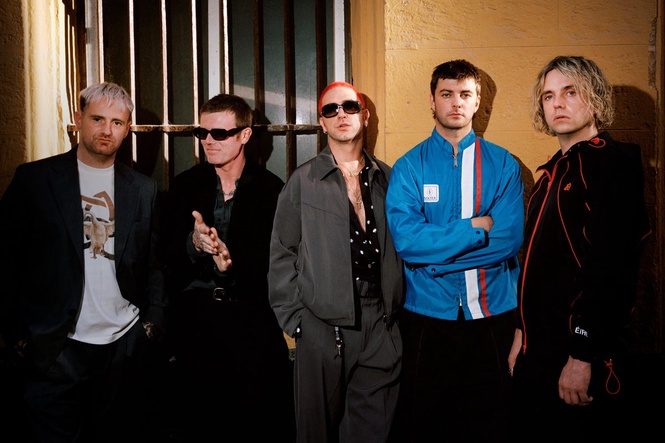
There’s a reverence to Fontaines DC’s Dopamine Chamber, the Irish rock band’s fifth album – which turns out to be their masterpiece. Just as their second album, A Hero’s Death, felt like a recoiling from the hype that surrounded their Mercury Prize-shortlisted 2019 debut, Dogrel, so does this feel like a reaction, of sorts, to their 2024 triumph, Romance. That fourth album bristled and swaggered, owning their newly claimed status as arena headliners – the greatest band of their generation. Dopamine Chamber is just as ambitious, if not more so, but it is ominous too, holding up a dark mirror to our dark times.
The tension that runs through the record makes sense when you learn that, years after they first played in Sicily, at a small festival outside of Palermo in 2019, frontman Grian Chatten returned – perhaps pulled by the same force that has lured artists, philosophers and poets there for centuries. Surrounded by what he described as “a sense of oldness”, he and producer James Ford built a fort from pillows and mattresses, like children. Sicily exists on this knife’s edge, of young and ancient, life and death. So does Fontaines’ music.
Ahead of the album’s release, guitarist Carlos O’Connell observed how “happy-go-lucky pop music” feels strange to him: “Optimism can feel delusional, while confronting darkness actually adds a lot of meaning to life.” They certainly confront it here, in the industrial trip-hop of single “Tongue”, which churns about queasily like guilt and self-loathing in the stomach. “You say you don’t, I swear your happiness is going missing,” Chatten sighs, “Am I allowed to say it if nobody’s going to listen?” The sorrowful, sweeping “One Man” is a lament: “Dopamine chamber, just trying to kill the pain, you can’t escape the feeling once you’ve given it a name.” His sense of helplessness is palpable in the echoing, hollow refrain: “I’m only one man.”
The themes of Dopamine Chamber take on new, tragic meaning after the death of Fontaines’ longtime manager, Trevor Dietz, in June this year. Such profound loss always brings certain things into a harsher glare, questions like, how do we keep going? What do we do?
As for its sound: Fontaines have always swerved any direct pastiching of their influences, but there are traces, like temples looming out of the fog, at which the band make respectful offerings. “Mimesis” has the bass thrum and buzzy synths of Depeche Mode, while The Cure’s gloom seeps into the guitar hooks of “You Miss Me” and “Happy for You”. Chatten’s tremendous duet with Catalan singer Rosalia, “Where is Gone?”, plays out like a dystopian western; a Morricone epic set in the ruins of a society that has destroyed itself and left Chatten and Rosalia as the last two standing, shrouded in dust.
On “Mimesis”, one of the album’s best, Chatten queries our false realities, the little worlds we build to hide ourselves away – at the same time, seemingly questioning his own purpose as the artist. “I’ve driven such a long way here,” he intones. “Your indifference won’t make me disappear.” It’s impossible to be indifferent about an album as astonishing as this.
Read MoreThe biggest headline rumours for Glastonbury 2027
Why Depeche Mode fans are flocking to a Prague bridge
Taylor Swift has released one diamond and three duds. What went wrong?