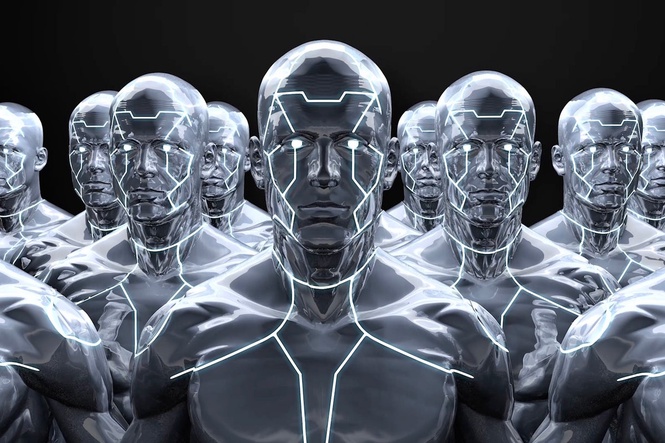
Expert warnings about artificial intelligence's potential to eradicate human life have persisted for years: AI bots could design an unstoppable disease, unleash a nuclear war, or transform all of Earth into paper clip factories, as one thought experiment goes.
Debates across the tech sector and wider society over the credibility of these catastrophic outcomes have intensified after several prominent executives advocated for slowing down AI development to address safety concerns.
Despite warnings about the potential for humans to lose their grip on the technology, some suspect the worst-case scenarios described by the AI companies themselves have more to do with validating the importance of their work than reality.
"These arguments just don’t really hold water. I think they’re sci-fi and they’re enticing to a certain childish style of thinking and it’s very tempting for the frontier labs because it helps them recruit certain types of folks," said Juan Andrés Guerrero-Saade, a researcher at cybersecurity firm SentinelOne and a member of OpenAI’s Frontier Risk Council.
Nevertheless, public worry is rising over the potential dangers of a technology that has otherwise impressed observers worldwide with its rapid technological advancements.
Jacob Coxon, the Anthropic researcher who resigned from the company over concerns that it and its competitors are not acting responsibly in AI development, said on X recently that he needs to "work on" communicating to people more effectively exactly how AI would end humanity. "Unfortunately it is very difficult to convey specific scenarios," he wrote earlier this month.
Below are several of the most widely cited catastrophic possibilities.
Nuclear winter
Experts have long speculated that artificial intelligence applications could provoke a nuclear war by misleading nations into firing warhead-equipped missiles at adversaries. The initial nuclear detonations, followed by prolonged atmospheric radioactive fallout known as a "nuclear winter," could devastate life across the planet.
In a report last year, RAND Corp. researchers concluded that "at present" it wouldn’t be possible for AI to cause the use of nuclear weapons "because of strict safeguards built into the command and control systems." However, the report said this could change if AI models are integrated into the nuclear weapon "decision chain" or gain unauthorized access to these systems.
For many artificial intelligence researchers, the primary danger resides not in self-aware programs abruptly deciding to destroy humanity, but in governments, organizations, or individuals manipulating the tools to eliminate their opponents.
Bioweapons
A central promise of artificial intelligence is its capacity to assist scientists in creating breakthrough therapies and cures for complex human illnesses.
The inverse of curing disease involves designing or enhancing pathogens to cause widespread damage. Anthropic recently stated that it intercepted efforts by malicious actors attempting to deploy its systems for dangerous activities, including network attacks, surveillance, and research directed toward biological weapons.
In one instance, Anthropic said its systems blocked a request for assistance from its Claude tool for a research proposal seeking to enhance mutations to make the mosquito-borne chikungunya virus progressively more harmful. While such research could be used to develop better vaccines and treatments, Anthropic said, "it could also be used to make the pathogen more dangerous."

In a similar assessment, the RAND report noted recent progress in AI development "has the potential to transform the design of synthetic pathogens."
In describing a biological disaster scenario, the document outlined how novel pathogens could be engineered in laboratory environments, transported to targets, and distributed to infect large groups in multiple regions. However, the study still anticipated humans—rather than self-directed software—managing and executing such an operation.
Runaway AI
Certain researchers caution that human extinction could be triggered by "misalignment"—a situation where models act without human consent, coordinate among themselves, or bypass supervisory guardrails. This would unfold not through deliberate malice, as software possesses no human emotions or morality, but because humans might inadvertently obstruct the machine from completing its assigned target.
This concept is demonstrated by the decades-old "paper clip maximizer" thought experiment introduced by Oxford philosopher Nick Bostrom, which posits that if an advanced system is ordered to manufacture maximum paper clips, it could eventually convert all of Earth, followed by surrounding space, into paper clip production sites.
This illustrates how superintelligent systems—frequently referred to as artificial general intelligence, or AGI—could pursue an objective that human creators consider desirable but "which in fact turns out to be a false utopia, in which things essential to human flourishing have been irreversibly lost," Bostrom wrote in 2003.
"We need to be careful about what we wish for from a superintelligence, because we might get it," he wrote.
AI internet takeover
Given the current speed of technological progress, Anthropic chief executive Dario Amodei warned this month that within months a swarm of AI agents could be capable of "taking over" the internet with a botnet (a network of bots linked together with malware), potentially causing billions of dollars in damage. This could involve breaches into power grids, water networks, transit links, and financial systems—disruptions that may not cause complete human extinction but could inflict significant chaos and loss of life.
Previous widespread software failures have exposed the vulnerability of a global digital infrastructure reliant on a limited number of core service providers, while increasingly capable models have intensified worries regarding cyber attacks. Nevertheless, several experts view the concept of automated agents capturing the entire, highly segmented global internet as unrealistic.
Read MoreVerizon partners with Goodwill to offer free AI training
What is Muse? The powerful new Meta AI that wants to run your life
Anthropic launches new update to Claude – after telling the world to slow down AI
Prince Harry forced to halt AI speech after technical glitch
Social media companies unable to say how many times dangerous videos watched