

A major political earthquake, which came close to rattling the very foundations of the Unity Government, may have been averted in Negeri Sembilan. But is the uneasy “pause” merely a prelude to something more perilous for PMX and PH – come GE16?
Still waters run deep. Perhaps this axiom best encapsulates the ongoing chaos in the relatively peaceful and progressive state of Negeri Sembilan.
Truth be told, could anyone have foretold the turmoil that has gripped the state lately: a bid by its four chieftains to remove its ruler, the Yang di-Pertuan Besar Tuanku Muhriz Tuanku Munawir – with a hapless Menteri Besar caught in the middle?
For the record, the political upheaval in the state was triggered last Monday (April 27) when 14 UMNO assemblymen withdrew their support for the state Menteri Besar Aminuddin Harun. Citing a “loss of confidence” in his leadership amid the royal dispute, the move effectively stripped Pakatan Harapan of its majority – and with it, the clear mandate to rule the state!
But how did a Palace crisis turn into a political time bomb?
Surely, the question many would ask is: since the crux of the problem was the Adat Perpatih – a Minangkabau-derived customary law involving the ruler and his Undangs (chieftains) – weren't there any prior discussions between the BN-UMNO leaders and their PH compatriots on how best to handle such a sensitive subject? More tellingly, why did the former resort to a sudden “about face,” which sparked allegations of betrayal and power grab?
Compatriots or conspirators…?
With BN-UMNO holding 14 seats and PH with 17, all it needed was the support of the five Perikatan Nasional state assemblymen to obtain the 19-seat threshold – the magic number in the 36-seat state assembly – to secure a simple majority.
Almost right on cue, the state's five opposition PN assemblymen then announced their readiness to work with BN-UMNO, reasoning that it was to ensure stability, continuity, and the people’s well-being.
Nevertheless, critics, including DAP Youth, have slammed any attempts to form a “backdoor government” with the opposition, as it would be a violation of democratic principles – perhaps invoking memories of the so-called “Sheraton Move” during the COVID-19 era.
With the crisis grabbing national headlines, and Menteri Besar Aminuddin’s PH-led government teetering on the brink of collapse, UMNO president Ahmad Zahid Hamidi then intervened – assuring that he will resolve it through proper political channels. Notably, he also promised not to interfere in the administrative affairs and the customary laws of the state.
Yet, significantly, didn't he admit that the party's top leadership was aware of the controversial move by his party's assemblymen – while defending their action as something done in good faith?
Are some forces within UMNO sharpening their knives already – for the kill?
More recently, in a series of hard-hitting social media posts, even former Rembau MP Khairy Jamaluddin challenged those accusing his party of pursuing a tebuk atap (backdoor coup). He drew a sharp comparison with the then-opposition leader Anwar Ibrahim’s bid to bring down the BN government back in 2008.
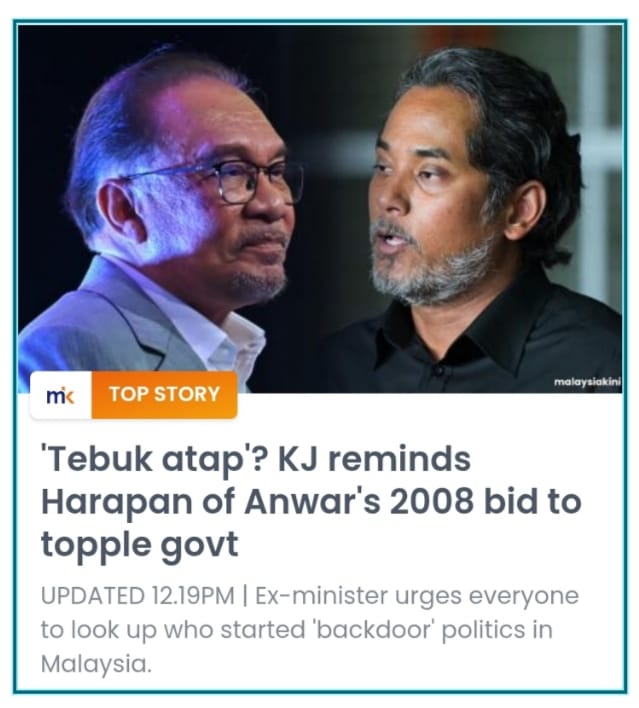
Screenshot of news headline and image from Malaysiakini.
Meanwhile, despite losing the majority, the embattled Aminuddin vowed to stand his ground – citing the ruler's orders to continue running the state as a minority government until the deadlock is resolved.
In fact, the ruler's “decree” effectively gave him a “lifeline” against any attempts to topple the state government. And the irony is that BN-UMNO can't form a new government with PN – so long as the current ruler refuses to swear them in. Period.
Amid all the mayhem, PM Anwar then reassured that Aminuddin will remain as Negeri Sembilan Menteri Besar – in line with the state ruler's order – and further signaled that a state election at this juncture was unlikely.
The truth is, in Malaysia's fluid and complex political landscape, nothing is ever truly predictable, and the latest flare-up only served to underscore the lingering feelings of distrust between PH and BN.
Inevitably, it has also raised some serious questions:
Firstly, why was BN-UMNO “hasty” in withdrawing support for the PH-led state government, especially when the issue had more to do with the Palace and its domestic adats than politics per se?
In a broader sense, how will the political flashpoint in Negeri Sembilan affect the relationship at the federal level between two key coalitions within the Unity Government? Moreover, foreign minister Mohamad Hasan – who serves in PM Anwar's administration – is also an assemblyman in the state. And as some might ask: if he were to distance himself from the other 13 assemblymen, wouldn't the entire “move” be rendered a no-go? But will that happen?
Instead, by seemingly aligning with the dissenting chieftains, the BN-UMNO assemblymen may have, by extension, implicitly agreed to the removal of the current ruler. Wouldn't this action be perceived by critics to be contradicting the party's own core principles, since it has always prided itself on being the undisputed defender of race, religion and royalty?
After all, isn't the act of “defying” a reigning ruler considered by some parties as a form of derhaka (treason)?
Then, what about the expected domino effect from the fallout in Negeri Sembilan vis-a-vis other BN-led state governments such as Perak and Pahang, where the party is dependent on PH to form a majority? Wouldn't it risk relinquishing the coveted Menteri Besar post to PN?
In truth, this latest conflict is another clear manifestation of the undercurrents of distrust and rivalry that still persist among the various political factions in the country. In fact, early this year, wasn't Bersatu involved in the removal of the Perlis Menteri Besar, who hails from its own coalition partner, PAS?
Indeed, had the alleged political “coup” succeeded in Negeri Sembilan, the momentum may well have triggered realignments in Perak and Pahang, while forcing PH into a retreat. Furthermore, wouldn't it also have gradually “paralyzed” the Unity Government – forcing an early general election while potentially paving the way for the return of the old pandemic-era BN-PN administration?
Crucially, last Thursday (April 30) UMNO president Zahid Hamidi announced that the political standoff in the state had been resolved, after the party's 14 assemblymen had agreed to continue supporting the current administration. Still, the gaping question remains: weren't they the very protagonists who had – just days earlier – proudly announced that by “joining hands” with the opposition, they had allegedly secured the majority to form a new state government?
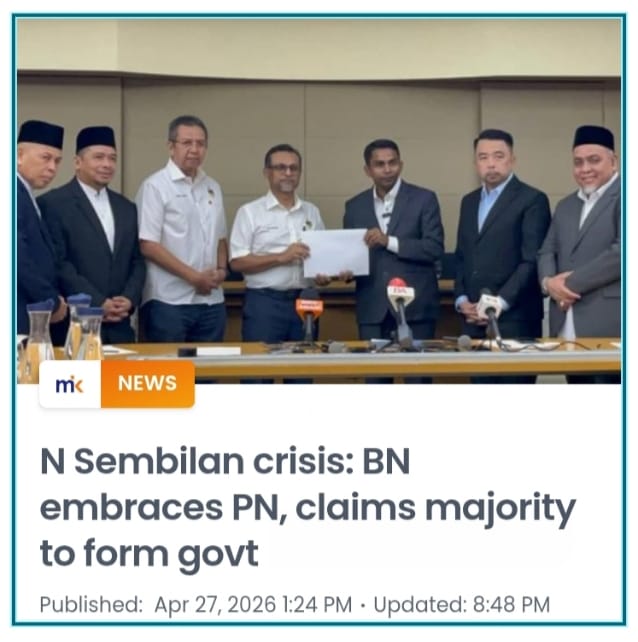
Screenshot of news headline and image from Malaysiakini.
So, was that the end of the saga – or was it merely a “dress rehearsal” for the real show?
The bottom line is, given that there is no love lost in Malaysian politics, even among so-called “old buddies,” the disturbing events in Negeri Sembilan may well be a chilling reminder to both PMX and PH that far greater aftershocks could be awaiting them in GE16. As such, shouldn't some hard lessons be learned from this seemingly brazen political gambit by their own supposedly trusted ally?
Main information source: The Straits Times, The Edge Malaysia, SCMP, Malaysiakini, Focus Malaysia, Vibes, Scoop and Malay Mail
JK Joseph (jtkingsworld@gmail.com) is a content creator under the Newswav Creator programme, where you get to express yourself, be a citizen journalist, and at the same time monetize your content & reach millions of users on Newswav. Log in to creator.newswav.com and become a Newswav Creator now!
The User Content (as defined on Newswav Terms of Use) above including the views expressed and media (pictures, videos, citations etc) were submitted & posted by the author. Newswav is solely an aggregation platform that hosts the User Content. If you have any questions about the content, copyright or other issues of the work, please contact creator@newswav.com.