There was a time not so distant, if we’re honest when the birth of a daughter was met not with joy, but with a quiet, uneasy pause.
In many traditional societies across Asia, including parts of Indian and Chinese communities, the first question that followed a baby girl’s arrival was often painfully pragmatic:
"What can a daughter do for us?"
It’s a question that feels harsh today, but it didn’t arise from cruelty alone. It was shaped by generations of economic realities and cultural expectations. Sons were seen as anchors they carried the family name, inherited property, performed ancestral rites, and were expected to support their parents in old age. Daughters, meanwhile, were often viewed as temporary members of the household, destined to marry and leave.
Over time, this thinking hardened into something deeper than bias. It became a worldview one that quietly assigned value to a child based not on who she was, but on what she could provide.
The consequences were severe. Across parts of South Asia, girls were denied education, married off young, or treated as burdens. In the most tragic cases, female infanticide became a grim reality.
Thankfully, societies evolve. Attitudes shift. But the echoes of that past remain. Understanding those echoes helps us appreciate how far we’ve come and how much strength it has taken to get here.
When Cinema Held Up a Mirror
Sometimes, it takes art to say what society struggles to admit.
The Tamil film Karuththamma did exactly that. It held up a mirror and forced audiences to confront an uncomfortable truth.
In the film, a newborn girl is condemned simply for being female. Yet fate intervenes. She is saved, raised with care, educated, and eventually becomes a doctor. Years later, she returns not with anger, but with compassion to save the life of the very father who once rejected her.
There is something quietly powerful about that story. It is not just about redemption; it is about possibility. The child once dismissed as worthless becomes the one who gives life back.
That narrative resonates beyond cinema. It reminds us that potential cannot be measured at birth, and that those we underestimate often carry the greatest capacity for change.
Today, that same lesson is unfolding across Malaysia.
The Quiet Reality of the Malaysian Indian Mother
The Malaysian Indian community has travelled a long and often difficult path. Many families trace their roots to the rubber estates of the colonial era places where life was physically demanding, economically uncertain, and socially limiting.
When those estates declined, families moved to towns and cities in search of better opportunities. But while the setting changed, the struggle did not disappear. It simply took on a different form.
Instead of tapping rubber trees, many mothers found themselves sweeping streets, cleaning offices, working in factories, or taking on domestic work. The jobs changed, but the reality remained the same: long hours, modest pay, and constant pressure to make ends meet.
Within these households, especially among the B40 income group, mothers became far more than caregivers. They were planners, negotiators, and problem-solvers. They stretched every ringgit, weighed every expense, and made difficult choices often at their own expense.
Some delayed medical treatment because school fees came first. Others skipped meals so their children would not go hungry. Many worked through pain and exhaustion because missing a day’s wages could mean falling behind on rent or utilities.
These sacrifices rarely appear in statistics. Yet they form the foundation of countless success stories we celebrate today.
We applaud graduates and professionals and rightly so. But behind many of those achievements is a mother who woke before dawn, worked tirelessly, and carried the weight of her family’s future on her shoulders.
Motherhood Beyond Affection
It is easy to romanticise motherhood. We see it in greeting cards, social media posts, and carefully staged celebrations.
But for many working-class Malaysian Indian mothers, love is expressed differently.
It is not always spoken. It is not always visible in grand gestures.
Instead, it appears in quieter ways in the extra shift taken without hesitation, in the meal skipped without mention, in the decision to prioritise a child’s education over personal comfort.
Their love is steady, practical, and rooted in sacrifice.
For many of these mothers, the dream was never about luxury. It was about giving their children a chance at something better. Education became more than a goal it became a lifeline.
A school uniform symbolised hope. A university acceptance letter marked a turning point for the entire family.
That is why education holds such a sacred place in many Malaysian Indian households. It represents not just academic success, but freedom the possibility of breaking cycles that once seemed unbreakable.
From the Streets of Seremban to the Skies
Few stories capture this journey more clearly than that of M. Kavita, a 50-year-old street sweeper from Seremban.
For over twelve years, Kavita worked under the Malaysian sun, keeping public spaces clean. It is the kind of job many overlook. But for her, it was never just about sweeping streets.
It was about building a future.
Every day she showed up not because the work was easy, but because she understood something simple: her children’s opportunities depended on her consistency.
Recently, her story touched many Malaysians when her eldest daughter, nurse L. Bharathi, together with her siblings, organised a surprise birthday celebration for her. It was not extravagant, but it did not need to be.
They were not celebrating her job. They were honouring her sacrifices.
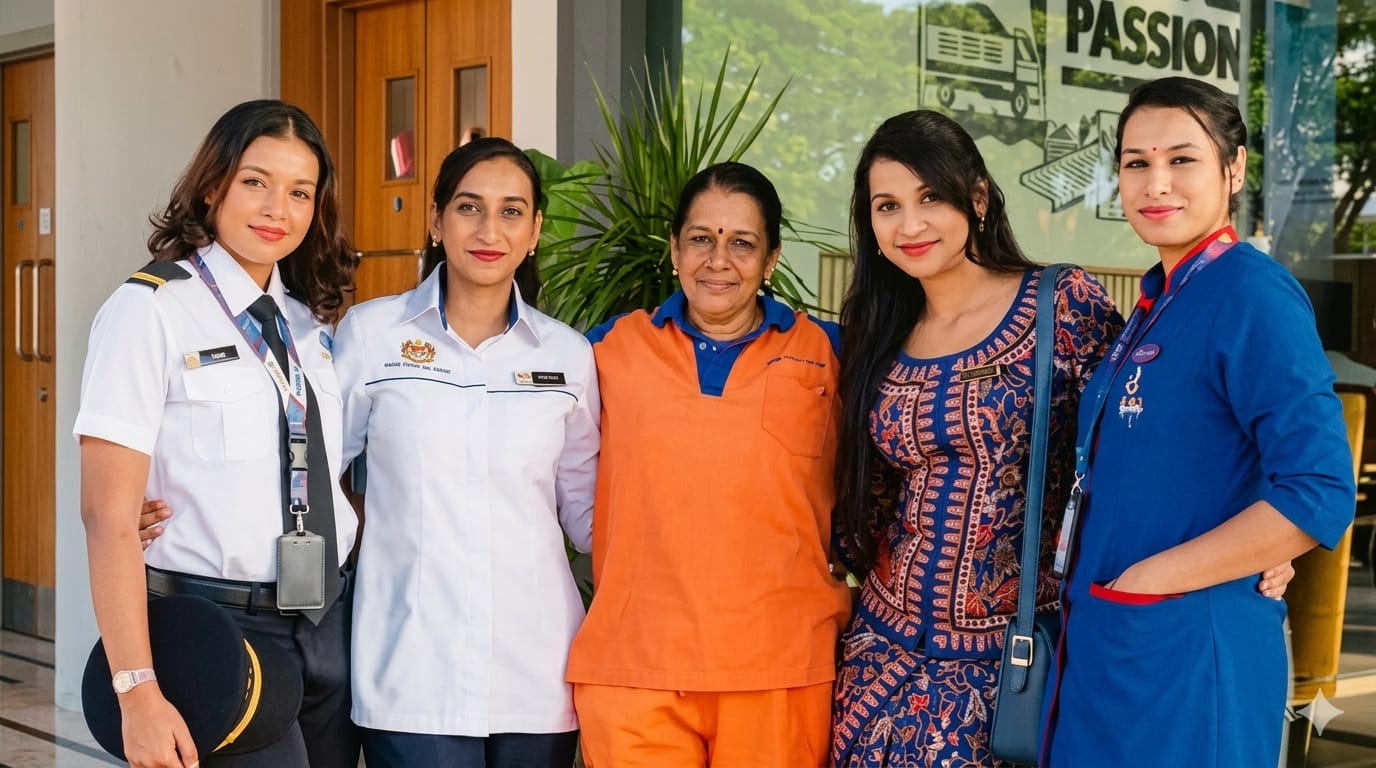
Today, Kavita’s children have built lives that reflect years of quiet perseverance. One is a pilot. Another works as a flight steward. Bharathi serves as a nurse. Another sibling is a government school teacher.
Each achievement tells the same story: a mother worked tirelessly so her children could reach places she never had the chance to.
What stands out even more is Kavita’s dignity. Despite her children’s success, she has expressed a desire to continue working not out of necessity, but out of independence.
It is a reminder that dignity is not tied to status or income. It is rooted in character.
For her children, their mother’s broom was never a symbol of hardship. It was a symbol of strength.
Redefining Success
Stories like Kavita’s challenge us to rethink what success means.
It is easy to associate success with titles, salaries, or recognition. But those markers do not tell the full story.
Sometimes, success looks like a cleaner whose child becomes a doctor. A factory worker whose daughter becomes an engineer. A single mother who sees her son graduate from university.
These stories may not dominate headlines, but they carry deep significance. They reflect a kind of progress that is personal, gradual, and transformative.
Behind each outcome is someone who chose to endure hardship so that someone else could dream more freely.
The Revolution No One Sees
There is a quiet revolution unfolding within many Malaysian Indian families.
It does not make noise or attract attention. But it is steady and powerful.
It happens in small homes where parents choose school fees over comfort. Where mothers continue working despite illness. Where fathers take on multiple jobs. Where children study late into the night, aware that their efforts carry the weight of their family’s sacrifices.
This change does not happen overnight. It unfolds across generations.
One generation survives.
The next moves forward.
And eventually, another begins to thrive.
It is not an easy journey. But it is a meaningful one.
Beyond the Question of Yesterday
Looking back, that old question “What can a daughter do for us?” feels out of place today.
Because the answers are everywhere.
A daughter can become a nurse, a teacher, a pilot, a scientist, or a leader. She can support her family, uplift her community, and shape the future.
Or she can simply be a child who remembers, with gratitude, the sacrifices that made her journey possible.
There is a quiet irony here. The daughters once seen as burdens have become pillars often carrying families forward in ways once unimaginable.
The question no longer needs to be asked. Life has already answered it.
The Architects of Compassion and Mobility
Working-class Malaysian Indian mothers may not appear in history books. They rarely stand on stages or receive public recognition.
But their impact is undeniable.
With tired hands and unwavering resolve, they have reshaped the futures of their families. They have shown that poverty is not permanent, that dignity exists in every honest job, and that education can open doors once thought closed.
They have also shown something deeper that children, whether sons or daughters, are never burdens when given love, opportunity, and belief.
The streets that mothers like M. Kavita sweep each day do more than keep a town clean. They clear the way for the next generation to walk further.
Perhaps that is the thread connecting Karuththamma to the streets of Seremban. A society that once questioned the worth of daughters now witnesses those same daughters and all children raised with care becoming healers, educators, professionals, and leaders.
This transformation did not begin in grand halls or policy debates.
It began quietly in kitchens before sunrise, on estate paths, in factory lines, and on city streets.
It began with mothers who believed, often against the odds, that their children deserved more.
Their names may not be widely known.
But their stories are written in the lives they have changed.
Annan Vaithegi writes, "Every generation remembers its heroes. But every successful generation is first shaped by a mother whose sacrifices history rarely records."
Annan Vaithegi (annanvaithegi@icloud.com) is a content creator under the Newswav Creator programme, where you get to express yourself, be a citizen journalist, and at the same time monetize your content & reach millions of users on Newswav. Log in to creator.newswav.com and become a Newswav Creator now!
The User Content (as defined on Newswav Terms of Use) above including the views expressed and media (pictures, videos, citations etc) were submitted & posted by the author. Newswav is solely an aggregation platform that hosts the User Content. If you have any questions about the content, copyright or other issues of the work, please contact creator@newswav.com.