THE Financial Stability Coordination Council (FSCC) is strengthening its monitoring of potential systemic risks as geopolitical tensions and volatile financial markets continue to pose challenges to the Philippine financial system.
“Global risks remain elevated, with geopolitical tensions in the Middle East and volatile financial markets,” Bangko Sentral ng Pilipinas (BSP) Governor and FSCC Chairman Eli Remolona Jr. said on Tuesday.
“Nonetheless, our financial system remains well-positioned to absorb shocks,” he added.
The council said it is taking steps to improve its ability to identify emerging vulnerabilities early and strengthen the financial system’s capacity to manage potential shocks.
“These measures include enhanced monitoring of non-bank financial intermediaries to support their sound and sustainable development,” the council said.
“The Council is also improving data collection and information sharing among FSCC members,” it added.
The FSCC made the assessment during its 46th Executive Committee meeting held earlier this month at the BSP Head Office in Manila.
The council said the Philippine financial system continued to be supported by sound capital and liquidity positions, as well as prudent risk management.
These strengths allow financial institutions to continue providing credit to households and businesses despite the challenging global environment.
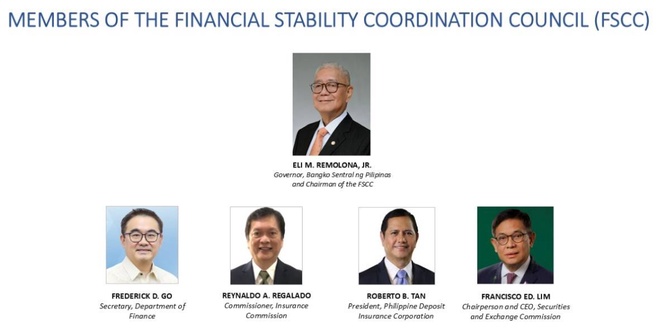
The FSCC is composed of the BSP, Department of Finance, Insurance Commission, Philippine Deposit Insurance Corp., and Securities and Exchange Commission. It coordinates efforts among financial authorities to monitor and manage systemic risks in the Philippine financial system.
The council said its efforts to strengthen surveillance would ensure that emerging vulnerabilities would be identified before they could develop into broader threats to financial stability.
The FSCC is further strengthening its assessment of liquidity, leverage, concentration and interconnectedness.
These assessments cover the relationships and linkages among banks, nonbank financial intermediaries, corporations and financial markets, allowing authorities to better understand how risks could spread across different parts of the financial system.
Moreover, the council conducts an annual Survey of Salient Risks to identify risks that could affect the financial system over different time horizons. The survey covers risks over the next 12 to 24 months as well as the next three to six years.
In the latest survey conducted in July, respondents identified geopolitical tensions, cyberattacks, and disruptions in global supply chains as key risks that warrant close monitoring.
The respondents included universal and commercial banks, rural and cooperative banks, thrift banks, other BSP-supervised financial institutions, nonbank financial institutions, nonfinancial corporations, government agencies, insurance companies, and members of the academe.
“The Council stressed that early identification of risks supports stronger preparedness,” it said.
“It allows financial authorities and market participants to improve safeguards, refine contingency arrangements, and limit the impact of shocks on households, firms, and financial institutions,” it added.
Remolona said they “proactively address risks through close monitoring, timely information sharing, and robust coordination among its members.”