DAVAO CITY — Homegrown Dabawenyo delicacies will take the spotlight in the new tourism circuit launched by the City Government of Davao.
Davao Food Crawl and Market Experience, a circuit that takes tourists to the sprawling Bankerohan Public Market, will stop at several stalls and stores selling well-loved food and delicacies.
One iconic market establishment is the 54-year-old Del Mar Painitan.
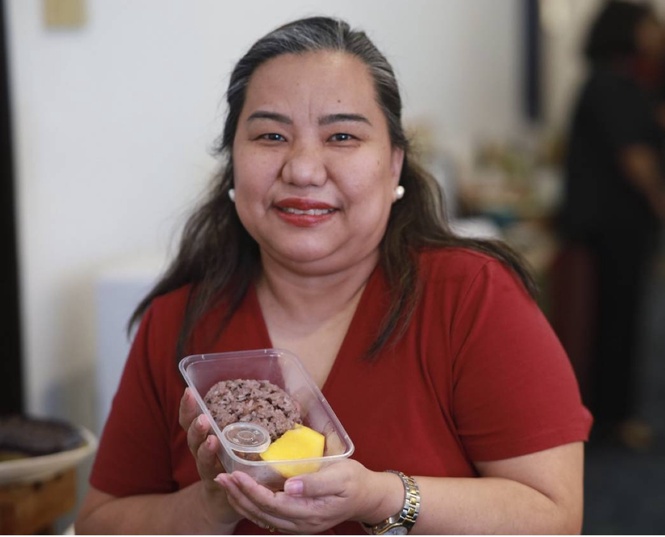
Opened in 1972 by the couple Alberto and Lourdes Delmar, the Painitan is known for its bestsellers, including puto maya (sticky rice cake) topped with mango and muscovado sugar, biko (sweet rice cake) and sapin-sapin (layered sticky rice cake).
It is also known for its sikwate (chocolate drink) from Davao cacao beans; and kinutil, a drink made from sikwate, tuba (coconut wine), egg and milk, which has attracted foreigners and local tourists.
“My parents started as vendors, but through hard work, the business improved. Now we have a stall, and since 1972, we have maintained the quality of our offerings. Kung unsa to before tung timpla, quality hangtod karon mao lang gihapon (How it was before, the mixture, the quality is still maintained),” current second-generation owner Lara Grace Tapiz said.
These delicacies were influenced by the taste of Alberto and Lourdes, who come from Cebu and Bohol.
“Bisayan gyud siya and pag-abot diri butangan nila og Davao flavor (Basically, our delicacies and drinks have Bisayan origins, and when Alberto and Lourdes came here, they laced them with a Davao flavor),” Tapiz said of their food and drinks, reflecting the rich influence brought by migrants coming from different parts of the country to Davao’s cuisine.
And the Davao market experience captures those stories, bringing life to what used to be a mundane destination: a public market.
The curated tours, under the new tourism circuits, plunged into the rich flavors, culture and unique stories that make Davao City a destination worth exploring.
“Our mission is to connect Davao City not just to Dabawenyos but to everyone who wants to visit Davao City. We are focusing on community-based tourism, targeting new circuits, new experiences,” City Tourism Operations Office OIC Willenito Tormis Jr. said during the launching of the new circuits.
Department of Tourism (DOT)-Davao Regional Director Tanya Rabat Tan says the new tourism circuit offers opportunities to communities, farmers and entrepreneurs who stand to benefit from tourism activities.
“This ensures that the tourism industry contributes meaningfully to local livelihoods,” Tan said.
The DOT has partnered with the city government to validate these new circuits. Aside from the market experience, the Davao Abundant Harvest (agro-tourism) and the Furosato Davao (Davao pre-war Japanese heritage) circuits were also launched on March 6.
“Expanding tourism routes supports a more sustainable approach to tourism by spreading visitor movement across multiple destinations,” Tan said.
For Tapiz, the new circuits will greatly help their business. Although before the validation and launch, there were already privately initiated, curated tours in Bankerohan, which brought in tourists and expanded their clientele.
She says people would not just pass them by, as the store is located along the main passageway inside the market, drawing regular customers as a place for afternoon or morning snacks. They now have tourists coming over to the store.
“Naka-help siya na dili nalang mi agi-anan, gina-adtuan na dyud mi. People now appreciate our products (Our location in the market helped passersby notice the store, which has now become a go-to site in that part of the market, and people appreciate their products),” Tapiz said.
She says they have prepared their store for the influx of tourists.
“We always maintain the quality of our products and at the same time prepare our store ready for foreigners and local visitors, maintaining cleanliness and quality food,” Tapiz said.
She added that tourists will enjoy their delicacies without shelling out much money as they maintain the prices of their products.
“Walay difference sa price, very affordable siya (There is no difference in prices, affordable),” she added.
As local entrepreneurs, they are grateful for the tourism activity as it has helped promote their products and stores.
“Grateful jud mi sa tourism kay nailhan mi hinay-hinay sa mga foreign and local visitors na naga-adto sa amoa (We are grateful to the tourism industry because we are slowly becoming known among foreign and local visitors),” Tapiz said.
" My parents started as vendors, but through hard work, the business improved. Now we have a stall, and since 1972, we have maintained the quality of our offerings. Kung unsa to before tung timpla, quality hangtod karon mao lang gihapon (How it was before, the mixture, the quality is still maintained).”
Davao’s edible map: A deep dive into the food crawl and market experience
To understand Davao City, one must eat it.
Unlike other urban centers where the culinary scene is often confined to air-conditioned malls, Davao’s gastronomic heart beats in its streets, open-air markets and backyard “holes-in-the-wall.” The Davao Food Crawl is more than a tour; it is a sensory immersion into the “Fruit Basket of the Philippines” and the unofficial culinary capital of Mindanao.
Rite of passage
No food crawl in Davao is complete without a pilgrimage to Magsaysay Fruit Vendor’s Association or the Agdao Public Market. Here, the air is thick with the polarizing, custardy scent of Durian. For the uninitiated, the crawl begins with a tasting session of various cultivars — from the mild, sweet Puyat to the intense, bitter Arancillo.
Market vendors here are seasoned educators, demonstrating the “hand-to-mouth” tradition of eating the fruit and often pairing it with a side of mangosteen to “balance the heat,” according to local folk wisdom. This market experience highlights Davao’s agricultural prowess, where the proximity to the fertile slopes of Mount Apo ensures that the produce — pomelo, marang and cacao — is unparalleled in freshness.
The ‘sugba’ culture
As the sun sets, the crawl shifts toward the smoky lanes of the Bankerohan Public Market or the upscale yet rustic “Pala-Pala” style eateries. Davao’s soul is found in sugba (grilling). The star of the show is almost always the tuna jaw (panga). In a city that serves as a gateway to the rich fishing grounds of the Celebes Sea, the tuna panga is grilled to a charred perfection, its fatty, gelatinous meat basted in a simple calamansi-soy glaze.
Complementing the grilled mains is the kinilaw, Davao’s answer to ceviche.
Unlike the northern versions, Davaoeño kinilaw often uses suwa (native lime) and tabon-tabon (a tropical fruit) to remove the fishiness and prevent indigestion.
Cacao connection
The crawl increasingly features Davao’s “black gold.” As the Cacao Capital of the Philippines, the city has integrated chocolate into its savory and sweet offerings.
A visit to the Malagos Garden Resort or specialized chocolate cafés allows visitors to trace the journey from “bean to bar.” Tasting a cup of thick, frothy sikwate (native hot chocolate) paired with puto maya (sticky rice with ginger) provides a glimpse into the city’s colonial and indigenous heritage.
The spirit of ‘boodle fight’
The Davao food experience is fundamentally communal.
Whether it is a luxury spread at an upscale Davao Gulf resort or a humble table at a turo-turo in Matina, the emphasis is on the “boodle fight” — a military-style dining tradition where food is served on banana leaves and eaten with bare hands (kamayan).
It reflects the city’s identity: a melting pot of Christian, Muslim and Lumad influences, all sharing a single table.
Davao’s market experience isn’t just about the food — it’s about the stories of the farmers, the fishermen and the vendors who have turned the city into a resilient, self-sustaining edible map of the South.