By Dr. Victor S. L. Tan
Artificial intelligence is no longer a distant possibility. It is changing how we serve customers, make decisions, solve problems and create value.
After decades of working with leaders and organisations on strategy, leadership and change, I have learned one enduring lesson: the greatest risk is not change itself, but our failure to change with it.
Today, I believe every employee must ask a challenging question: If AI can perform more of the tasks I do, what will make me valuable tomorrow?
My answer is both reassuring and demanding. We must learn to work intelligently with AI while strengthening the distinctly human qualities that give our work meaning and impact. One without the other will not be enough.
The New Definition of an Indispensable Employee
Employees once built their careers largely on knowledge, experience and technical competence. These still matter, but are no longer sufficient. Information that once took hours to gather can now be assembled in seconds, while reports and data analysis can be accelerated.
This does not mean employees have become less important. It means the definition of their value is changing.
I see the future-proof employee as someone who combines AI-powered productivity with human-centred effectiveness: delivering better outcomes while building confidence, relationships and commitment among people.
The goal is not merely to remain employed. It is to become more capable, more adaptable and more valuable to the organisation and the people it serves.
Turn AI into a Partner for Performance
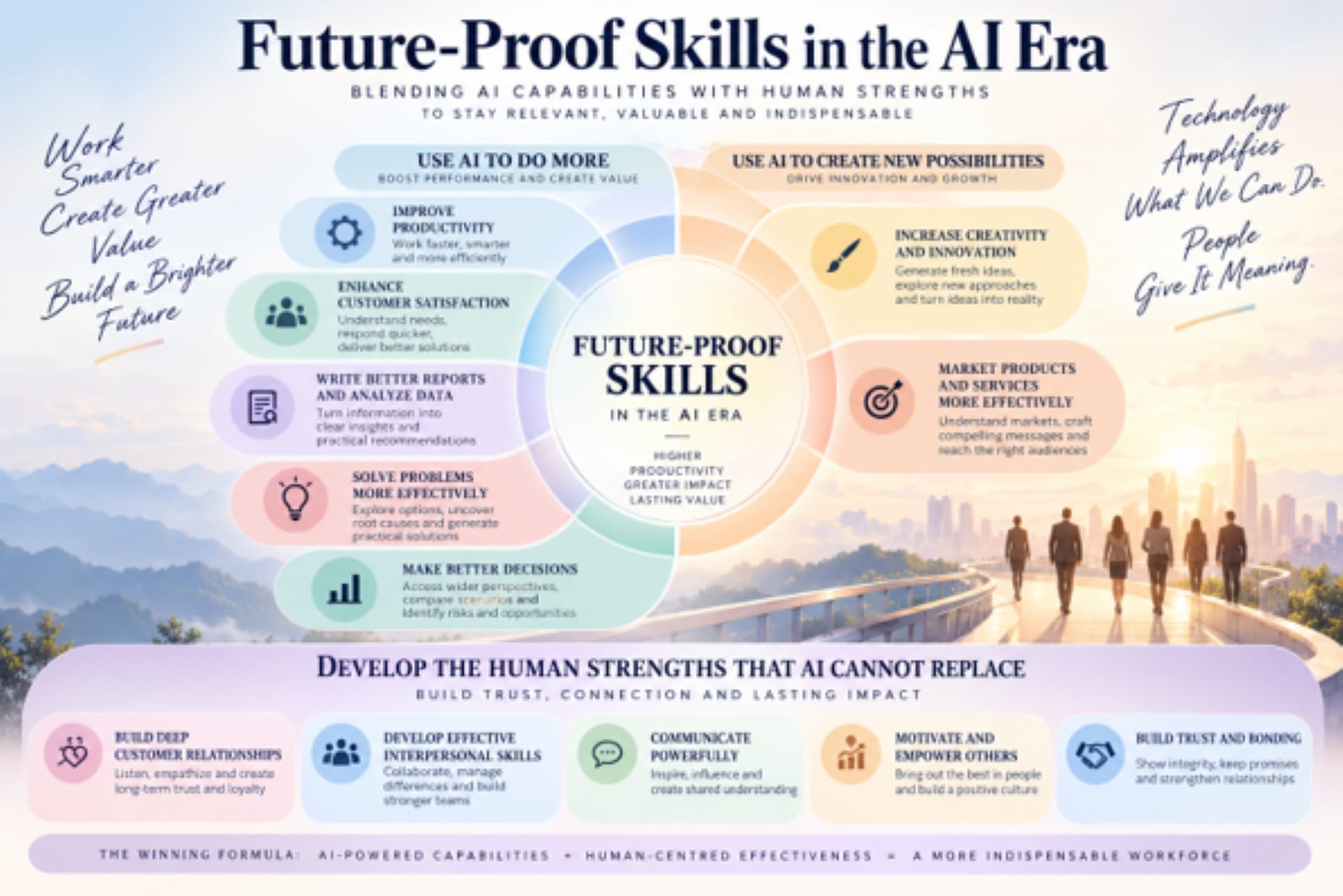
First, we must use AI to raise productivity. Consider routine activities: preparing presentations, summarising meetings, organising information, drafting correspondence or developing proposals. AI can accelerate these tasks, freeing time for deeper thinking, problem-solving and customer engagement.
But productivity is not about doing more work for its own sake. It is about achieving better results with the time and resources available.
Second, we should use AI to enhance customer satisfaction. Intelligent tools can help us understand recurring complaints, identify changing preferences, respond more promptly and tailor solutions to different customer needs. Yet I always remind leaders that customers do not merely want fast answers. They want to feel heard, respected and understood. Technology can support good service; it cannot replace sincere concern.
Third, AI can strengthen reporting and data analysis. It can help employees organise information, identify trends, spot anomalies and communicate findings clearly. Instead of spending hours compiling figures, they can focus on understanding what the evidence means and what action it calls for.
Fourth, AI can help us solve problems more effectively. When faced with declining sales, repeated customer complaints or operational delays, we can use AI to explore root causes, connect patterns and compare possible solutions. The value lies not in accepting its first answer, but in asking sharper questions and testing solutions against reality.
Fifth, AI can support better decision-making. It can help us evaluate alternatives, model scenarios, assess risks and anticipate consequences before we act. But AI must inform decisions, not make them for us. Sound decisions still require experience, ethical judgment, accountability and an understanding of people.
However, AI-generated answers must never be accepted blindly. Facts need verification, sensitive information must be protected, and final judgments must remain accountable to people. Speed without sound judgment is not progress.
Sixth, AI can stimulate creativity and innovation. Progress begins when we challenge familiar assumptions. AI can generate fresh possibilities, test different approaches and help us see opportunities we might otherwise overlook. Yet it takes human imagination and initiative to turn an idea into meaningful change.
Finally, AI can transform how we market products and services. From understanding market segments and drafting campaign messages to exploring customer insights and refining communication, it can help organisations reach the right audiences more effectively. Still, a compelling message must be backed by a product that delivers, and a promise that is kept.
The opportunity is to use AI thoughtfully where it improves performance, quality and customer value.
Develop the Human Strengths That Technology Cannot Replace
There is another side of future-proofing that concerns me even more.
As organisations invest heavily in technology, we must not neglect the human capabilities that sustain trust, teamwork and loyalty.
I have seen many situations where technical competence alone was insufficient to win a customer, resolve a conflict or inspire a team. What made the difference was the ability to connect with people.
Consider customer relationships. AI may help us understand a customer's history and preferences, but a truly meaningful relationship grows through listening, empathy, reliability and genuine care. Customers stay not only because a company is efficient, but because they trust the people behind it.
The same applies to interpersonal skills. Employees who can collaborate across departments, appreciate different viewpoints and manage disagreements constructively create value that cannot be measured simply by how quickly they complete tasks.
Then there is communication. AI can draft a polished speech or presentation, but it cannot assume personal responsibility for standing before anxious employees, explaining difficult decisions with sensitivity and winning their confidence. Powerful communication requires not only the right words, but also authenticity, courage and emotional awareness.
Motivation is equally important. A leader may use AI to create performance plans, yet inspiring someone to believe in their potential requires encouragement, understanding and personal example. People give their best when they feel respected, trusted and part of something worthwhile.
Above all, we must learn to build trust and bonding. Trust is not created by clever prompts or impressive dashboards. It is earned through integrity, consistency, keeping promises and being there when people need us.
I believe the winning formula is simple: become technologically smarter without becoming emotionally poorer.
A Wake-Up Call for CEOs and Leaders
CEOs and senior leaders must recognise this shift before it becomes a crisis.
The question is no longer simply, “How much should we invest in AI?” It is also, “How are we preparing our people to remain valuable as AI transforms their jobs?”
I would encourage leaders to begin by identifying how roles are changing, which tasks AI can support, and which human capabilities will become more important. Employees need practical opportunities to use AI for productivity, problem-solving and better decisions while learning to question its output and apply sound judgment.
Equally, organisations must invest in communication, customer relationship-building, teamwork, motivational leadership and a culture of trust. These are not optional “soft skills”. They are strategic capabilities that influence customer loyalty, employee commitment and organisational resilience.
Leaders should also measure success differently. Do not celebrate the number of AI tools adopted. Ask whether customers are better served, decisions have improved, teams are more effective and people have more time for work that truly matters.
And importantly, create an environment where employees feel encouraged to learn rather than ashamed of what they do not yet know. Fear produces resistance. Confidence, supported by clear expectations and responsible safeguards, creates commitment.
The Choice We Must Make Today
My message to every employee is this: do not wait for your organisation to decide your future for you. Take responsibility for your own growth. Learn one useful AI application. Improve one customer interaction. Strengthen one relationship. Become a better listener, communicator and problem-solver. Small improvements, consistently pursued, can lead to remarkable transformation.
To every CEO and leader, my message is equally clear: future-proofing your organisation begins with future-proofing your people. Technology may change the way work is done, but people will continue to determine how wisely it is applied and how much trust it earns.
No skill can guarantee a job for life. But a willingness to learn, the ability to create value and the character to earn people's confidence can greatly strengthen our relevance through change.
The future will not belong merely to those who know how to use AI. It will belong to those who know how to combine the intelligence of technology with the wisdom, compassion and influence of being human.
When machines become smarter, we must not become less human.
We must become more capable, more connected and more indispensable than ever before.

Dr Victor S. L. Tan is the Chief Executive Officer of KL Strategic Change Consulting Group. He is the author of 21 books, including Changing Mindsets, Releasing Trapped Minds, Changing Your Corporate Culture, and Lessons of Tan Sri Teh Hong Piow. KL Strategic Change Consulting Group is the winner of The BrandLaureate Award for making one of the most positive and profitable impacts on organisations through corporate training.For a free assessment of your organisation’s Change Readiness In The AI Era, email him at victorsltan@klscc.com or contact at 012-390 3168. www.klscc.com
Dr Victor SL Tan (victorsltan@klscc.com) is a content creator under the Newswav Creator programme, where you get to express yourself, be a citizen journalist, and at the same time monetize your content & reach millions of users on Newswav. Log in to creator.newswav.com and become a Newswav Creator now!
The User Content (as defined on Newswav Terms of Use) above including the views expressed and media (pictures, videos, citations etc) were submitted & posted by the author. Newswav is solely an aggregation platform that hosts the User Content. If you have any questions about the content, copyright or other issues of the work, please contact creator@newswav.com.