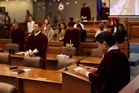
PRESIDING Senator-Judge Francis Escudero should actually be commended for issuing what can reasonably be construed as a gag order against all parties in the impeachment trial of Vice President Sara Duterte. The restriction covers not only the lawyers for the prosecution and the defense, but also the impeached official herself and, more importantly, Escudero’s fellow senator-judges.
At least on paper, the ruling recognizes that restraint must apply to everyone who can influence the proceedings.
What is disconcerting, however, is the apparent overjudicialization of what remains primarily a political process. I have already expressed in this column my reservations about invoking the sub judice rule against the litigants and even against Duterte herself. An impeachment court may borrow the language, rituals and procedures of an ordinary court, but it cannot completely erase the political character of impeachment.
The traditional justification for the sub judice rule is most compelling in jury trials, where ordinary citizens sit as jurors and may be vulnerable to outside influence coming from the parties, the media and the wider public. Restrictions on public commentary are intended to shield them from prejudicial information that could affect their judgment before all the evidence has been formally presented.
That is not what is happening here. The senator-judges are not ordinary jurors randomly selected from the population. They are elected national officials, seasoned political actors and, in many cases, experienced lawyers. They routinely confront public criticism, partisan pressure, media scrutiny and competing narratives. If they are so gullible or vulnerable that public commentary could easily corrupt their judgment, then they should not be sitting as judges in an impeachment trial in the first place.
Escudero rationalized his gag order as a way to maintain decorum and preserve the dignity of the proceedings. This is a legitimate objective. An impeachment trial should not deteriorate into a media circus, a shouting match or a competition among lawyers and politicians for viral moments.
But the actions of the parties, from the prosecution and defense lawyers to Duterte herself, are not the first things that would erode the dignity of the proceedings. If anything, the greater threat would come from the conduct of the senator-judges. The people sitting on the bench carry the heavier responsibility because they possess the authority to ask questions, issue rulings and ultimately decide the fate of the impeached official.
It was therefore telling that immediately after Escudero read his ruling, some senator-judges continued to behave as if the demand for restraint applied only to other people. Problematic words such as “stupid” and “nagtatanga-tangahan” were still uttered. The latter was even translated into the English phrase “feigning ignorance,” as if the foreign construction were somehow less accusatory.
And then there is Robinhood Padilla, who can ignore his poor, restless, misplaced, unfortunate soul, who never fails to surprise us with his constant violation of decorum and rational thinking. Escudero could have illustrated there and then that he meant business if he allowed lawyer Mae Divinagracia to reply to the idiotic line of questioning of Padilla. But this is where the problem lies. Instead of allowing reason in Divinagracia to surface, as she would surely have responded with clarity, Escudero gagged her, and allowed Padilla to inflict on all of us his irrationality without the benefit of a challenge.
This is where the lack of fairness becomes glaring. Parties who violate the ruling may be publicly admonished or fined as much as P30,000. Lawyers may even be referred to the Supreme Court for disciplinary action. Yet the principal remedy against an erring senator-judge is an ethics proceeding, which, as everyone knows, can take forever and may eventually lead nowhere.
Escudero has also appeared hesitant to call his colleagues out of order, even when some of them clearly deserve such a ruling. It is not enough for the presiding officer to ask the lawyers and Duterte to observe decorum while allowing senator-judges to engage in grandstanding, insulting insinuations and lines of questioning that appear designed more for social media than for establishing facts.
The robes cannot become shields against accountability. On the contrary, wearing them should impose a higher standard of restraint. A senator-judge cannot demand respect for the impeachment court while behaving in a manner that invites ridicule. Judicial authority is not created by costumes, honorifics or ceremonial language. It is earned through fairness, competence, impartiality and disciplined conduct.
This is the greater danger to the credibility of the impeachment process and to the public’s respect for it. It is not necessarily destroyed when litigants advocate their causes inside and outside the impeachment court. Neither is it automatically diminished when Sara Duterte behaves in her usual intemperate, uncouth and unrestrained manner. These are expected features of an intensely political confrontation.
Impeachment was never intended to be insulated completely from politics. Its ultimate question is not merely whether a technical legal violation occurred, but whether an official remains worthy of holding public office. Legal standards matter, but political accountability, public trust and constitutional judgment are equally central. Public discussion is therefore not an alien intrusion into the process. It is part of the democratic environment in which impeachment necessarily operates.
What would certainly erode the credibility of the process is the spectacle of Escudero being harder on the parties while refusing to discipline colleagues wearing judicial robes. A gag order that silences lawyers and litigants but leaves senator-judges free to insult, grandstand and display irrationality would not protect the dignity of the impeachment court. It would merely enforce a hierarchy in which those with the greatest power are subjected to the least restraint. Restraint cannot be credible when it descends only upon those seated before the bench and never upon those seated on it.
Escudero deserves credit for recognizing that decorum must be protected. But if he truly wants his ruling to command respect, he must apply it most firmly on those seated beside him. The dignity of the impeachment court will not be preserved by gagging everyone except the people who can damage it the most.
The author is a professor at the University of the Philippines Los Baños and vice chairman of the board of People’s Television Network Inc. (PTVN).