
-is-measured-in-Australia.jpeg?width=1200&auto=webp&trim=0%2C0%2C0%2C0)
Invasive cane toads in Japan are growing bigger and changing more rapidly than suggested by long-held theories about the pace of evolution, scientists say in a new study.
The cane toad has spread to more than 40 countries from its habitat in northeastern South America, making it one of the most studied invasive species in the world.
Just decades after they were introduced in Australia to control beetles, they spread rapidly, causing widespread damage to native wildlife.
The palm-sized animal carries toxins that are deadly to predators like quolls, crocodiles, and snakes, making their introduction into the country one of the world’s most famous ecological disasters.
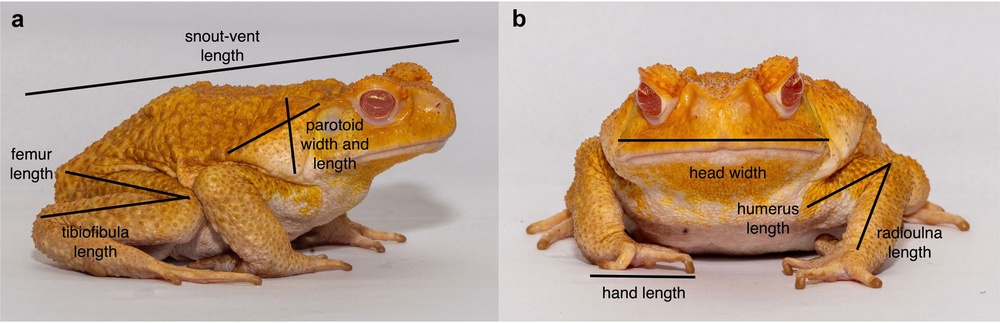
The new study found that the cane toads in Japan were larger than their Australian counterparts. Researchers compared the dimensions and weights of cane toads caught in Australia to wild ones caught on the subtropical Ishigaki island in southern Japan as well as those from Hawaii and South America.
“Comparison of our samples with cane toads from the native range (French Guiana) and other invasive populations (Hawaii and Australia) reveals substantial shifts in mean body size and shape,” researchers noted in the study published in the journal Royal Society Open Science.
They found that adult toads from Ishagaki weighed an average of 190g compared to 135g for toads from Australia.
“Given these populations of toads in Japan and Australia shared a common history in Hawaii until the 1930s, these differences in size and body shape have developed in less than 100 years,” Rick Shine, an evolutionary biologist at Macquarie University, Sydney, said. “The idea that evolutionary change happens at a glacially slow pace is being challenged by recent evidence showing rapid changes in species confronted with novel challenges, like being translocated to a different habitat.”
Researchers are not entirely sure what might be driving the changes in body size.
“We don’t have a clear idea of the evolutionary forces that might be involved, so we can’t say why body mass and shape have changed among the toads in the Japanese system,” Dr Shine said.
Researchers suspect that favourable climatic conditions, especially year-round rainfall on the Japanese island, as well as the impact of lower predation pressure, may be driving the changes.