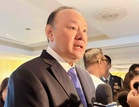
GILBERTO “Gibo” Teodoro Jr.’s continued stay as head of the Department of National Defense (DND) has become a serious concern. This is no longer simply a question of whether one agrees or not with his views on China. The larger question is whether his actions, statements and apparent approach to the dispute serve the national interest or place the country in greater danger.
Gibo, however, carries himself as though the Philippines has the military strength to dictate the terms of a confrontation. There is confidence in his statements and actions that appears to assume that the United States will always be there to protect us.
That is a dangerous assumption.
Having a powerful ally does not make us a powerful country. An alliance is not a magic shield that can make the country impervious to any military attack. It likewise does not mean that the Philippines can provoke a confrontation and assume that someone else will bear the consequences.
The recent lesson from the Middle East should not be lost on us. Countries in the Gulf have hosted American forces and maintained close military ties with the US. However, when the conflict between the US and Iran intensified, American military facilities and interests in the region became targets. The presence of American forces did not make the region immune from conflict. It made the countries hosting those forces the battlefield.
What happened there can happen in the Philippines.
If the Philippines increasingly allows itself to become a military outpost in a larger conflict between the US and China, we should not assume that we will remain untouched if that conflict turns into war. American military facilities will not deter an attack on the Philippines, just as they did not in the Middle East.
This is where diplomacy becomes important.
The 1987 Constitution declares that the Philippines renounces war as an instrument of national policy and adopts the generally accepted principles of international law as part of the law of the land. It also directs the state to pursue an independent foreign policy. None of these principles means that the Philippines should surrender its rights or abandon its claims in the South China Sea. However, defending our rights and avoiding war are not inconsistent.
A responsible government should use every available means to protect the country. This includes diplomacy, international law, alliances and military preparedness. The problem arises when one instrument of national policy begins to undermine the others.
Recently, President Ferdinand Marcos Jr. has spoken of the need to improve engagement and communication with China. Whatever one may think of this approach, foreign policy ultimately comes from the president. The defense secretary does not have a separate mandate to conduct his own foreign policy.
Gibo appears to have forgotten this.
His actions and statements give the impression that he is pursuing his own course, even when that course appears inconsistent with the president’s efforts to open or improve diplomatic engagement with China. Even the head of the Department of Foreign Affairs (DFA) has not been spared from public disagreements with him.
This is not how a coherent government should operate.
The DFA and the DND have different functions, but they should work together toward the same national policy. Diplomacy and defense should complement each other. One should not undermine the other. Most importantly, Cabinet members must recognize that the president sets the direction of the government.
A defense secretary may advise the president. He may likewise disagree with a proposed policy in private, and even argue against it within the Cabinet. But once the president has set the direction, a Cabinet secretary has only two honorable choices: support that policy or resign.
There is also the unresolved issue of Gibo’s citizenship. His explanation that he returned his Maltese passport raises more questions than it answers. Returning a passport is not necessarily the same as formally renouncing citizenship. Since he tacitly admitted to having acquired foreign citizenship, Gibo is duty-bound to explain the matter fully and clearly.
The secretary of National Defense holds one of the most sensitive positions in government. He deals with military secrets, national security, defense plans, and the protection of the country. The public is entitled to demand complete clarity regarding his qualifications and allegiance.
Gibo’s dangerous game is based on the belief that the Philippines can take greater risks because the US is behind us. Recent events should teach us that even powerful alliances cannot guarantee that a host country will escape the consequences of war.
If Gibo cannot support the president’s direction toward greater diplomatic engagement while maintaining the country’s legitimate defense interests, then he should resign.
The position of the secretary of National Defense is too important to be occupied by someone whose judgment, policy direction and qualifications have become serious issues of public concern.
Gibo should either resign or be fired.
Rafael P. Tuvera is a lawyer who taught law and political science. He analyzes geopolitics and diplomatic strategy with an emphasis on productive approaches with legal and historical context.