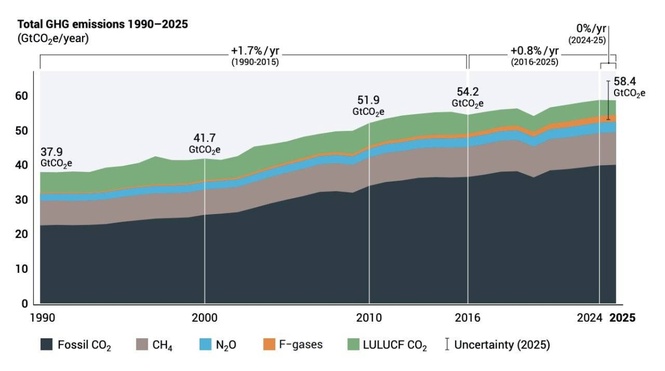
TOTAL global greenhouse gas emissions climbed by 2.3 percent to hit an all-time high of 57.7 gigatons of carbon dioxide equivalent, according to the United Nations Environment Programme’s (UNEP) newly released Emissions Gap Report.
The year-over-year expansion outpaced previous annual gains, driven by persistent fossil fuel combustion and industrial electricity consumption.
In an address accompanying the report’s release on Wednesday, October 21, UN Secretary-General António Guterres acknowledged that decades of delayed action mean a temporary breach of the 1.5-degree Celsius threshold has become virtually inevitable, but insisted that governments cannot surrender.
“Overshoot is not surrender,” Guterres said. “We can still keep it as small and as short as possible, and bring temperatures back below 1.5 degrees by the end of the century.”
Titled “The Point of Return,” the report models a “lowest possible” overshoot pathway where warming peaks between 1.7 and 1.8 degrees Celsius around mid-century before declining. To make that return achievable, UNEP researchers calculate that global emissions must drop 18 percent by 2030, 45 percent by 2035, and 69 percent by 2040 compared with 2025 levels.
Under current national policies, the planet is on course for 2.8 degrees Celsius of warming by 2100. Full implementation of current unconditional Nationally Determined Contributions (NDCs) only trims that projection to 2.6 degrees.
UNEP Executive Director Inger Andersen warned from Nairobi that incremental policy updates will not avert physical shocks.
“Every additional fraction of a degree and additional year of warming above 1.5 degrees increases climate impacts and risks, such as the deadly floods, heat waves, and wildfires that have plagued many nations this year,” Andersen said. “We must pull out all the stops to minimize peak warming and return to 1.5 degrees by the end of the century. This is possible.”
While utility-scale solar and wind additions set global deployment records, overall electricity demand expanded faster, forcing grid operators to burn higher volumes of coal, fuel oil, and natural gas.
For climate-vulnerable archipelagos in Southeast Asia, warming beyond 2 degrees sharply escalates operational hazards: intense Category 4 and 5 tropical cyclones, accelerated coastal erosion, and recurring marine heat waves that wipe out coral reef habitats supporting local fisheries.
The report concluded that preventing runaway temperatures requires structural interventions ahead of next month’s UN COP31 summit in Antalya, Türkiye: cutting the share of coal, oil, and gas in the global energy mix by at least 55 percent, 15 percent, and 5 percent respectively by 2035, tripling renewable capacity, halting deforestation, and enforcing strict limits on methane leaks.