
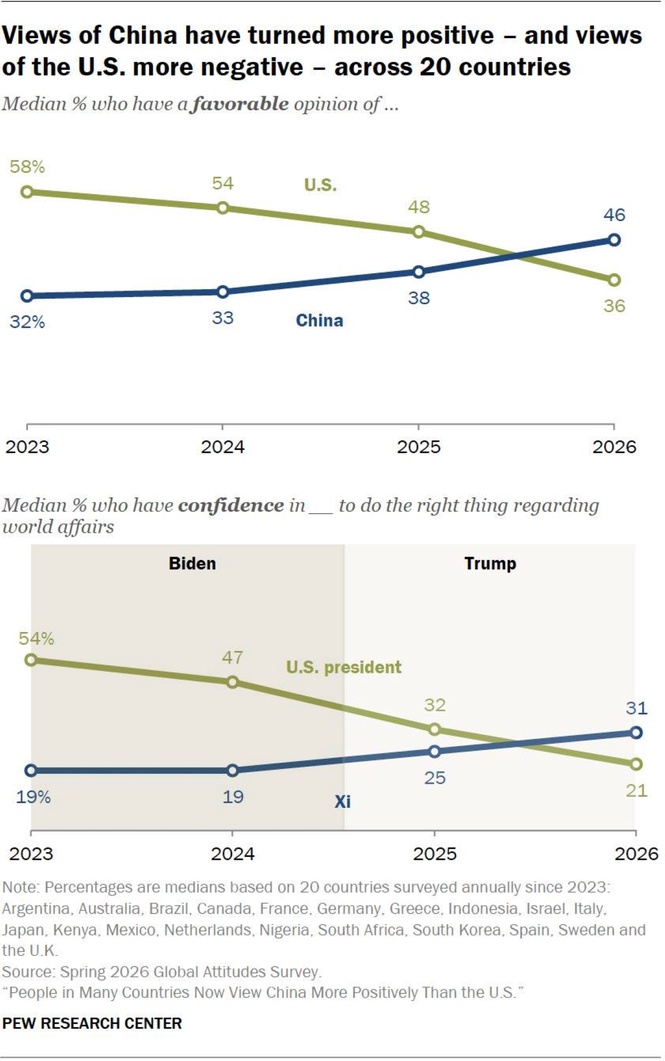
FOR the first time in nearly 20 years of tracking, a comprehensive survey by the Pew Research Center reveals that more people around the world now view China more favorably than the United States.
This global public opinion for international relations has crossed a threshold that would have seemed unthinkable a decade ago.
The findings – based on surveys of tens of thousands of adults across dozens of countries – highlight a dramatic repositioning in global soft power, driven by declining confidence in Washington and Beijing’s expanding diplomatic footprint.
The numbers behind the reversal
According to Pew’s latest global attitudes data, China holds a favorability lead over the US in a majority of nations surveyed.
The shift is particularly striking across traditional US allies in Europe and North America – including Canada, the United Kingdom, France and Germany – as well as emerging economies across Latin America, Africa and Southeast Asia.
The US managed to retain its favorability edge in only six surveyed nations, primarily in the Indo-Pacific and Eastern Europe: India, Japan, the Philippines, South Korea, Israel and Poland.
“Some of the views that we see of the US are at or near historic lows,” noted Laura Silver, associate director of Pew’s Global Attitudes Research.
How global news outlets and experts are reacting
News organizations and foreign policy analysts around the globe have weighed in on what this shift signals for the balance of global influence.
BBC: A Broader Trend of Converging Approval Ratings. Reporting on the structural decline in US perception, British Broadcasting Corp. (BBC) News highlighted that Pew’s findings mirror wider polling patterns, citing Gallup data where China’s global approval ratings surpassed those of the US. BBC noted that while American soft power once appeared untouchable, shifting global sentiment has steadily closed the gap over recent years. Xinhua and Chinese Media: Upholding ‘Win-Win Cooperation.’ Official Chinese media outlets, including Xinhua and state-affiliated commentators, framed the survey results as a natural consequence of Beijing’s persistent foreign policy strategy.“Compared with the US, China has long upheld a steady foreign policy characterized by openness and friendly engagement through a wide range of cross-border cooperation projects that deliver shared benefits,” reported Chinese media, emphasizing Beijing’s economic investments and public goods under initiatives in the Global South.
Council on Foreign Relations (CFR): Soft Power Vacuum vs Genuine Affection. Writing for the Council on Foreign Relations, international relations scholars emphasized that China’s lead stems less from a surge in global affection and more from American self-inflicted wounds.
“For nearly two decades, one finding in Pew Research Center’s global surveys was as reliable as the sunrise: the world viewed the United States more favorably than China. That era has ended. Beijing now looks – in the eyes of many – like the more accessible and predictable partner, especially as Washington’s retrenchment creates a vacuum. But China has won the comparison; it has not yet won hearts and minds.”
Regional Perspectives (CGTN/Asia-Pacific Commentary). Speaking with international news outlets like CGTN, regional observers noted that smaller nations prioritize predictability and economic stability above all else.
“Small countries want stability, we want rules, we want an environment where we know that it’s a fair playing field,” stated Suzannah Jessep, Chief Executive of the Asia New Zealand Foundation.
“Major powers that are talking about stability and peace are very welcome. Positive connection with China through trade... has made a real difference.”
Key drivers of the shift
Researchers point to two main dynamics behind the changing trendlines.
US volatility and reduced trust. Worsening opinions of American policy, political polarization and doubts regarding Washington’s commitment as a reliable long-term partner have eroded US standing.
China’s economic accessibility. In middle-income and developing nations across Africa, Latin America and Southeast Asia, China’s infrastructure trade, investment and steady diplomatic presence have significantly boosted its image.
The road ahead
While the Pew survey marks a symbolic turning point in global opinion, experts emphasize that perception remains fluid.
Nearby neighbors facing maritime or territorial disputes with Beijing remain skeptical and concerns over political freedoms in China persist.Nonetheless, the data underscores a geopolitical reality: the era of uncontested US soft power supremacy has given way to a far more competitive multi-polar world.