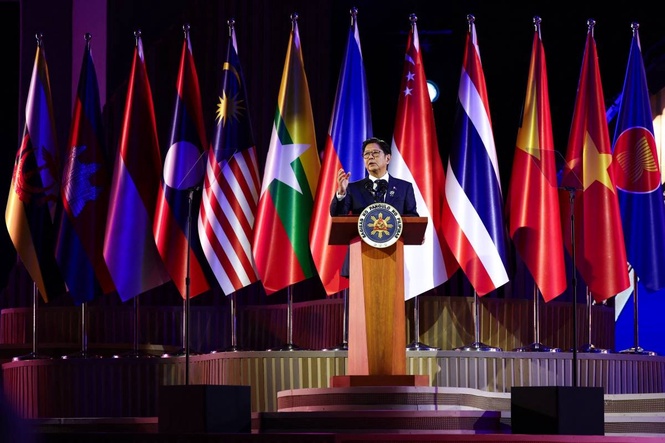
MANILA, Philippines — President Ferdinand Marcos Jr. led the opening ceremony of the 49th Association of Southeast Asian Nations (Asean) Summit on Sunday, with heads of state facing questions on trade, security and an ongoing energy crisis while playing host to a who's who of global leaders.
Nine heads of state and 2 representatives of the 11 Asean states are attending, along with several dialogue partners.
After the opening ceremony, the leaders will congregate for the plenary session, followed by the Inter-Parliamentary Assembly and the Business Advisory Council.
US President Donald Trump is scheduled to arrive on Tuesday near the summit's conclusion, a visit expected to include a sideline meeting with fellow Quad countries India, Japan and Australia -- the first of his second term.
The meeting of the Quad -- a grouping broadly aimed at counterbalancing China's regional influence -- would come days before a historic sit-down with Chinese leader Xi Jinping and Russia's Vladimir Putin in Shenzhen.
Brazil's recently re-elected Luiz Inacio Lula da Silva, meanwhile, is set to attend a plenary session of the 11-member Association of Southeast Asian Nations (Asean) on Sunday, while Australian Prime Minister Anthony Albanese will sign a new defense pact with host country the Philippines.
Nearly 20,000 police officers have been deployed around Metro Manila for the summit, with progressive groups predicting a turnout of thousands on Tuesday for an anti-Trump march on the summit site.
Much of the uproar targets the US Pax Silica program — a supply-chain initiative designed to counter China's dominance in semiconductors and rare earths — whose flagship Philippine project, a 1,620-hectare AI manufacturing hub north of Manila, threatens to displace Indigenous families.
US Ambassador to the Philippines Lee Lipton said last week that a widely rumored November target date for a deal signing timed to Trump's visit was never in the works.
Unfinished business
A day of early meetings kicked off on Saturday with Canadian Prime Minister Mark Carney announcing a Philippine trade deal, and Asean leaders huddling on key issues, including haze from Indonesia and potential fuel-sharing schemes as members struggle with Iran war-driven shortages.
But two issues that have vexed Asean leaders for years -- a languishing South China Sea "Code of Conduct" and their relationship with war-torn Myanmar -- look to be Singapore's problem when the bloc's rotating chair passes to the city-state in 2027.
Myanmar has been excluded from high-level Asean meetings since a 2021 military coup that ousted the elected government of Aung San Suu Kyi and triggered an ongoing civil war.
Thailand, which shares a border with Myanmar and is leading the charge for closer relations, last week called for Naypyidaw's foreign minister to be allowed back into meetings.
But Philippine Foreign Secretary Theresa Lazaro told reporters on Saturday there was "no easing" of the approach being taken with Myanmar, which faces an international ruling later this week on whether it committed genocide against its marginalised Muslim Rohingya minority.
Hopes of achieving a so-called Code of Conduct in the disputed South China Sea between Asean states and China during Manila's year in the chair, meanwhile, have flagged.
A Southeast Asian diplomat involved in summit preparations told AFP he did not expect a code to be signed at the summit.
Lazaro indicated as much on Saturday, saying negotiations were "80 percent" complete.
"If it happens, then it's a small miracle," said Siew Mun Tang, former head of the Asean Studies Centre at Singapore's ISEAS-Yusof Ishak Institute.
Shadow of Beijing
Beijing claims most of the South China Sea despite an international ruling that its assertion has no legal basis, and its coast guard has clashed repeatedly with that of the Philippines.
The row has reared its head at inopportune times over the past year, with a July foreign ministers summit opening less than a day after Chinese and Philippine sailors engaged in a clash.
An Asean defense chiefs meeting last month saw Beijing send only an embassy defense attache, blaming "reckless" statements by Philippine politicians.
A week later, Manila issued a rare rebuke to its own public officials over comments about China, stressing the need for a unified voice as the two countries negotiate.
As the summit opens on Sunday, an annual seminar less than five kilometers (three miles) away will be making the case against China's South China Sea claims.
Philippine defense chief Gilberto Teodoro, sanctioned by Beijing this year for what it called "irresponsible remarks", will give a keynote address.