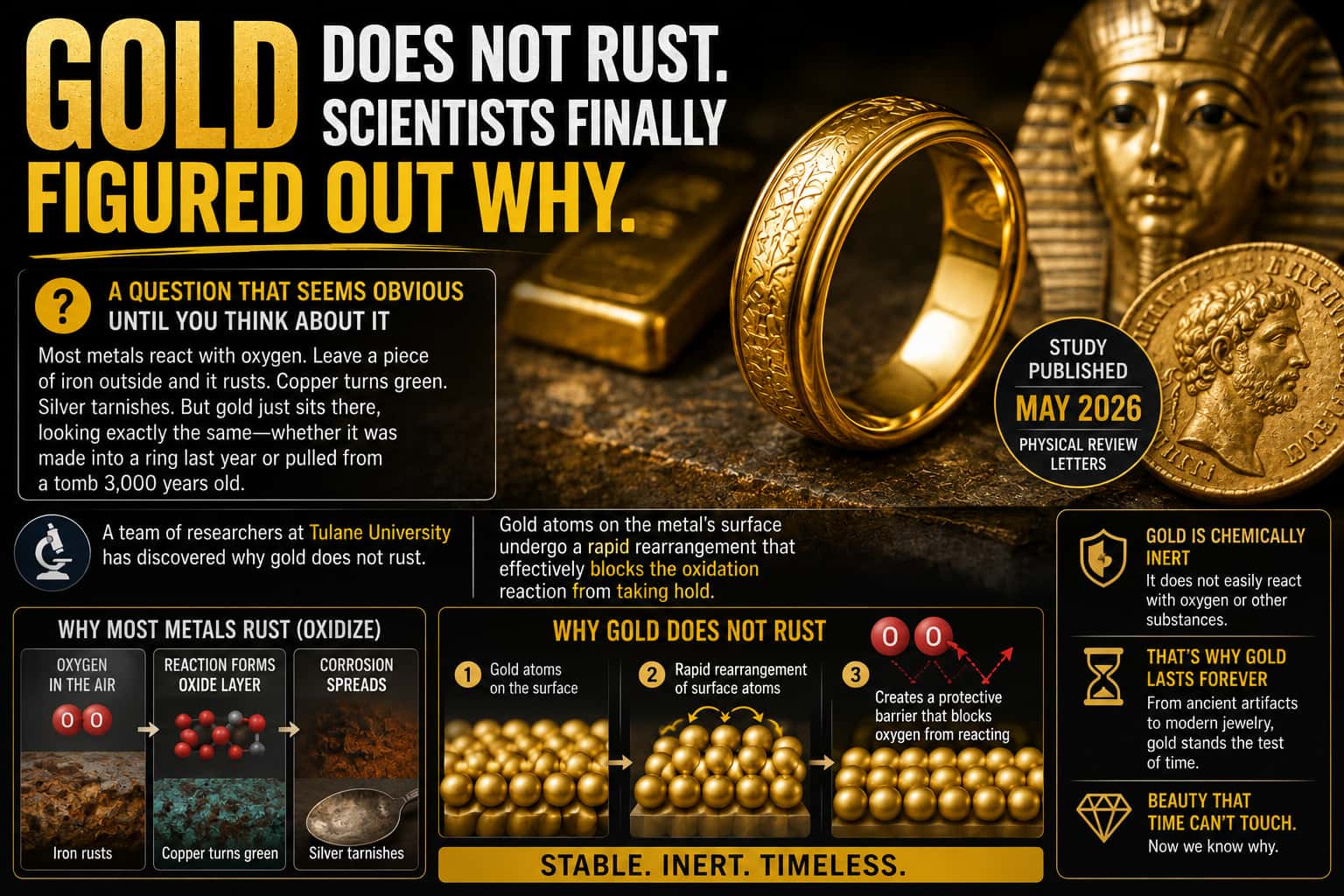
A question that seems obvious until you think about it
Most metals react with oxygen. Leave a piece of iron outside and it rusts. Copper turns green. Silver tarnishes. But gold just sits there, looking exactly the same whether it was made into a ring last year or pulled from a tomb 3,000 years old.
Scientists have known for a long time that gold resists oxidation. What they did not fully understand was the mechanism behind it. A team of researchers at Tulane University has now discovered that gold atoms on the metal's surface undergo a rapid rearrangement that effectively blocks the oxidation reaction from taking hold. The findings were published in Physical Review Letters in May 2026.
How it works
When oxygen molecules land on most metal surfaces, they bond with the surface atoms and trigger the chemical reaction we see as rusting, tarnishing, or corrosion. On gold's surface, something different happens. The atoms shift their arrangement so quickly that the oxygen never gets a stable foothold. It is like trying to stick a magnet to a surface that keeps moving before the magnet can attach.
This is not the same as saying gold is chemically inert. Gold can react with other elements under the right conditions, particularly with halogens like chlorine. But under normal atmospheric conditions, that surface-level atomic shuffle is what keeps your gold jewellery looking the same decade after decade.
Why it matters
Understanding exactly how gold resists corrosion has practical applications beyond jewellery. Gold is used in electronics, medical devices, and space technology precisely because of its resistance to degradation. Knowing the specific mechanism could help materials scientists design new alloys or coatings that mimic gold's protective behaviour without the cost.
It also answers one of those small but nagging questions that most people never think to ask. Why does gold not change? Now there is an answer, and it turns out the answer involves atoms rearranging themselves faster than oxygen can react.
The researchers calculated that this surface reconstruction reduces oxygen reactions by a factor of one billion to one trillion. That is not a small effect. It is the difference between a metal that corrodes in hours and one that lasts for millennia.
Associate Professor Matthew Montemore, who led the study, pointed out an interesting flip side. If you can find ways to prevent or reverse these surface rearrangements, gold could become a much more effective catalyst for industrial chemical reactions. Gold-palladium catalysts are already used in producing vinyl acetate, a key ingredient in plastics, and researchers are exploring gold for cleaning carbon monoxide from vehicle exhaust.
Have you ever noticed how gold looks the same no matter how old it is? There is an actual physics reason for that, and it took scientists until 2026 to fully map the mechanism.
Ronny M (ronny76netstuff@gmail.com) is a content creator under the Newswav Creator programme, where you get to express yourself, be a citizen journalist, and at the same time monetize your content & reach millions of users on Newswav. Log in to creator.newswav.com and become a Newswav Creator now!
The User Content (as defined on Newswav Terms of Use) above including the views expressed and media (pictures, videos, citations etc) were submitted & posted by the author. Newswav is solely an aggregation platform that hosts the User Content. If you have any questions about the content, copyright or other issues of the work, please contact creator@newswav.com.