One email. Four sentences. Zero professionalism. And that CV will never be read.
Let me share something that happened to me a few years back. I was hiring for a position. A young applicant sent me an email. Here is what it said, word for word:
"Hello, I need a job. I attached my resume in this email. Please consider me. Thank you."
I stared at it for a moment. Then I felt something. Not one feeling, actually. Several, arriving in quick succession. Puzzlement. Mild annoyance. Genuine amusement. And finally, a deep secondhand embarrassment on behalf of someone I had never met.
I did not reply. I moved on. And that CV, wherever it is, remains unread to this day.
If you are reading this and you recognise yourself in that email, please read on. This article is for you. And I mean that kindly.
The Skills Gap Nobody is Talking About Loudly Enough
Here is a number worth sitting with. 70% of business leaders report that Gen Z employees demonstrate poor communication skills in the workplace. Not technical skills. Not digital literacy. Communication. The most fundamental human workplace skill there is.
Gen Z is set to make up 30% of Malaysia's workforce by 2030. That is a significant chunk of the people running companies, serving clients, managing teams, and representing organisations across the country. And right now, a meaningful portion of them cannot write a professional email, make a phone call without panicking, or show up on time consistently.
Malaysian Gen Z workers are less likely than older counterparts to feel their skills match employer needs, signalling a perceived readiness gap even among the young workers themselves. They know something is missing. They are just not always sure what.
This article is that what.
Skill #1: Writing a Professional Email
Let us start here because this is the hill I will die on.
An email to a potential employer is not a WhatsApp message. It is not a text to a friend. It is the first piece of professional work that person will ever see from you, and it tells them everything about how seriously you take the opportunity.
A professional job application email should have a subject line that actually describes the email. Something like "Application for Marketing Executive Position" rather than no subject, or worse, "Hi."
It should open with a proper greeting. Not "Hello" floating alone at the top like a lost balloon. "Dear Mr. Kamarul" or "Dear Hiring Manager" if you do not know the name.
It should contain a brief, confident introduction of who you are, what position you are applying for, and why you are a strong candidate. Two to three sentences. Not a life story. Not one sentence telling them you need a job.
It should close professionally. "I look forward to hearing from you" followed by your full name, phone number, and if applicable, a link to your portfolio.
The cover letter attached to that email should do the heavier lifting. But the email itself is the handshake before the meeting. A limp, apologetic handshake does not inspire confidence before the interview even begins.
A well-written cover letter increases interview chances by up to 40% according to recruitment research. And yet most young Malaysian applicants either skip it entirely or treat it as an afterthought. The ones who put genuine effort into their cover letters immediately stand out, not because the bar is high, but because almost nobody is clearing it.
Skill #2: Making and Receiving Phone Calls
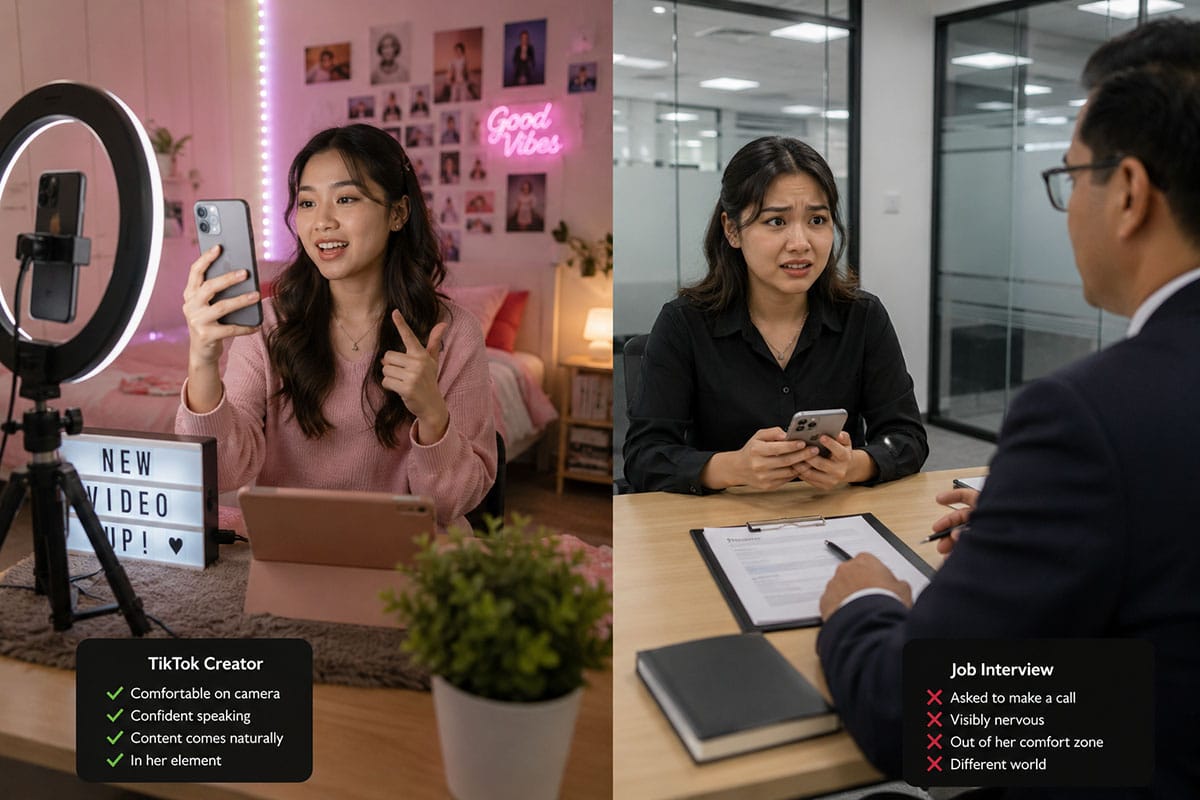
Picture this. You are a supervisor. You ask a fresh graduate on their first week to call a client and confirm a meeting time. Simple task. Five minutes. One call.
They look at you with the expression of someone asked to defuse a bomb.
"I do not know what to say," they tell you. "Can I send an email instead?"
You say no, a call is faster and more professional in this context.
"Can you call them for me?"
This is not a hypothetical. This happened. And it is happening in offices across Malaysia with increasing frequency. An entire generation has grown up communicating primarily through text, and the result is a genuine and deeply inconvenient inability to have a professional voice conversation with another human being.
Phone skills matter in the workplace. They matter when you need to confirm details quickly. They matter when a client calls unexpectedly. They matter during unexpected emergencies when an email chain simply will not do.
The fix is simple but requires actually doing the uncomfortable thing. Call someone. Anyone. Practice introducing yourself professionally. Practice saying "Good morning, this is [name] calling from [company]. I am calling to follow up on [matter]. Is this a convenient time?" out loud, to yourself, until it does not feel strange. Then do it for real.
Being unable to make a phone call is not a personality quirk. In a professional environment, it is a liability.
Skill #3: Doing Your Own Research
Another scenario. A young employee is given a task. Compile a report on a competitor's recent product launches.
What follows is a series of messages: "Can you send me the links to look at?" then "Can you tell me which products to focus on?" then "Can you give me the format for the report?" and eventually "Can you check if this is what you wanted?"
By the time the report is done, the senior colleague has essentially done 60% of the work through instructions alone. The young employee has contributed formatting and copy-paste.
Research consistently shows Gen Z workers often prefer being given very specific instructions rather than exercising independent initiative, a trait linked to how heavily structured their educational experience has been. Everything from SPM to university has had a very clear "do this, submit here, get marked" format. The workplace rarely works that way. Most tasks come with ambiguity, and the ability to navigate that ambiguity independently is one of the most valuable skills any employee can have.
Good research skills mean being able to sit with a vague brief, figure out what you actually need to find out, find it through your own effort, and present it coherently. Not asking someone to pre-digest the task before you begin.
A useful internal question for any young worker before asking for help is: "Have I spent at least 15 minutes genuinely trying to figure this out myself?" If the answer is no, try that first.
Skill #4: Being On Time. Every Time.
The Grab excuse. Malaysian hiring managers know it well.
"I am sorry I am late. I could not get a Grab."
Transportation challenges in Malaysia are real. Traffic in the Klang Valley is genuinely difficult. Not every part of the country has reliable public transport. These are legitimate structural issues.
They are also not your employer's problem.
Punctuality is one of the most basic signals an employee sends about how much they respect other people's time. Arriving late to an interview tells the interviewer the job is not important enough to plan ahead for. Arriving late to meetings tells colleagues their time is worth less than your morning routine.
The solution is straightforward. Plan for contingency. If you need to be somewhere at 9am, plan to leave at 8am. If the Grab does not come, call one earlier or take public transport or ask someone for a ride. The preparation is your responsibility, not a collective problem for your office to absorb.
Skill #5: Professionalism You Can See
This one is less discussed but equally real. Showing up to a professional environment appropriately dressed, knowing when to put your phone down in a meeting, understanding that a formal setting requires a different energy than a casual one, these are all skills that need to be developed.
Group chats and memes have their place. That place is not a client presentation or a meeting with senior leadership. Reading the room and adjusting your behaviour accordingly is a skill that takes practice but pays dividends across your entire career.
The same goes for responsiveness. Replying to professional messages in a reasonable time, acknowledging tasks when they are assigned, and following up without being chased, these small habits compound into a reputation over months and years. Build a good one early and it follows you. Build a bad one and it follows you just as faithfully.
But Here is Where We Give Credit
This would be an incomplete and unfair article if it stopped at the criticism.
Because here is the truth: Gen Z is genuinely exceptional at things that matter enormously for the future of Malaysian business.
Digital fluency that older workers spend months learning comes naturally to them. They understand social media not as a platform to be managed but as a native environment they already live in. They spot trends early. They create content instinctively. They work with AI tools without fear. In digital marketing, content creation, live commerce, TikTok strategy, and media innovation, they are not just adequate. They are often the best people in the room.
The LinkedIn Opportunity Index found that soft skills are the biggest gap for Gen Z while tech skills are the gap for older generations. Both generations need each other. The older generation's professional foundations combined with Gen Z's digital instincts is genuinely the most powerful combination any Malaysian organisation can have right now.
The soft skills are not a verdict on Gen Z's potential. They are the missing pieces that would let that potential fully land.
My Take
I will not pretend the email I received did not make me laugh a little after the initial shock wore off. It was genuinely, impressively bad. And the young person who sent it may have had a perfectly good CV sitting behind it that I will never know, because the email that introduced it was so unprofessional that it closed the door before I even got there.
That is the real cost of not mastering these basics. It is not just a bad interview or a negative performance review. It is opportunities that disappear before you even know they were there.
To every young Malaysian entering the workforce or preparing to: your digital skills are real and they matter. The world you are entering needs exactly what you bring to it. But the workplace also needs you to be able to write an email, make a phone call, figure things out independently, and show up on time.
These are not hard things. They are learnable things. And the moment you master them alongside your existing strengths, you will be genuinely unstoppable.
The email though. Please fix the email.
Kamarul Azwan (k.azwan@gmail.com) is a content creator under the Newswav Creator programme, where you get to express yourself, be a citizen journalist, and at the same time monetize your content & reach millions of users on Newswav. Log in to creator.newswav.com and become a Newswav Creator now!
The User Content (as defined on Newswav Terms of Use) above including the views expressed and media (pictures, videos, citations etc) were submitted & posted by the author. Newswav is solely an aggregation platform that hosts the User Content. If you have any questions about the content, copyright or other issues of the work, please contact creator@newswav.com.