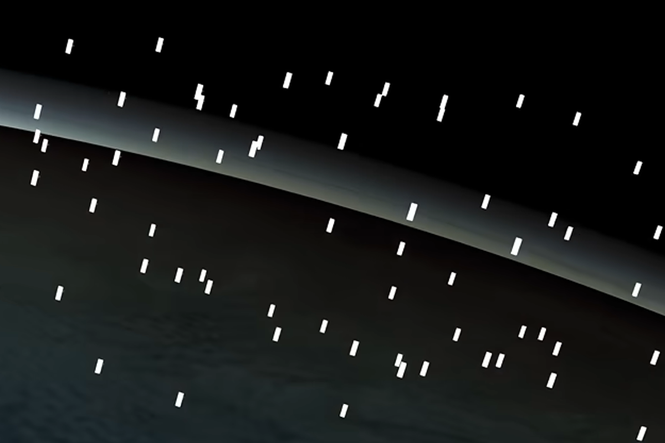
Google has powered up its first AI satellite, marking a significant step towards the tech giant’s ambition to build solar-powered data centres in space.
The prototype satellite, which launched to orbit aboard a SpaceX rocket last month, is the first test of Google’s ambitious Project Suncatcher effort.
The US tech giant hopes to place the computer chips needed to power AI into space, marking a new era for artificial intelligence.
Google researchers sent a prompt to its Gemma 4 AI model on an onboard tensor processing unit (TPU), asking it to generate a haiku about being in space.
The three-line poem it generated was:
Blue marble below
Data streams in silent grace
Starlight feeds my core.
GoogleGoogle said it marked the fist time an AI response has been generated by a data-centre-class TPU operating in orbit.
“Verifying our TPUs can reliably execute workloads in space paves the way for our next milestone of twin interconnected satellites in 2027,” Google’s Travis Beals, who runs the firm’s Paradigms of Intelligence team, wrote in a blog post detailing the feat.
“Our chips have officially earned their space wings – an important achievement on the long road ahead for this cosmic moonshot.”
Project Suncatcher is one of several efforts to move some of the computing infrastructure needed to power AI beyond Earth.
Low-Eartch orbit offers a unique environment to meet the ever-growing needs of advanced artificial intelligence, offering abundant energy from the Sun and low temperatures to cool down the hardware.
Following the successful test of its Gemma model in space, the next phase will be to examine how the satellite’s onboard processors withstand radiation and the extreme temperature changes in space.
Google will then attempt to connect two AI satellites next year to test high-speed optical communications between spacecraft.
This could significantly expand the capabilities of AI chips in space and pave the way for AI satellite megaconstellations.
Other efforts to place AI in space include a plan by SpaceX boss Elon Musk to launch up to 1 million satellites to low-Earth orbit to serve as orbital data centres.
Some critics have questioned the economics of placing AI processors in space, while others have warned that the vast numbers of satellites it would require will heighten the risk of collisions and space debris.
Read MoreNew Apple boss faces investors for first time amid iPhone Duo scrutiny
OpenAI will give ‘data centres’ new name to stop people hating them
How the zombie internet is changing the web – and the world
How to keep your money safe with AI hacks and cyberattacks on the rise
Could hackers target my fridge after suspected supermarket attacks?
Claude will now leave a trail that shows whether a text was made with AI